

4 Types of Natural Selection and Tests of Selection
81
detects selection by comparing the haplotype structure around derived alleles with
the haplotype structure around ancestral alleles. The integral of EHH is noted iHH
and is calculated for both the ancestral (iHH A ) and the derived allele (iHH D ). The
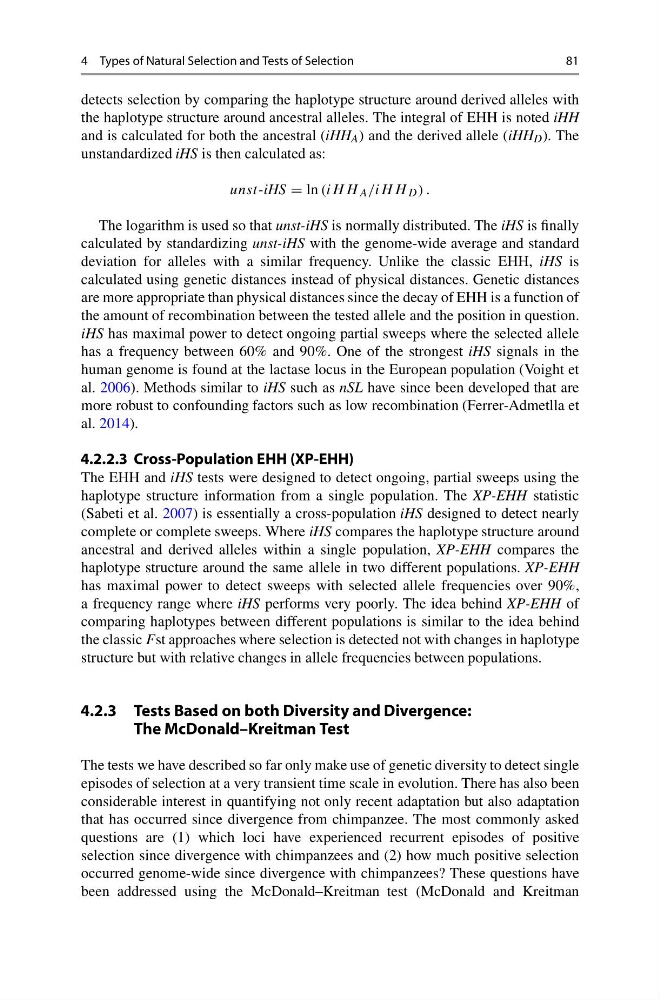
unstandardized iHS is then calculated as:
unst-iHS = ln (iH H A /iH H D ) .
The logarithm is used so that unst-iHS is normally distributed. The iHS is finally
calculated by standardizing unst-iHS with the genome-wide average and standard
deviation for alleles with a similar frequency. Unlike the classic EHH, iHS is
calculated using genetic distances instead of physical distances. Genetic distances
are more appropriate than physical distances since the decay of EHH is a function of
the amount of recombination between the tested allele and the position in question.
iHS has maximal power to detect ongoing partial sweeps where the selected allele
has a frequency between 60% and 90%. One of the strongest iHS signals in the
human genome is found at the lactase locus in the European population (Voight et
al. 2006). Methods similar to iHS such as nSL have since been developed that are
more robust to confounding factors such as low recombination (Ferrer-Admetlla et
al. 2014).
4.2.2.3 Cross-Population EHH (XP-EHH)
The EHH and iHS tests were designed to detect ongoing, partial sweeps using the
haplotype structure information from a single population. The XP-EHH statistic
(Sabeti et al. 2007) is essentially a cross-population iHS designed to detect nearly
complete or complete sweeps. Where iHS compares the haplotype structure around
ancestral and derived alleles within a single population, XP-EHH compares the
haplotype structure around the same allele in two different populations. XP-EHH
has maximal power to detect sweeps with selected allele frequencies over 90%,
a frequency range where iHS performs very poorly. The idea behind XP-EHH of
comparing haplotypes between different populations is similar to the idea behind
the classic Fst approaches where selection is detected not with changes in haplotype
structure but with relative changes in allele frequencies between populations.
4.2.3 Tests Based on both Diversity and Divergence:
The McDonald–Kreitman Test
The tests we have described so far only make use of genetic diversity to detect single
episodes of selection at a very transient time scale in evolution. There has also been
considerable interest in quantifying not only recent adaptation but also adaptation
that has occurred since divergence from chimpanzee. The most commonly asked
questions are (1) which loci have experienced recurrent episodes of positive
selection since divergence with chimpanzees and (2) how much positive selection
occurred genome-wide since divergence with chimpanzees? These questions have
been addressed using the McDonald–Kreitman test (McDonald and Kreitman
81
detects selection by comparing the haplotype structure around derived alleles with
the haplotype structure around ancestral alleles. The integral of EHH is noted iHH
and is calculated for both the ancestral (iHH A ) and the derived allele (iHH D ). The
unstandardized iHS is then calculated as:
unst-iHS = ln (iH H A /iH H D ) .
The logarithm is used so that unst-iHS is normally distributed. The iHS is finally
calculated by standardizing unst-iHS with the genome-wide average and standard
deviation for alleles with a similar frequency. Unlike the classic EHH, iHS is
calculated using genetic distances instead of physical distances. Genetic distances
are more appropriate than physical distances since the decay of EHH is a function of
the amount of recombination between the tested allele and the position in question.
iHS has maximal power to detect ongoing partial sweeps where the selected allele
has a frequency between 60% and 90%. One of the strongest iHS signals in the
human genome is found at the lactase locus in the European population (Voight et
al. 2006). Methods similar to iHS such as nSL have since been developed that are
more robust to confounding factors such as low recombination (Ferrer-Admetlla et
al. 2014).
4.2.2.3 Cross-Population EHH (XP-EHH)
The EHH and iHS tests were designed to detect ongoing, partial sweeps using the
haplotype structure information from a single population. The XP-EHH statistic
(Sabeti et al. 2007) is essentially a cross-population iHS designed to detect nearly
complete or complete sweeps. Where iHS compares the haplotype structure around
ancestral and derived alleles within a single population, XP-EHH compares the
haplotype structure around the same allele in two different populations. XP-EHH
has maximal power to detect sweeps with selected allele frequencies over 90%,
a frequency range where iHS performs very poorly. The idea behind XP-EHH of
comparing haplotypes between different populations is similar to the idea behind
the classic Fst approaches where selection is detected not with changes in haplotype
structure but with relative changes in allele frequencies between populations.
4.2.3 Tests Based on both Diversity and Divergence:
The McDonald–Kreitman Test
The tests we have described so far only make use of genetic diversity to detect single
episodes of selection at a very transient time scale in evolution. There has also been
considerable interest in quantifying not only recent adaptation but also adaptation
that has occurred since divergence from chimpanzee. The most commonly asked
questions are (1) which loci have experienced recurrent episodes of positive
selection since divergence with chimpanzees and (2) how much positive selection
occurred genome-wide since divergence with chimpanzees? These questions have
been addressed using the McDonald–Kreitman test (McDonald and Kreitman