

32
M. Slatkin
A population is characterized by the frequencies of the four haplotypes, f AB ,
f Ab , f aB , and f ab . Allele frequencies can be recovered from the haplotype frequencies:f A = f AB + f Ab , etc. Given the haplotype frequencies, we can determine whether
an allele’s presence in a haplotype is independent of the allele present at the other
locus. If they are independent, then the haplotype frequency is the product of the
allele frequencies. For example, f AB = f A f B . If that is the case, the two loci are
said to be in linkage equilibrium. If not, they are in linkage disequilibrium, often
abbreviated LD. If they are in LD, the extent of LD is quantified by the difference
between the actual haplotype frequency and the frequency expected at linkage
equilibrium:
D = f AB − f A f B .
(2.1)
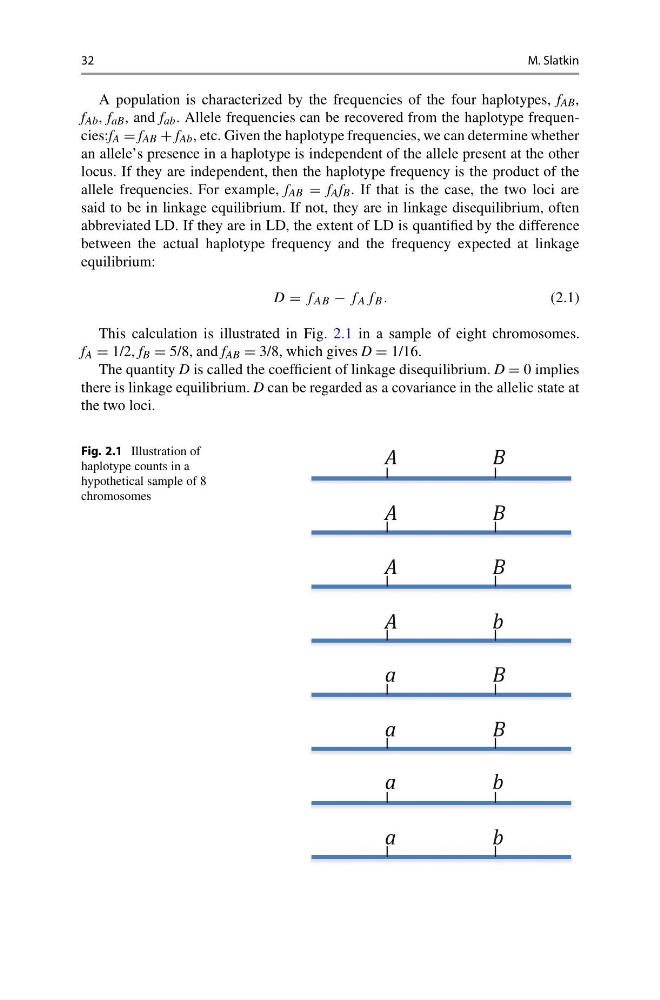
This calculation is illustrated in Fig. 2.1 in a sample of eight chromosomes.
f A = 1/2, f B = 5/8, and f AB = 3/8, which gives D = 1/16.
The quantity D is called the coefficient of linkage disequilibrium. D = 0 implies
there is linkage equilibrium. D can be regarded as a covariance in the allelic state at
the two loci.
Fig. 2.1 Illustration of
haplotype counts in a
hypothetical sample of 8
chromosomes
A
B
A
B
A
B
a
B
a
b
a
b
a
B
A
b
A
B
A
B
a
B
a
b
a
b
a
B
A
b
M. Slatkin
A population is characterized by the frequencies of the four haplotypes, f AB ,
f Ab , f aB , and f ab . Allele frequencies can be recovered from the haplotype frequencies:f A = f AB + f Ab , etc. Given the haplotype frequencies, we can determine whether
an allele’s presence in a haplotype is independent of the allele present at the other
locus. If they are independent, then the haplotype frequency is the product of the
allele frequencies. For example, f AB = f A f B . If that is the case, the two loci are
said to be in linkage equilibrium. If not, they are in linkage disequilibrium, often
abbreviated LD. If they are in LD, the extent of LD is quantified by the difference
between the actual haplotype frequency and the frequency expected at linkage
equilibrium:
D = f AB − f A f B .
(2.1)
This calculation is illustrated in Fig. 2.1 in a sample of eight chromosomes.
f A = 1/2, f B = 5/8, and f AB = 3/8, which gives D = 1/16.
The quantity D is called the coefficient of linkage disequilibrium. D = 0 implies
there is linkage equilibrium. D can be regarded as a covariance in the allelic state at
the two loci.
Fig. 2.1 Illustration of
haplotype counts in a
hypothetical sample of 8
chromosomes
A
B
A
B
A
B
a
B
a
b
a
b
a
B
A
b
A
B
A
B
a
B
a
b
a
b
a
B
A
b