

208
L. S. Emery and J. M. Akey
“Classical selective sweep” or “hard sweep”
“Soft sweep” from standing variation
“Soft sweep” with recurrent mutation
Selection on an epistatic variant
Selection on a microsatellite
Positive Selection Models
a
e
d
c
b
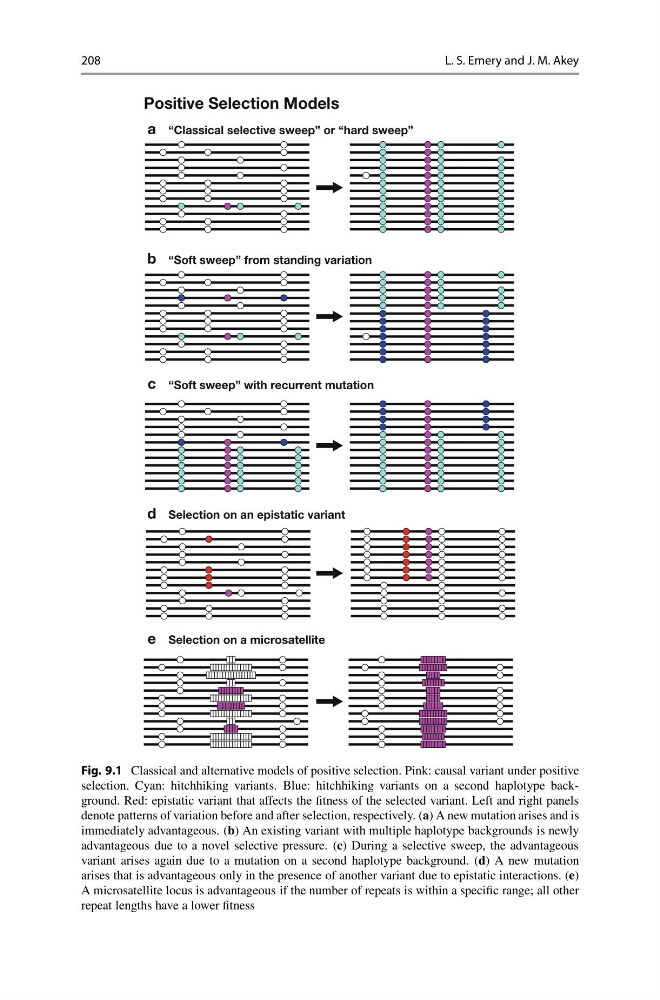
Fig. 9.1 Classical and alternative models of positive selection. Pink: causal variant under positive
selection. Cyan: hitchhiking variants. Blue: hitchhiking variants on a second haplotype background. Red: epistatic variant that affects the fitness of the selected variant. Left and right panels
denote patterns of variation before and after selection, respectively. (a) A new mutation arises and is
immediately advantageous. (b) An existing variant with multiple haplotype backgrounds is newly
advantageous due to a novel selective pressure. (c) During a selective sweep, the advantageous
variant arises again due to a mutation on a second haplotype background. (d) A new mutation
arises that is advantageous only in the presence of another variant due to epistatic interactions. (e)
A microsatellite locus is advantageous if the number of repeats is within a specific range; all other
repeat lengths have a lower fitness
L. S. Emery and J. M. Akey
“Classical selective sweep” or “hard sweep”
“Soft sweep” from standing variation
“Soft sweep” with recurrent mutation
Selection on an epistatic variant
Selection on a microsatellite
Positive Selection Models
a
e
d
c
b
Fig. 9.1 Classical and alternative models of positive selection. Pink: causal variant under positive
selection. Cyan: hitchhiking variants. Blue: hitchhiking variants on a second haplotype background. Red: epistatic variant that affects the fitness of the selected variant. Left and right panels
denote patterns of variation before and after selection, respectively. (a) A new mutation arises and is
immediately advantageous. (b) An existing variant with multiple haplotype backgrounds is newly
advantageous due to a novel selective pressure. (c) During a selective sweep, the advantageous
variant arises again due to a mutation on a second haplotype background. (d) A new mutation
arises that is advantageous only in the presence of another variant due to epistatic interactions. (e)
A microsatellite locus is advantageous if the number of repeats is within a specific range; all other
repeat lengths have a lower fitness