

10
J. Wakeley
1.3
The Standard Neutral Model: The Kingman Coalescent
The standard neutral coalescent model, also called the Kingman coalescent, begins
with single-generation probabilities like c N above and then takes advantage of the
fact that a relatively simple model of the ancestral genetic process for a sample of
size n ≥ 2 holds for many different kinds of reproduction as long as the population
size (N) is large and the sample size n is much smaller than N. Mathematically, this
involves rescaling time so that it is measured in units of 1/c N generations (2N for
the diploid, monoecious Wright–Fisher model) and then taking the limit N → ∞.
The standard coalescent is a backward-time dual process (see Möhle 1999) of the
standard forward-time diffusion model of population genetics, as both models use
this procedure of rescaling time and taking the limit N → ∞ (Ewens 2004).
Kingman assumed a general family of haploid models of reproduction introduced
by Cannings (1974) which includes the diploid, monoecious Wright–Fisher model.
By studying all possible events in the immediate ancestry of a sample of size
n, Kingman found—see Eq. 4.3 in Kingman (1982a)—that the most likely event
is a coalescent event between a pair of lineages. Considering all possible pairs
of lineages and averaging over the process of reproduction, the probability of a
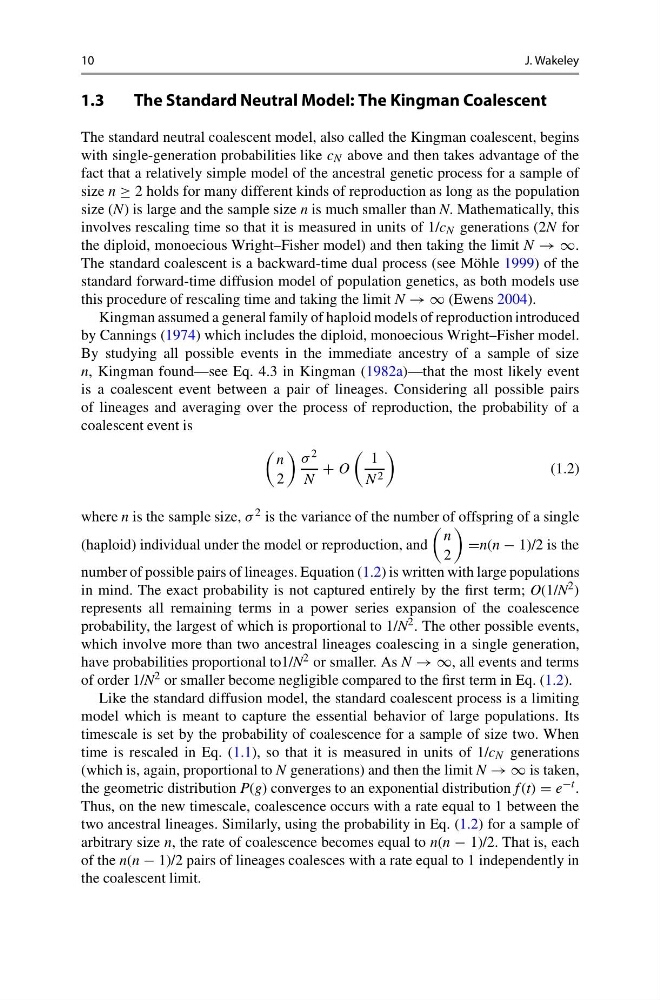
coalescent event is
n
2
σ 2
N
+ O
1
N 2
(1.2)
where n is the sample size, σ 2 is the variance of the number of offspring of a single
(haploid) individual under the model or reproduction, and
n
2
=n(n − 1)/2 is the
number of possible pairs of lineages. Equation (1.2) is written with large populations
in mind. The exact probability is not captured entirely by the first term; O(1/N 2 )
represents all remaining terms in a power series expansion of the coalescence
probability, the largest of which is proportional to 1/N 2 . The other possible events,
which involve more than two ancestral lineages coalescing in a single generation,
have probabilities proportional to1/N 2 or smaller. As N → ∞, all events and terms
of order 1/N 2 or smaller become negligible compared to the first term in Eq. (1.2).
Like the standard diffusion model, the standard coalescent process is a limiting
model which is meant to capture the essential behavior of large populations. Its
timescale is set by the probability of coalescence for a sample of size two. When
time is rescaled in Eq. (1.1), so that it is measured in units of 1/c N generations
(which is, again, proportional to N generations) and then the limit N → ∞ is taken,
the geometric distribution P(g) converges to an exponential distribution f (t) = e −t .
Thus, on the new timescale, coalescence occurs with a rate equal to 1 between the
two ancestral lineages. Similarly, using the probability in Eq. (1.2) for a sample of
arbitrary size n, the rate of coalescence becomes equal to n(n − 1)/2. That is, each
of the n(n − 1)/2 pairs of lineages coalesces with a rate equal to 1 independently in
the coalescent limit.
J. Wakeley
1.3
The Standard Neutral Model: The Kingman Coalescent
The standard neutral coalescent model, also called the Kingman coalescent, begins
with single-generation probabilities like c N above and then takes advantage of the
fact that a relatively simple model of the ancestral genetic process for a sample of
size n ≥ 2 holds for many different kinds of reproduction as long as the population
size (N) is large and the sample size n is much smaller than N. Mathematically, this
involves rescaling time so that it is measured in units of 1/c N generations (2N for
the diploid, monoecious Wright–Fisher model) and then taking the limit N → ∞.
The standard coalescent is a backward-time dual process (see Möhle 1999) of the
standard forward-time diffusion model of population genetics, as both models use
this procedure of rescaling time and taking the limit N → ∞ (Ewens 2004).
Kingman assumed a general family of haploid models of reproduction introduced
by Cannings (1974) which includes the diploid, monoecious Wright–Fisher model.
By studying all possible events in the immediate ancestry of a sample of size
n, Kingman found—see Eq. 4.3 in Kingman (1982a)—that the most likely event
is a coalescent event between a pair of lineages. Considering all possible pairs
of lineages and averaging over the process of reproduction, the probability of a
coalescent event is
n
2
σ 2
N
+ O
1
N 2
(1.2)
where n is the sample size, σ 2 is the variance of the number of offspring of a single
(haploid) individual under the model or reproduction, and
n
2
=n(n − 1)/2 is the
number of possible pairs of lineages. Equation (1.2) is written with large populations
in mind. The exact probability is not captured entirely by the first term; O(1/N 2 )
represents all remaining terms in a power series expansion of the coalescence
probability, the largest of which is proportional to 1/N 2 . The other possible events,
which involve more than two ancestral lineages coalescing in a single generation,
have probabilities proportional to1/N 2 or smaller. As N → ∞, all events and terms
of order 1/N 2 or smaller become negligible compared to the first term in Eq. (1.2).
Like the standard diffusion model, the standard coalescent process is a limiting
model which is meant to capture the essential behavior of large populations. Its
timescale is set by the probability of coalescence for a sample of size two. When
time is rescaled in Eq. (1.1), so that it is measured in units of 1/c N generations
(which is, again, proportional to N generations) and then the limit N → ∞ is taken,
the geometric distribution P(g) converges to an exponential distribution f (t) = e −t .
Thus, on the new timescale, coalescence occurs with a rate equal to 1 between the
two ancestral lineages. Similarly, using the probability in Eq. (1.2) for a sample of
arbitrary size n, the rate of coalescence becomes equal to n(n − 1)/2. That is, each
of the n(n − 1)/2 pairs of lineages coalesces with a rate equal to 1 independently in
the coalescent limit.