

154
E. A. Thompson
had negative impact especially in regions of high IBD. As noted in Sect. 6.3.3, the
DW method underestimates IBD particularly in regions of within-individual IBD
and multi-gamete IBD.
If a genetic model requires only local pairwise estimates of IBD, the HMM
method of Brown et al. (2012) provides an alternative method. In this case the 15state HMM is simply run separately on all pairs of observed individuals, to provide
estimates of j across all j . The result of applying this approach to the simulated
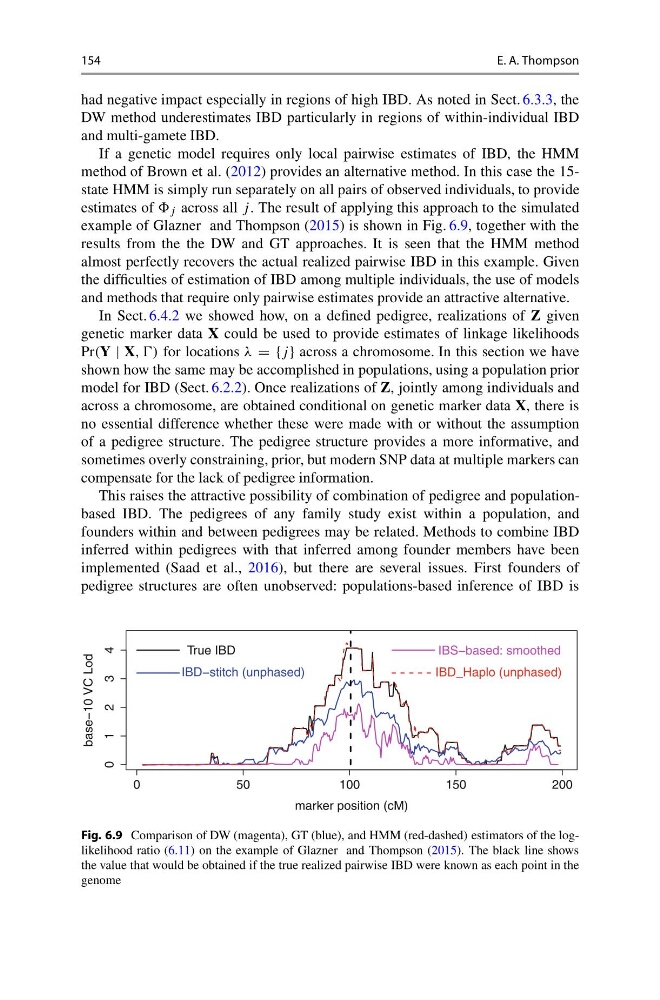
example of Glazner and Thompson (2015) is shown in Fig. 6.9, together with the
results from the the DW and GT approaches. It is seen that the HMM method
almost perfectly recovers the actual realized pairwise IBD in this example. Given
the difficulties of estimation of IBD among multiple individuals, the use of models
and methods that require only pairwise estimates provide an attractive alternative.
In Sect. 6.4.2 we showed how, on a defined pedigree, realizations of Z given
genetic marker data X could be used to provide estimates of linkage likelihoods
Pr(Y | X, ,) for locations λ = {j } across a chromosome. In this section we have
shown how the same may be accomplished in populations, using a population prior
model for IBD (Sect. 6.2.2). Once realizations of Z, jointly among individuals and
across a chromosome, are obtained conditional on genetic marker data X, there is
no essential difference whether these were made with or without the assumption
of a pedigree structure. The pedigree structure provides a more informative, and
sometimes overly constraining, prior, but modern SNP data at multiple markers can
compensate for the lack of pedigree information.
This raises the attractive possibility of combination of pedigree and populationbased IBD. The pedigrees of any family study exist within a population, and
founders within and between pedigrees may be related. Methods to combine IBD
inferred within pedigrees with that inferred among founder members have been
implemented (Saad et al., 2016), but there are several issues. First founders of
pedigree structures are often unobserved: populations-based inference of IBD is
0
50
100
150
200
0
1
2
3
4
marker position (cM)
base 10 VC Lod
True IBD
IBD stitch (unphased)
IBS based: smoothed
IBD_Haplo (unphased)
Fig. 6.9 Comparison of DW (magenta), GT (blue), and HMM (red-dashed) estimators of the loglikelihood ratio (6.11) on the example of Glazner and Thompson (2015). The black line shows
the value that would be obtained if the true realized pairwise IBD were known as each point in the
genome
E. A. Thompson
had negative impact especially in regions of high IBD. As noted in Sect. 6.3.3, the
DW method underestimates IBD particularly in regions of within-individual IBD
and multi-gamete IBD.
If a genetic model requires only local pairwise estimates of IBD, the HMM
method of Brown et al. (2012) provides an alternative method. In this case the 15state HMM is simply run separately on all pairs of observed individuals, to provide
estimates of j across all j . The result of applying this approach to the simulated
example of Glazner and Thompson (2015) is shown in Fig. 6.9, together with the
results from the the DW and GT approaches. It is seen that the HMM method
almost perfectly recovers the actual realized pairwise IBD in this example. Given
the difficulties of estimation of IBD among multiple individuals, the use of models
and methods that require only pairwise estimates provide an attractive alternative.
In Sect. 6.4.2 we showed how, on a defined pedigree, realizations of Z given
genetic marker data X could be used to provide estimates of linkage likelihoods
Pr(Y | X, ,) for locations λ = {j } across a chromosome. In this section we have
shown how the same may be accomplished in populations, using a population prior
model for IBD (Sect. 6.2.2). Once realizations of Z, jointly among individuals and
across a chromosome, are obtained conditional on genetic marker data X, there is
no essential difference whether these were made with or without the assumption
of a pedigree structure. The pedigree structure provides a more informative, and
sometimes overly constraining, prior, but modern SNP data at multiple markers can
compensate for the lack of pedigree information.
This raises the attractive possibility of combination of pedigree and populationbased IBD. The pedigrees of any family study exist within a population, and
founders within and between pedigrees may be related. Methods to combine IBD
inferred within pedigrees with that inferred among founder members have been
implemented (Saad et al., 2016), but there are several issues. First founders of
pedigree structures are often unobserved: populations-based inference of IBD is
0
50
100
150
200
0
1
2
3
4
marker position (cM)
base 10 VC Lod
True IBD
IBD stitch (unphased)
IBS based: smoothed
IBD_Haplo (unphased)
Fig. 6.9 Comparison of DW (magenta), GT (blue), and HMM (red-dashed) estimators of the loglikelihood ratio (6.11) on the example of Glazner and Thompson (2015). The black line shows
the value that would be obtained if the true realized pairwise IBD were known as each point in the
genome