

8
J. Wakeley
Elizabeth
of Castile
Ferdinand
of Aragon
Mary
of Aragon
Manuel I
of Portugal
King Philip I
Joanna I
of Aragon
Isabella
of Portugal
John III
of Portugal
King Charles I
Catherine
Mary
of Portugal
King Philip II
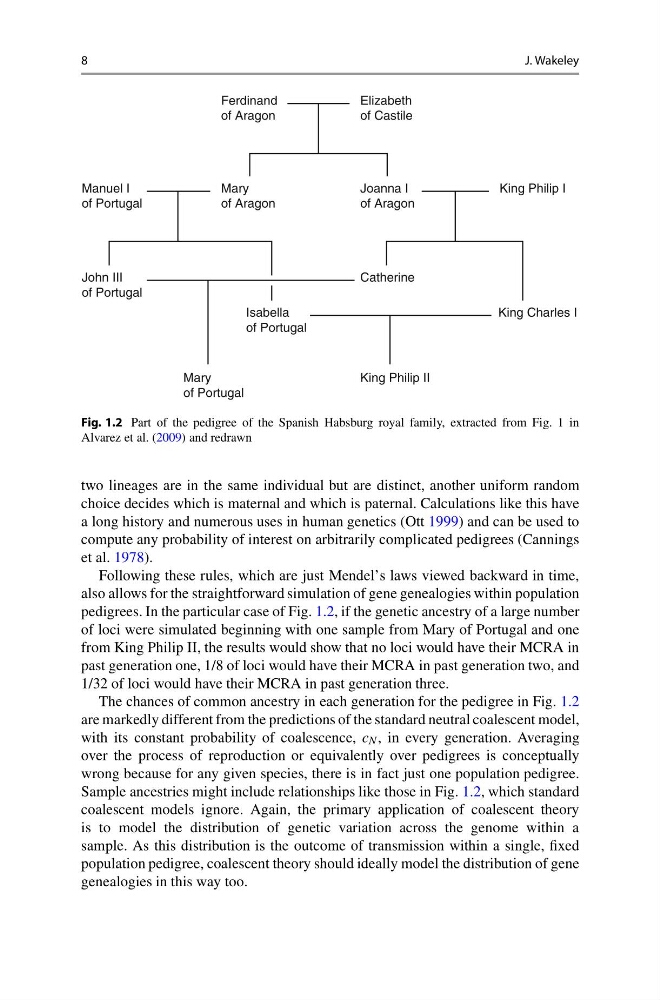
Fig. 1.2 Part of the pedigree of the Spanish Habsburg royal family, extracted from Fig. 1 in
Alvarez et al. (2009) and redrawn
two lineages are in the same individual but are distinct, another uniform random
choice decides which is maternal and which is paternal. Calculations like this have
a long history and numerous uses in human genetics (Ott 1999) and can be used to
compute any probability of interest on arbitrarily complicated pedigrees (Cannings
et al. 1978).
Following these rules, which are just Mendel’s laws viewed backward in time,
also allows for the straightforward simulation of gene genealogies within population
pedigrees. In the particular case of Fig. 1.2, if the genetic ancestry of a large number
of loci were simulated beginning with one sample from Mary of Portugal and one
from King Philip II, the results would show that no loci would have their MCRA in
past generation one, 1/8 of loci would have their MCRA in past generation two, and
1/32 of loci would have their MCRA in past generation three.
The chances of common ancestry in each generation for the pedigree in Fig. 1.2
are markedly different from the predictions of the standard neutral coalescent model,
with its constant probability of coalescence, c N , in every generation. Averaging
over the process of reproduction or equivalently over pedigrees is conceptually
wrong because for any given species, there is in fact just one population pedigree.
Sample ancestries might include relationships like those in Fig. 1.2, which standard
coalescent models ignore. Again, the primary application of coalescent theory
is to model the distribution of genetic variation across the genome within a
sample. As this distribution is the outcome of transmission within a single, fixed
population pedigree, coalescent theory should ideally model the distribution of gene
genealogies in this way too.
J. Wakeley
Elizabeth
of Castile
Ferdinand
of Aragon
Mary
of Aragon
Manuel I
of Portugal
King Philip I
Joanna I
of Aragon
Isabella
of Portugal
John III
of Portugal
King Charles I
Catherine
Mary
of Portugal
King Philip II
Fig. 1.2 Part of the pedigree of the Spanish Habsburg royal family, extracted from Fig. 1 in
Alvarez et al. (2009) and redrawn
two lineages are in the same individual but are distinct, another uniform random
choice decides which is maternal and which is paternal. Calculations like this have
a long history and numerous uses in human genetics (Ott 1999) and can be used to
compute any probability of interest on arbitrarily complicated pedigrees (Cannings
et al. 1978).
Following these rules, which are just Mendel’s laws viewed backward in time,
also allows for the straightforward simulation of gene genealogies within population
pedigrees. In the particular case of Fig. 1.2, if the genetic ancestry of a large number
of loci were simulated beginning with one sample from Mary of Portugal and one
from King Philip II, the results would show that no loci would have their MCRA in
past generation one, 1/8 of loci would have their MCRA in past generation two, and
1/32 of loci would have their MCRA in past generation three.
The chances of common ancestry in each generation for the pedigree in Fig. 1.2
are markedly different from the predictions of the standard neutral coalescent model,
with its constant probability of coalescence, c N , in every generation. Averaging
over the process of reproduction or equivalently over pedigrees is conceptually
wrong because for any given species, there is in fact just one population pedigree.
Sample ancestries might include relationships like those in Fig. 1.2, which standard
coalescent models ignore. Again, the primary application of coalescent theory
is to model the distribution of genetic variation across the genome within a
sample. As this distribution is the outcome of transmission within a single, fixed
population pedigree, coalescent theory should ideally model the distribution of gene
genealogies in this way too.