

6 Identity by Descent in the Mapping of Genetic Traits
139
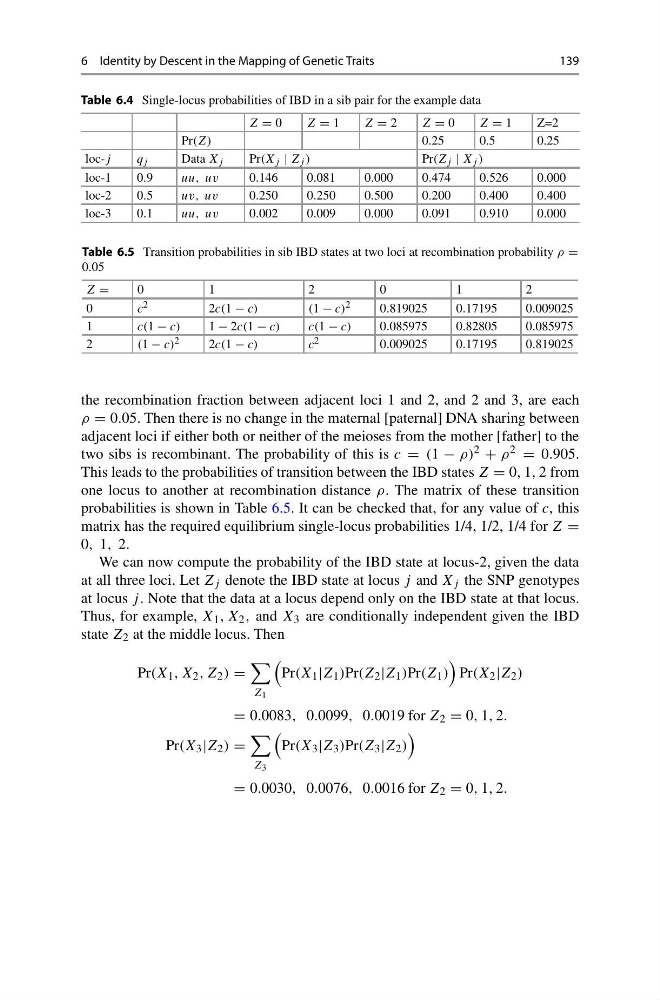
Table 6.4 Single-locus probabilities of IBD in a sib pair for the example data
Z = 0
Z = 1
Z = 2
Z = 0
Z = 1
Z=2
Pr(Z)
0.25
0.5
0.25
loc-j
q j
Data X j
Pr(X j | Z j )
Pr(Z j | X j )
loc-1
0.9
uu, uv
0.146
0.081
0.000
0.474
0.526
0.000
loc-2
0.5
uv, uv
0.250
0.250
0.500
0.200
0.400
0.400
loc-3
0.1
uu, uv
0.002
0.009
0.000
0.091
0.910
0.000
Table 6.5 Transition probabilities in sib IBD states at two loci at recombination probability ρ =
0.05
Z =
0
1
2
0
1
2
0
c 2
2c(1 − c)
(1 − c) 2
0.819025
0.17195
0.009025
1
c(1 − c)
1 − 2c(1 − c)
c(1 − c)
0.085975
0.82805
0.085975
2
(1 − c) 2
2c(1 − c)
c 2
0.009025
0.17195
0.819025
the recombination fraction between adjacent loci 1 and 2, and 2 and 3, are each
ρ = 0.05. Then there is no change in the maternal [paternal] DNA sharing between
adjacent loci if either both or neither of the meioses from the mother [father] to the
two sibs is recombinant. The probability of this is c = (1 − ρ) 2 + ρ 2 = 0.905.
This leads to the probabilities of transition between the IBD states Z = 0, 1, 2 from
one locus to another at recombination distance ρ. The matrix of these transition
probabilities is shown in Table 6.5. It can be checked that, for any value of c, this
matrix has the required equilibrium single-locus probabilities 1/4, 1/2, 1/4 for Z =
0, 1, 2.
We can now compute the probability of the IBD state at locus-2, given the data
at all three loci. Let Z j denote the IBD state at locus j and X j the SNP genotypes
at locus j . Note that the data at a locus depend only on the IBD state at that locus.
Thus, for example, X 1 , X 2 , and X 3 are conditionally independent given the IBD
state Z 2 at the middle locus. Then
Pr(X 1 , X 2 , Z 2 ) =
Z 1
Pr(X 1 |Z 1 )Pr(Z 2 |Z 1 )Pr(Z 1 )
Pr(X 2 |Z 2 )
= 0.0083, 0.0099, 0.0019 for Z 2 = 0, 1, 2.
Pr(X 3 |Z 2 ) =
Z 3
Pr(X 3 |Z 3 )Pr(Z 3 |Z 2 )
= 0.0030, 0.0076, 0.0016 for Z 2 = 0, 1, 2.
139
Table 6.4 Single-locus probabilities of IBD in a sib pair for the example data
Z = 0
Z = 1
Z = 2
Z = 0
Z = 1
Z=2
Pr(Z)
0.25
0.5
0.25
loc-j
q j
Data X j
Pr(X j | Z j )
Pr(Z j | X j )
loc-1
0.9
uu, uv
0.146
0.081
0.000
0.474
0.526
0.000
loc-2
0.5
uv, uv
0.250
0.250
0.500
0.200
0.400
0.400
loc-3
0.1
uu, uv
0.002
0.009
0.000
0.091
0.910
0.000
Table 6.5 Transition probabilities in sib IBD states at two loci at recombination probability ρ =
0.05
Z =
0
1
2
0
1
2
0
c 2
2c(1 − c)
(1 − c) 2
0.819025
0.17195
0.009025
1
c(1 − c)
1 − 2c(1 − c)
c(1 − c)
0.085975
0.82805
0.085975
2
(1 − c) 2
2c(1 − c)
c 2
0.009025
0.17195
0.819025
the recombination fraction between adjacent loci 1 and 2, and 2 and 3, are each
ρ = 0.05. Then there is no change in the maternal [paternal] DNA sharing between
adjacent loci if either both or neither of the meioses from the mother [father] to the
two sibs is recombinant. The probability of this is c = (1 − ρ) 2 + ρ 2 = 0.905.
This leads to the probabilities of transition between the IBD states Z = 0, 1, 2 from
one locus to another at recombination distance ρ. The matrix of these transition
probabilities is shown in Table 6.5. It can be checked that, for any value of c, this
matrix has the required equilibrium single-locus probabilities 1/4, 1/2, 1/4 for Z =
0, 1, 2.
We can now compute the probability of the IBD state at locus-2, given the data
at all three loci. Let Z j denote the IBD state at locus j and X j the SNP genotypes
at locus j . Note that the data at a locus depend only on the IBD state at that locus.
Thus, for example, X 1 , X 2 , and X 3 are conditionally independent given the IBD
state Z 2 at the middle locus. Then
Pr(X 1 , X 2 , Z 2 ) =
Z 1
Pr(X 1 |Z 1 )Pr(Z 2 |Z 1 )Pr(Z 1 )
Pr(X 2 |Z 2 )
= 0.0083, 0.0099, 0.0019 for Z 2 = 0, 1, 2.
Pr(X 3 |Z 2 ) =
Z 3
Pr(X 3 |Z 3 )Pr(Z 3 |Z 2 )
= 0.0030, 0.0076, 0.0016 for Z 2 = 0, 1, 2.