

6 Identity by Descent in the Mapping of Genetic Traits
131
6.2.2 IBD in Populations
In this section we consider IBD at the population level, when no pedigree relationship is specified. However, to motivate the discussion, we consider first the case of
two individuals who have a single common ancestor, such that they are separated by
a total of m meioses. For example, half-kth-cousins have a single common ancestor
(k + 1) generations ago and are separated by m = 2(k + 1) meioses.
The probability of sharing genome IBD decreases by a factor of (1/2) with each
additional meiosis. The formula for sharing any of an autosomal genome length L
Morgans is more complicated (Donnelly, 1983) but also decays exponentially for
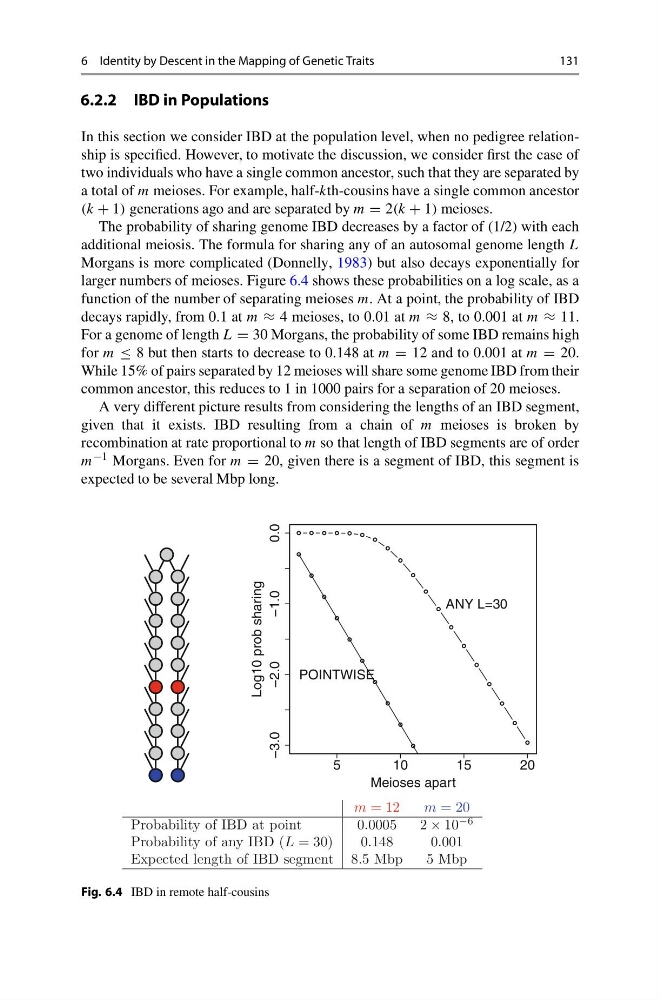
larger numbers of meioses. Figure 6.4 shows these probabilities on a log scale, as a
function of the number of separating meioses m. At a point, the probability of IBD
decays rapidly, from 0.1 at m ≈ 4 meioses, to 0.01 at m ≈ 8, to 0.001 at m ≈ 11.
For a genome of length L = 30 Morgans, the probability of some IBD remains high
for m ≤ 8 but then starts to decrease to 0.148 at m = 12 and to 0.001 at m = 20.
While 15% of pairs separated by 12 meioses will share some genome IBD from their
common ancestor, this reduces to 1 in 1000 pairs for a separation of 20 meioses.
A very different picture results from considering the lengths of an IBD segment,
given that it exists. IBD resulting from a chain of m meioses is broken by
recombination at rate proportional to m so that length of IBD segments are of order
m −1 Morgans. Even for m = 20, given there is a segment of IBD, this segment is
expected to be several Mbp long.
m = 12
m = 20
Probability of IBD at point
0.0005
2 × 10
−6
Probability of any IBD (L = 30)
0.148
0.001
Expected length of IBD segment 8.5 Mbp
5 Mbp
5
1 0
1 5
2 0
3.0
2.0
1.0
0.0
Meioses apart
Log10 prob sharing
ANY L=30
POINTWISE
Fig. 6.4 IBD in remote half-cousins
131
6.2.2 IBD in Populations
In this section we consider IBD at the population level, when no pedigree relationship is specified. However, to motivate the discussion, we consider first the case of
two individuals who have a single common ancestor, such that they are separated by
a total of m meioses. For example, half-kth-cousins have a single common ancestor
(k + 1) generations ago and are separated by m = 2(k + 1) meioses.
The probability of sharing genome IBD decreases by a factor of (1/2) with each
additional meiosis. The formula for sharing any of an autosomal genome length L
Morgans is more complicated (Donnelly, 1983) but also decays exponentially for
larger numbers of meioses. Figure 6.4 shows these probabilities on a log scale, as a
function of the number of separating meioses m. At a point, the probability of IBD
decays rapidly, from 0.1 at m ≈ 4 meioses, to 0.01 at m ≈ 8, to 0.001 at m ≈ 11.
For a genome of length L = 30 Morgans, the probability of some IBD remains high
for m ≤ 8 but then starts to decrease to 0.148 at m = 12 and to 0.001 at m = 20.
While 15% of pairs separated by 12 meioses will share some genome IBD from their
common ancestor, this reduces to 1 in 1000 pairs for a separation of 20 meioses.
A very different picture results from considering the lengths of an IBD segment,
given that it exists. IBD resulting from a chain of m meioses is broken by
recombination at rate proportional to m so that length of IBD segments are of order
m −1 Morgans. Even for m = 20, given there is a segment of IBD, this segment is
expected to be several Mbp long.
m = 12
m = 20
Probability of IBD at point
0.0005
2 × 10
−6
Probability of any IBD (L = 30)
0.148
0.001
Expected length of IBD segment 8.5 Mbp
5 Mbp
5
1 0
1 5
2 0
3.0
2.0
1.0
0.0
Meioses apart
Log10 prob sharing
ANY L=30
POINTWISE
Fig. 6.4 IBD in remote half-cousins