

6 Identity by Descent in the Mapping of Genetic Traits
129
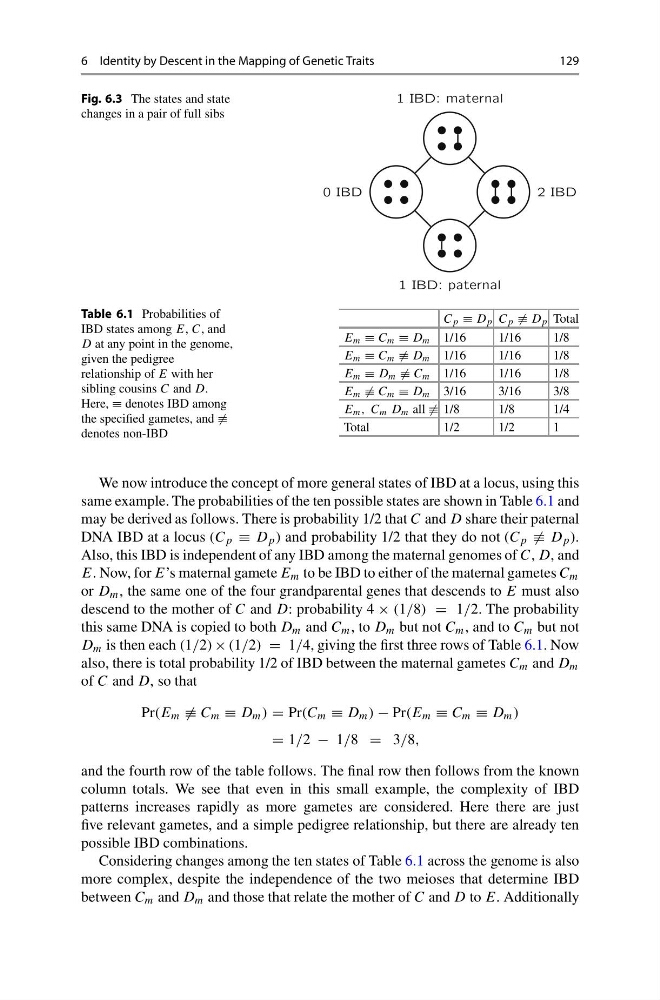
Fig. 6.3 The states and state
changes in a pair of full sibs
Table 6.1 Probabilities of
IBD states among E, C, and
D at any point in the genome,
given the pedigree
relationship of E with her
sibling cousins C and D.
Here, ≡ denotes IBD among
the specified gametes, and ≡
denotes non-IBD
C p ≡ D p C p ≡ D p Total
E m ≡ C m ≡ D m 1/16
1/16
1/8
E m ≡ C m ≡ D m 1/16
1/16
1/8
E m ≡ D m ≡ C m 1/16
1/16
1/8
E m ≡ C m ≡ D m 3/16
3/16
3/8
E m , C m D m all ≡ 1/8
1/8
1/4
Total
1/2
1/2
1
We now introduce the concept of more general states of IBD at a locus, using this
same example. The probabilities of the ten possible states are shown in Table 6.1 and
may be derived as follows. There is probability 1/2 that C and D share their paternal
DNA IBD at a locus (C p ≡ D p ) and probability 1/2 that they do not (C p ≡ D p ).
Also, this IBD is independent of any IBD among the maternal genomes of C, D, and
E. Now, for E’s maternal gamete E m to be IBD to either of the maternal gametes C m
or D m , the same one of the four grandparental genes that descends to E must also
descend to the mother of C and D: probability 4 × (1/8) = 1/2. The probability
this same DNA is copied to both D m and C m , to D m but not C m , and to C m but not
D m is then each (1/2) × (1/2) = 1/4, giving the first three rows of Table 6.1. Now
also, there is total probability 1/2 of IBD between the maternal gametes C m and D m
of C and D, so that
Pr(E m ≡ C m ≡ D m ) = Pr(C m ≡ D m ) − Pr(E m ≡ C m ≡ D m )
= 1/2 − 1/8 = 3/8,
and the fourth row of the table follows. The final row then follows from the known
column totals. We see that even in this small example, the complexity of IBD
patterns increases rapidly as more gametes are considered. Here there are just
five relevant gametes, and a simple pedigree relationship, but there are already ten
possible IBD combinations.
Considering changes among the ten states of Table 6.1 across the genome is also
more complex, despite the independence of the two meioses that determine IBD
between C m and D m and those that relate the mother of C and D to E. Additionally
129
Fig. 6.3 The states and state
changes in a pair of full sibs
Table 6.1 Probabilities of
IBD states among E, C, and
D at any point in the genome,
given the pedigree
relationship of E with her
sibling cousins C and D.
Here, ≡ denotes IBD among
the specified gametes, and ≡
denotes non-IBD
C p ≡ D p C p ≡ D p Total
E m ≡ C m ≡ D m 1/16
1/16
1/8
E m ≡ C m ≡ D m 1/16
1/16
1/8
E m ≡ D m ≡ C m 1/16
1/16
1/8
E m ≡ C m ≡ D m 3/16
3/16
3/8
E m , C m D m all ≡ 1/8
1/8
1/4
Total
1/2
1/2
1
We now introduce the concept of more general states of IBD at a locus, using this
same example. The probabilities of the ten possible states are shown in Table 6.1 and
may be derived as follows. There is probability 1/2 that C and D share their paternal
DNA IBD at a locus (C p ≡ D p ) and probability 1/2 that they do not (C p ≡ D p ).
Also, this IBD is independent of any IBD among the maternal genomes of C, D, and
E. Now, for E’s maternal gamete E m to be IBD to either of the maternal gametes C m
or D m , the same one of the four grandparental genes that descends to E must also
descend to the mother of C and D: probability 4 × (1/8) = 1/2. The probability
this same DNA is copied to both D m and C m , to D m but not C m , and to C m but not
D m is then each (1/2) × (1/2) = 1/4, giving the first three rows of Table 6.1. Now
also, there is total probability 1/2 of IBD between the maternal gametes C m and D m
of C and D, so that
Pr(E m ≡ C m ≡ D m ) = Pr(C m ≡ D m ) − Pr(E m ≡ C m ≡ D m )
= 1/2 − 1/8 = 3/8,
and the fourth row of the table follows. The final row then follows from the known
column totals. We see that even in this small example, the complexity of IBD
patterns increases rapidly as more gametes are considered. Here there are just
five relevant gametes, and a simple pedigree relationship, but there are already ten
possible IBD combinations.
Considering changes among the ten states of Table 6.1 across the genome is also
more complex, despite the independence of the two meioses that determine IBD
between C m and D m and those that relate the mother of C and D to E. Additionally