

282 Reia Anquet and Fabien Girard
to the fact that the Kenyan government had grounded its decision to evict
indigenous communities upon the alleged need to protect the Mau Forest
Complex, an important water catchment. The African Court on Human and
Peoples’ Rights
27 explicitly ruled out this argument as unsubstantiated. The
Ogiek’s BCP strives to dispel the government’s portrayal of Ogiek communities as “enemies of nature” by using a counter-narrative underlying their
“vital role as guardians and conservators of biological diversity in Mau Forest
Complex” (p. iv). The BCP also recalls that the “[…] word Ogiek means ‘caretaker of all’ plants and animals, or scientifically the flora and fauna”, and that
Ogiek communities “have always been among the most responsible stewards
of forests owing to [their] historical links and attachment to it” (p. 3).
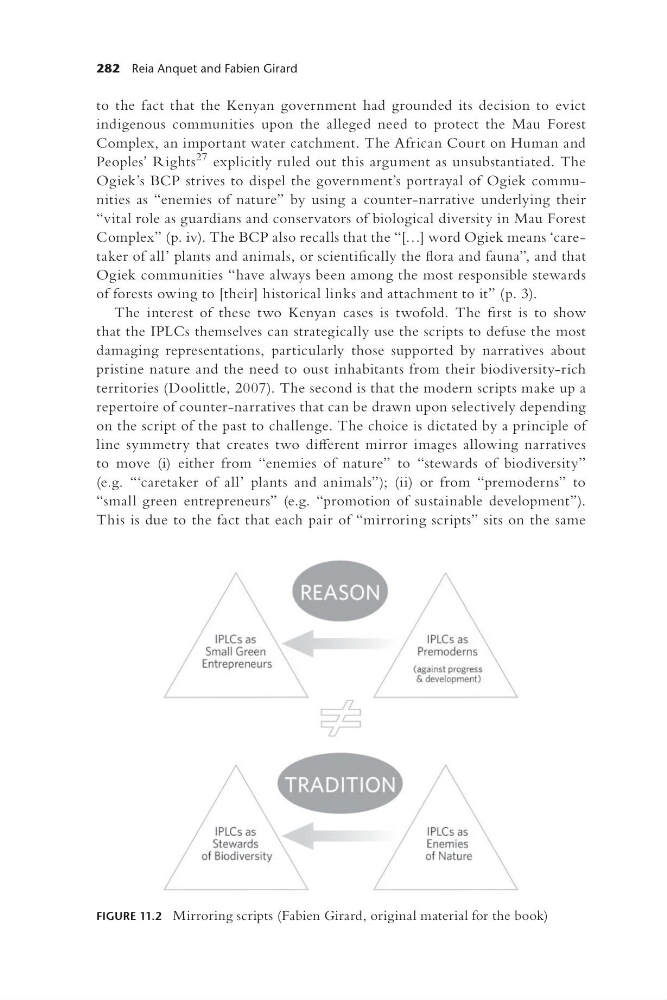
The interest of these two Kenyan cases is twofold. The first is to show
that the IPLCs themselves can strategically use the scripts to defuse the most
damaging representations, particularly those supported by narratives about
pristine nature and the need to oust inhabitants from their biodiversity-rich
territories (Doolittle, 2007). The second is that the modern scripts make up a
repertoire of counter-narratives that can be drawn upon selectively depending
on the script of the past to challenge. The choice is dictated by a principle of
line symmetry that creates two different mirror images allowing narratives
to move (i) either from “enemies of nature” to “stewards of biodiversity”
(e.g. “‘caretaker of all’ plants and animals”); (ii) or from “premoderns” to
“small green entrepreneurs” (e.g. “promotion of sustainable development”).
This is due to the fact that each pair of “mirroring scripts” sits on the same
FIGURE 11.2 Mirroring scripts (Fabien Girard, original material for the book)
to the fact that the Kenyan government had grounded its decision to evict
indigenous communities upon the alleged need to protect the Mau Forest
Complex, an important water catchment. The African Court on Human and
Peoples’ Rights
27 explicitly ruled out this argument as unsubstantiated. The
Ogiek’s BCP strives to dispel the government’s portrayal of Ogiek communities as “enemies of nature” by using a counter-narrative underlying their
“vital role as guardians and conservators of biological diversity in Mau Forest
Complex” (p. iv). The BCP also recalls that the “[…] word Ogiek means ‘caretaker of all’ plants and animals, or scientifically the flora and fauna”, and that
Ogiek communities “have always been among the most responsible stewards
of forests owing to [their] historical links and attachment to it” (p. 3).
The interest of these two Kenyan cases is twofold. The first is to show
that the IPLCs themselves can strategically use the scripts to defuse the most
damaging representations, particularly those supported by narratives about
pristine nature and the need to oust inhabitants from their biodiversity-rich
territories (Doolittle, 2007). The second is that the modern scripts make up a
repertoire of counter-narratives that can be drawn upon selectively depending
on the script of the past to challenge. The choice is dictated by a principle of
line symmetry that creates two different mirror images allowing narratives
to move (i) either from “enemies of nature” to “stewards of biodiversity”
(e.g. “‘caretaker of all’ plants and animals”); (ii) or from “premoderns” to
“small green entrepreneurs” (e.g. “promotion of sustainable development”).
This is due to the fact that each pair of “mirroring scripts” sits on the same
FIGURE 11.2 Mirroring scripts (Fabien Girard, original material for the book)