

The Sovereign Stewards of Biodiversity 275
(Blaser, 2009) or meta-ontology (Blaser, 2013, p. 544) which is built along the
“nature-culture divide”. More importantly, storied practices (narratives) and theoretical knowledge stabilise into performative interpretations (Bonneuil, 2019,
p. 9) of the world, which we define as “scripts” or “scenarios”. As they are interpreting what is “out there”, they necessarily take part in the enactment of what
they narrate (Blaser, 2013, p. 552). This allows them to produce, in turn, “social
practices and relationships of power” (Ulloa, 2005, p. 5). This is what is meant
by eco-governmentality. Following Agrawal’s Foucauldian-inspired analytic,
eco-governmentality is defined as the variety of “knowledge-making apparatuses” (Brosius, 1999, n. 6) used to shape “[…] the conduct of specific persons and
groups, including the mechanisms that such persons and groups use on themselves” (Agrawal, 2005a, n. 3). Eco-governmentality relies on the “techniques of
the self ” used (along with a State’s regulatory strategies) to forge new practices
and new links of political influence (e.g. the creation of a new local council, a
division of space, or a provisioning of new crop varieties). The typology of these
“techniques of the self ” is not explored in the following paragraphs. What matters to our analysis are their outcomes: the effects of the regimes of power and the
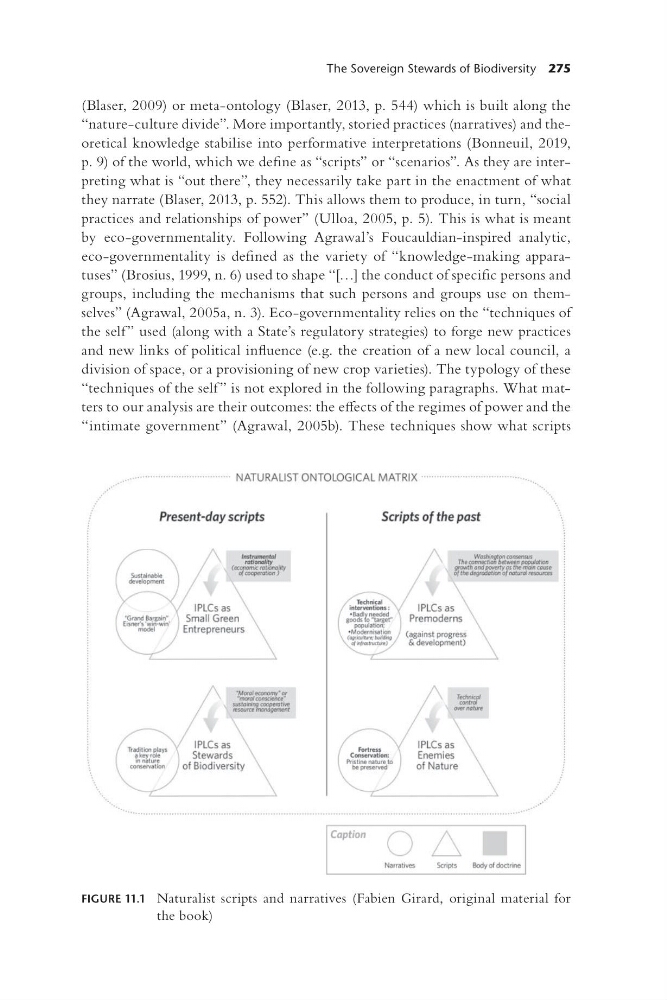
“intimate government” (Agrawal, 2005b). These techniques show what scripts
FIGURE 11.1 N aturalist scripts and narratives (Fabien Girard, original material for
the book)
(Blaser, 2009) or meta-ontology (Blaser, 2013, p. 544) which is built along the
“nature-culture divide”. More importantly, storied practices (narratives) and theoretical knowledge stabilise into performative interpretations (Bonneuil, 2019,
p. 9) of the world, which we define as “scripts” or “scenarios”. As they are interpreting what is “out there”, they necessarily take part in the enactment of what
they narrate (Blaser, 2013, p. 552). This allows them to produce, in turn, “social
practices and relationships of power” (Ulloa, 2005, p. 5). This is what is meant
by eco-governmentality. Following Agrawal’s Foucauldian-inspired analytic,
eco-governmentality is defined as the variety of “knowledge-making apparatuses” (Brosius, 1999, n. 6) used to shape “[…] the conduct of specific persons and
groups, including the mechanisms that such persons and groups use on themselves” (Agrawal, 2005a, n. 3). Eco-governmentality relies on the “techniques of
the self ” used (along with a State’s regulatory strategies) to forge new practices
and new links of political influence (e.g. the creation of a new local council, a
division of space, or a provisioning of new crop varieties). The typology of these
“techniques of the self ” is not explored in the following paragraphs. What matters to our analysis are their outcomes: the effects of the regimes of power and the
“intimate government” (Agrawal, 2005b). These techniques show what scripts
FIGURE 11.1 N aturalist scripts and narratives (Fabien Girard, original material for
the book)