

From Obstruction to Decolonization? 157
following the lead of indigenous scholars), in much the same way as Biocultural
Community Protocols. Many of the people who formulated the concepts of
Biocultural Community Protocols negotiated and established them in close collaboration with researchers – or who were themselves community-based scholars, following the Tkarihwaieri Code of Ethical Conduct.
15 The TK Labels draw
upon the CBD’s Article 8( j), but deliberately remain at the educational – not the
legal – level. This initiative seeks to guard indigenous materials from copyright
enclosure but also by the open knowledge movement itself, which can reinscribe
colonial appropriation.
Academia has a long history and wide geography of cultural appropriation
and racialized/racist and gendered/misogynist epistemic hierarchy. Meanwhile,
scholars working to counter the colonialist tendency toward extractive research
methodologies have developed community research protocols that parallel
Biocultural Community Protocols: from principles of partnership and terms
of engagement on to memorandums of understanding. Following the primary
principle of community-partnered research, these are developed in collaboration
with and following the lead of frontline community representatives (Montenegro de Wit et al., 2021).
In the face of a centuries-long legal hegemony of copyright, the open knowledge movement arose and is expanding, particularly with mass digitization of
cultural heritage objects held in museums, libraries, archives, conservatories, and
collections. But merely opening access risks further cultural appropriation or
reproducing racist harms. The TK and BC Labels work as an epistemic, not
legal, tool. They emerged as public educational, public research, and community
knowledge response to coloniality of intellectual property regimes. In this way,
they parallel and actualize key principles of Biocultural Community Protocols
regarding ownership of data in that they address crucial questions overlooked
in colonialist epistemologies, such as who is an expert on whom, who gets to
speak on behalf of whom, and who gets to take credit for the knowledge? At
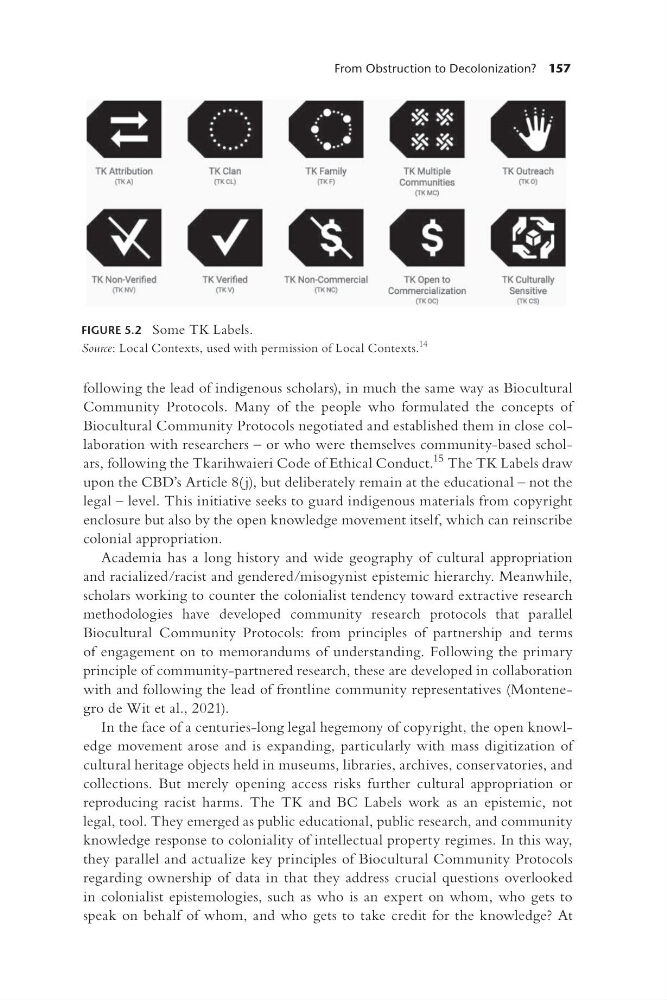
FIGURE 5.2 Some TK Labels.
Source: Local Contexts, used with permission of Local Contexts.
14
following the lead of indigenous scholars), in much the same way as Biocultural
Community Protocols. Many of the people who formulated the concepts of
Biocultural Community Protocols negotiated and established them in close collaboration with researchers – or who were themselves community-based scholars, following the Tkarihwaieri Code of Ethical Conduct.
15 The TK Labels draw
upon the CBD’s Article 8( j), but deliberately remain at the educational – not the
legal – level. This initiative seeks to guard indigenous materials from copyright
enclosure but also by the open knowledge movement itself, which can reinscribe
colonial appropriation.
Academia has a long history and wide geography of cultural appropriation
and racialized/racist and gendered/misogynist epistemic hierarchy. Meanwhile,
scholars working to counter the colonialist tendency toward extractive research
methodologies have developed community research protocols that parallel
Biocultural Community Protocols: from principles of partnership and terms
of engagement on to memorandums of understanding. Following the primary
principle of community-partnered research, these are developed in collaboration
with and following the lead of frontline community representatives (Montenegro de Wit et al., 2021).
In the face of a centuries-long legal hegemony of copyright, the open knowledge movement arose and is expanding, particularly with mass digitization of
cultural heritage objects held in museums, libraries, archives, conservatories, and
collections. But merely opening access risks further cultural appropriation or
reproducing racist harms. The TK and BC Labels work as an epistemic, not
legal, tool. They emerged as public educational, public research, and community
knowledge response to coloniality of intellectual property regimes. In this way,
they parallel and actualize key principles of Biocultural Community Protocols
regarding ownership of data in that they address crucial questions overlooked
in colonialist epistemologies, such as who is an expert on whom, who gets to
speak on behalf of whom, and who gets to take credit for the knowledge? At
FIGURE 5.2 Some TK Labels.
Source: Local Contexts, used with permission of Local Contexts.
14