

Reducing Greenhouse Gas Emissions and Improving Air Quality
30
30
in concentrations of pollutants. Population- weighted PM2.5 concentrations
increased by 18% from 2010 to 2016 (HEI, 2018). In 2016, ambient PM2.5
contributed to 4.1 million deaths and to 106 million disability- adjusted life years
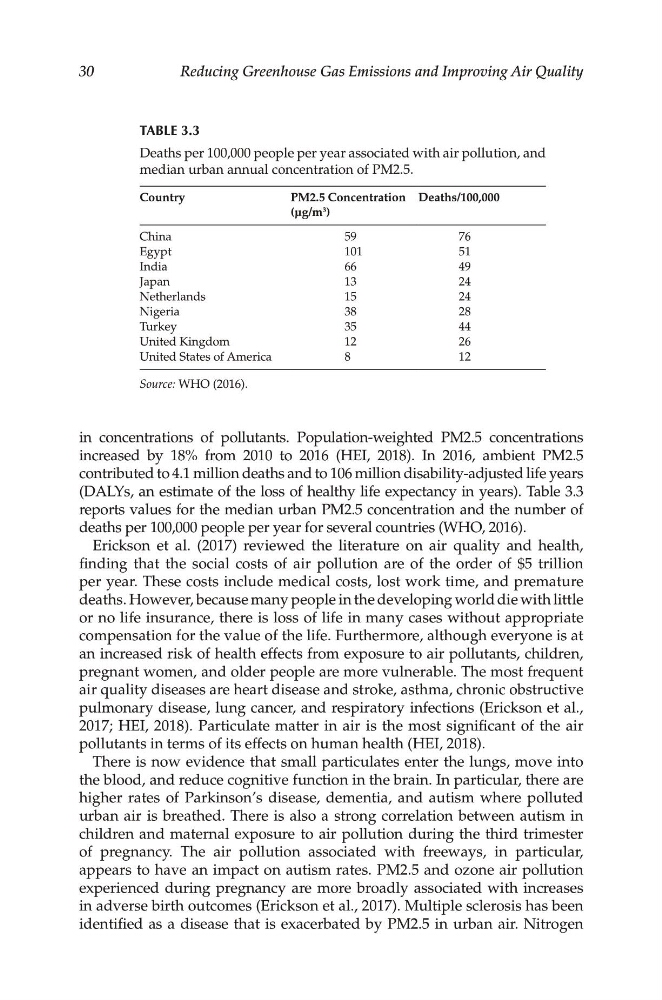
(DALYs, an estimate of the loss of healthy life expectancy in years). Table 3.3
reports values for the median urban PM2.5 concentration and the number of
deaths per 100,000 people per year for several countries (WHO, 2016).
Erickson et al. (2017) reviewed the literature on air quality and health,
finding that the social costs of air pollution are of the order of $5 trillion
per year. These costs include medical costs, lost work time, and premature
deaths. However, because many people in the developing world die with little
or no life insurance, there is loss of life in many cases without appropriate
compensation for the value of the life. Furthermore, although everyone is at
an increased risk of health effects from exposure to air pollutants, children,
pregnant women, and older people are more vulnerable. The most frequent
air quality diseases are heart disease and stroke, asthma, chronic obstructive
pulmonary disease, lung cancer, and respiratory infections (Erickson et al.,
2017; HEI, 2018). Particulate matter in air is the most significant of the air
pollutants in terms of its effects on human health (HEI, 2018).
There is now evidence that small particulates enter the lungs, move into
the blood, and reduce cognitive function in the brain. In particular, there are
higher rates of Parkinson’s disease, dementia, and autism where polluted
urban air is breathed. There is also a strong correlation between autism in
children and maternal exposure to air pollution during the third trimester
of pregnancy. The air pollution associated with freeways, in particular,
appears to have an impact on autism rates. PM2.5 and ozone air pollution
experienced during pregnancy are more broadly associated with increases
in adverse birth outcomes (Erickson et al., 2017). Multiple sclerosis has been
identified as a disease that is exacerbated by PM2.5 in urban air. Nitrogen
TABLE 3.3
Deaths per 100,000 people per year associated with air pollution, and
median urban annual concentration of PM2.5.
Country
PM2.5 Concentration
(μg/ m
3 )
Deaths/ 100,000
China
59
76
Egypt
101
51
India
66
49
Japan
13
24
Netherlands
15
24
Nigeria
38
28
Turkey
35
44
United Kingdom
12
26
United States of America
8
12
Source: WHO (2016).
30
30
in concentrations of pollutants. Population- weighted PM2.5 concentrations
increased by 18% from 2010 to 2016 (HEI, 2018). In 2016, ambient PM2.5
contributed to 4.1 million deaths and to 106 million disability- adjusted life years
(DALYs, an estimate of the loss of healthy life expectancy in years). Table 3.3
reports values for the median urban PM2.5 concentration and the number of
deaths per 100,000 people per year for several countries (WHO, 2016).
Erickson et al. (2017) reviewed the literature on air quality and health,
finding that the social costs of air pollution are of the order of $5 trillion
per year. These costs include medical costs, lost work time, and premature
deaths. However, because many people in the developing world die with little
or no life insurance, there is loss of life in many cases without appropriate
compensation for the value of the life. Furthermore, although everyone is at
an increased risk of health effects from exposure to air pollutants, children,
pregnant women, and older people are more vulnerable. The most frequent
air quality diseases are heart disease and stroke, asthma, chronic obstructive
pulmonary disease, lung cancer, and respiratory infections (Erickson et al.,
2017; HEI, 2018). Particulate matter in air is the most significant of the air
pollutants in terms of its effects on human health (HEI, 2018).
There is now evidence that small particulates enter the lungs, move into
the blood, and reduce cognitive function in the brain. In particular, there are
higher rates of Parkinson’s disease, dementia, and autism where polluted
urban air is breathed. There is also a strong correlation between autism in
children and maternal exposure to air pollution during the third trimester
of pregnancy. The air pollution associated with freeways, in particular,
appears to have an impact on autism rates. PM2.5 and ozone air pollution
experienced during pregnancy are more broadly associated with increases
in adverse birth outcomes (Erickson et al., 2017). Multiple sclerosis has been
identified as a disease that is exacerbated by PM2.5 in urban air. Nitrogen
TABLE 3.3
Deaths per 100,000 people per year associated with air pollution, and
median urban annual concentration of PM2.5.
Country
PM2.5 Concentration
(μg/ m
3 )
Deaths/ 100,000
China
59
76
Egypt
101
51
India
66
49
Japan
13
24
Netherlands
15
24
Nigeria
38
28
Turkey
35
44
United Kingdom
12
26
United States of America
8
12
Source: WHO (2016).