

81
Groundwater Modeling Involving PRBs
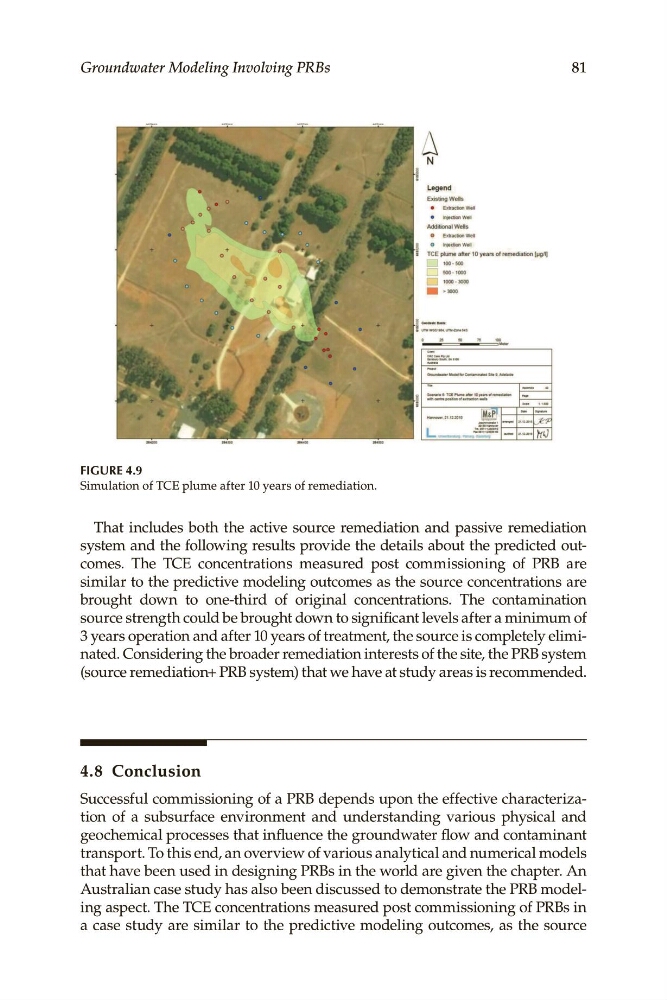
FIGURE 4.9
Simulation of TCE plume after 10 years of remediation.
That includes both the active source remediation and passive remediation
system and the following results provide the details about the predicted outcomes. The TCE concentrations measured post commissioning of PRB are
similar to the predictive modeling outcomes as the source concentrations are
brought down to one-third of original concentrations. The contamination
source strength could be brought down to significant levels after a minimum of
3 years operation and after 10 years of treatment, the source is completely eliminated. Considering the broader remediation interests of the site, the PRB system
(source remediation+ PRB system) that we have at study areas is recommended.
4.8 Conclusion
Successful commissioning of a PRB depends upon the effective characterization of a subsurface environment and understanding various physical and
geochemical processes that influence the groundwater flow and contaminant
transport. To this end, an overview of various analytical and numerical models
that have been used in designing PRBs in the world are given the chapter. An
Australian case study has also been discussed to demonstrate the PRB modeling aspect. The TCE concentrations measured post commissioning of PRBs in
a case study are similar to the predictive modeling outcomes, as the source
Groundwater Modeling Involving PRBs
FIGURE 4.9
Simulation of TCE plume after 10 years of remediation.
That includes both the active source remediation and passive remediation
system and the following results provide the details about the predicted outcomes. The TCE concentrations measured post commissioning of PRB are
similar to the predictive modeling outcomes as the source concentrations are
brought down to one-third of original concentrations. The contamination
source strength could be brought down to significant levels after a minimum of
3 years operation and after 10 years of treatment, the source is completely eliminated. Considering the broader remediation interests of the site, the PRB system
(source remediation+ PRB system) that we have at study areas is recommended.
4.8 Conclusion
Successful commissioning of a PRB depends upon the effective characterization of a subsurface environment and understanding various physical and
geochemical processes that influence the groundwater flow and contaminant
transport. To this end, an overview of various analytical and numerical models
that have been used in designing PRBs in the world are given the chapter. An
Australian case study has also been discussed to demonstrate the PRB modeling aspect. The TCE concentrations measured post commissioning of PRBs in
a case study are similar to the predictive modeling outcomes, as the source