

∂u
�P
2
+ ⋅�u =
v u
u
+ �
∂t
ρ
�h
Q = AK L
66
Permeable Reactive Barrier
where
L = barrier thickness (L)
c = constant contaminant concentration entering the barrier (M/L3)
Most real-world contaminated sites are heterogeneous and anisotropic in
nature. To simulate the groundwater flow and pollutant transport for the
actual subsurface conditions, it is desirable that the simulation model chosen is able to accommodate both these aspects of the modeling. Important
concepts of groundwater modeling have been presented by Anderson and
Woessner (1992) and Zheng and Bennet (2002).
4.2.1 Modeling of Induced Heterogeneity
The presence of a PRB induces changes in the subsurface heterogeneity, which
influence the groundwater flow and contamination migration pathways. The
subsurface system is viewed as a combination of adjacent flow fields of different characteristics, such as hydraulic conductivities rather than a continuous
domain (Das, 2002). In this scenario, the fluid dynamics play a vital role and
the contaminant transport model must take this aspect into consideration.
An example of the application of this model would be former gas works sites
which often contain discarded pipes and large cavities. The presence of these
in the subsurface results in the zones of free flow and thus, overall contaminant transport in the subsurface is a combination of free flow and porous flow
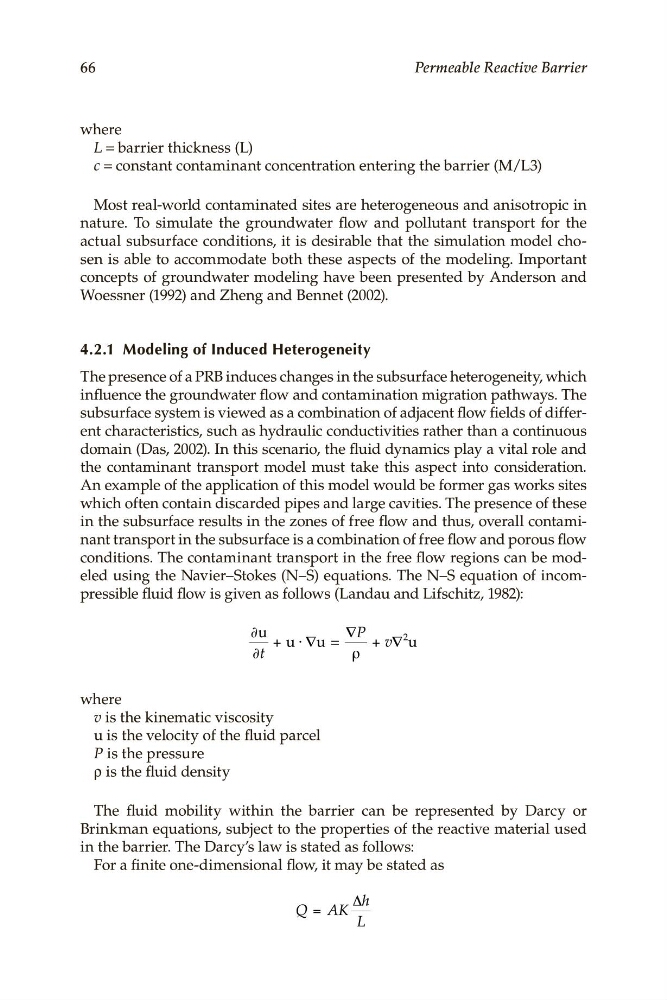
conditions. The contaminant transport in the free flow regions can be modeled using the Navier–Stokes (N–S) equations. The N–S equation of incompressible fluid flow is given as follows (Landau and Lifschitz, 1982):
where
v is the kinematic viscosity
u is the velocity of the fluid parcel
P is the pressure
ρ is the fluid density
The fluid mobility within the barrier can be represented by Darcy or
Brinkman equations, subject to the properties of the reactive material used
in the barrier. The Darcy’s law is stated as follows:
For a finite one-dimensional flow, it may be stated as
�P
2
+ ⋅�u =
v u
u
+ �
∂t
ρ
�h
Q = AK L
66
Permeable Reactive Barrier
where
L = barrier thickness (L)
c = constant contaminant concentration entering the barrier (M/L3)
Most real-world contaminated sites are heterogeneous and anisotropic in
nature. To simulate the groundwater flow and pollutant transport for the
actual subsurface conditions, it is desirable that the simulation model chosen is able to accommodate both these aspects of the modeling. Important
concepts of groundwater modeling have been presented by Anderson and
Woessner (1992) and Zheng and Bennet (2002).
4.2.1 Modeling of Induced Heterogeneity
The presence of a PRB induces changes in the subsurface heterogeneity, which
influence the groundwater flow and contamination migration pathways. The
subsurface system is viewed as a combination of adjacent flow fields of different characteristics, such as hydraulic conductivities rather than a continuous
domain (Das, 2002). In this scenario, the fluid dynamics play a vital role and
the contaminant transport model must take this aspect into consideration.
An example of the application of this model would be former gas works sites
which often contain discarded pipes and large cavities. The presence of these
in the subsurface results in the zones of free flow and thus, overall contaminant transport in the subsurface is a combination of free flow and porous flow
conditions. The contaminant transport in the free flow regions can be modeled using the Navier–Stokes (N–S) equations. The N–S equation of incompressible fluid flow is given as follows (Landau and Lifschitz, 1982):
where
v is the kinematic viscosity
u is the velocity of the fluid parcel
P is the pressure
ρ is the fluid density
The fluid mobility within the barrier can be represented by Darcy or
Brinkman equations, subject to the properties of the reactive material used
in the barrier. The Darcy’s law is stated as follows:
For a finite one-dimensional flow, it may be stated as