

54
Permeable Reactive Barrier
and aquitard are homogeneous, but they are always heterogeneous in nature.
Detailed information on these techniques helps to choose the most appropriate construction methodology to install the barrier successfully.
3.3.1 Excavation Techniques
3.3.1.1 Biopolymer Trenching
Biopolymer trenching is a cost-effective and versatile PRB construction
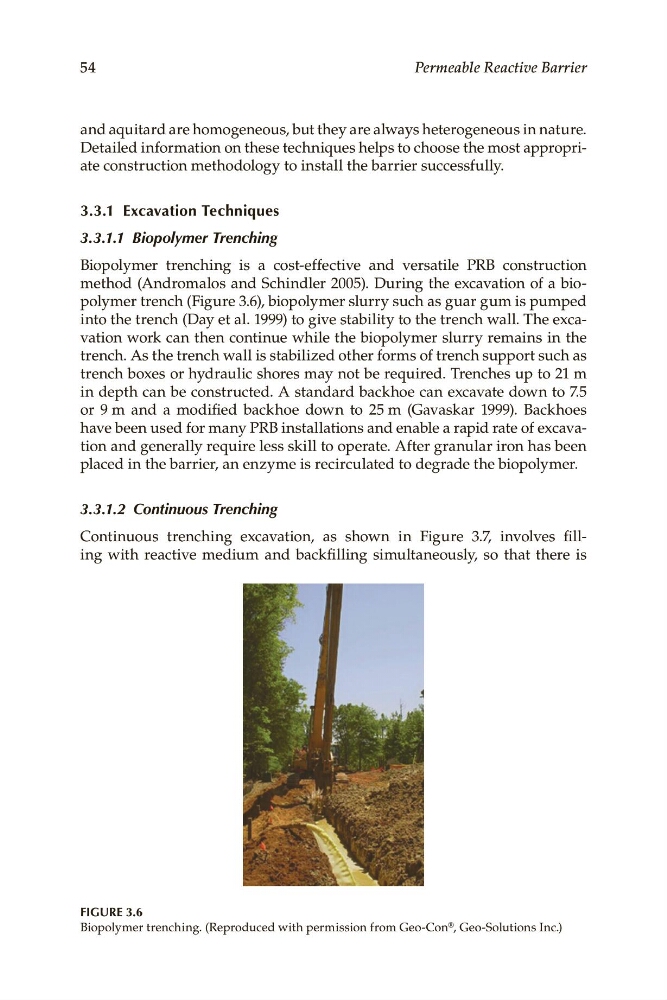
method (Andromalos and Schindler 2005). During the excavation of a biopolymer trench (Figure 3.6), biopolymer slurry such as guar gum is pumped
into the trench (Day et al. 1999) to give stability to the trench wall. The excavation work can then continue while the biopolymer slurry remains in the
trench. As the trench wall is stabilized other forms of trench support such as
trench boxes or hydraulic shores may not be required. Trenches up to 21 m
in depth can be constructed. A standard backhoe can excavate down to 7.5
or 9 m and a modified backhoe down to 25 m (Gavaskar 1999). Backhoes
have been used for many PRB installations and enable a rapid rate of excavation and generally require less skill to operate. After granular iron has been
placed in the barrier, an enzyme is recirculated to degrade the biopolymer.
3.3.1.2 Continuous Trenching
Continuous trenching excavation, as shown in Figure 3.7, involves filling with reactive medium and backfilling simultaneously, so that there is
FIGURE 3.6
Biopolymer trenching. (Reproduced with permission from Geo-Con ® , Geo-Solutions Inc.)
Permeable Reactive Barrier
and aquitard are homogeneous, but they are always heterogeneous in nature.
Detailed information on these techniques helps to choose the most appropriate construction methodology to install the barrier successfully.
3.3.1 Excavation Techniques
3.3.1.1 Biopolymer Trenching
Biopolymer trenching is a cost-effective and versatile PRB construction
method (Andromalos and Schindler 2005). During the excavation of a biopolymer trench (Figure 3.6), biopolymer slurry such as guar gum is pumped
into the trench (Day et al. 1999) to give stability to the trench wall. The excavation work can then continue while the biopolymer slurry remains in the
trench. As the trench wall is stabilized other forms of trench support such as
trench boxes or hydraulic shores may not be required. Trenches up to 21 m
in depth can be constructed. A standard backhoe can excavate down to 7.5
or 9 m and a modified backhoe down to 25 m (Gavaskar 1999). Backhoes
have been used for many PRB installations and enable a rapid rate of excavation and generally require less skill to operate. After granular iron has been
placed in the barrier, an enzyme is recirculated to degrade the biopolymer.
3.3.1.2 Continuous Trenching
Continuous trenching excavation, as shown in Figure 3.7, involves filling with reactive medium and backfilling simultaneously, so that there is
FIGURE 3.6
Biopolymer trenching. (Reproduced with permission from Geo-Con ® , Geo-Solutions Inc.)