

51
Choosing the Best Design and Construction Technologies for PRBs
discharge through the gate can be increased by increasing the width, length,
and hydraulic conductivity of the gate, and the width of the funnel (Starr and
Cherry 1994). Various funnel extensions (Figures 3.3e, f, and g) are occasionally used to capture plumes under site-specific conditions.
3.2.3.3 Reactive Vessels
For decontamination, GW can be routed through a natural or engineered
preferential pathway to a reaction vessel. The reactive vessel PRB design is
very similar to the funnel-and-gate barrier except that it replaces the gate
with in situ reactive vessels. These can be lifted out from the ground for
maintenance or to replace the reactive medium (Phillips et al. 2010). The reactive medium can readily be replaced when exhausted and its performance
can be restored quickly. The design of the reactive vessel enables investigation of any problems and allows them to be fixed to restore performance. The
design does not add much cost to the conventional funnel-and-gate system,
but requires a permanent structure or provision for lifting the barrier at the
site. In Europe, this design has become popular and several installations are
now in place (Birke et al. 2007).
3.2.3.4 Caissons PRBs
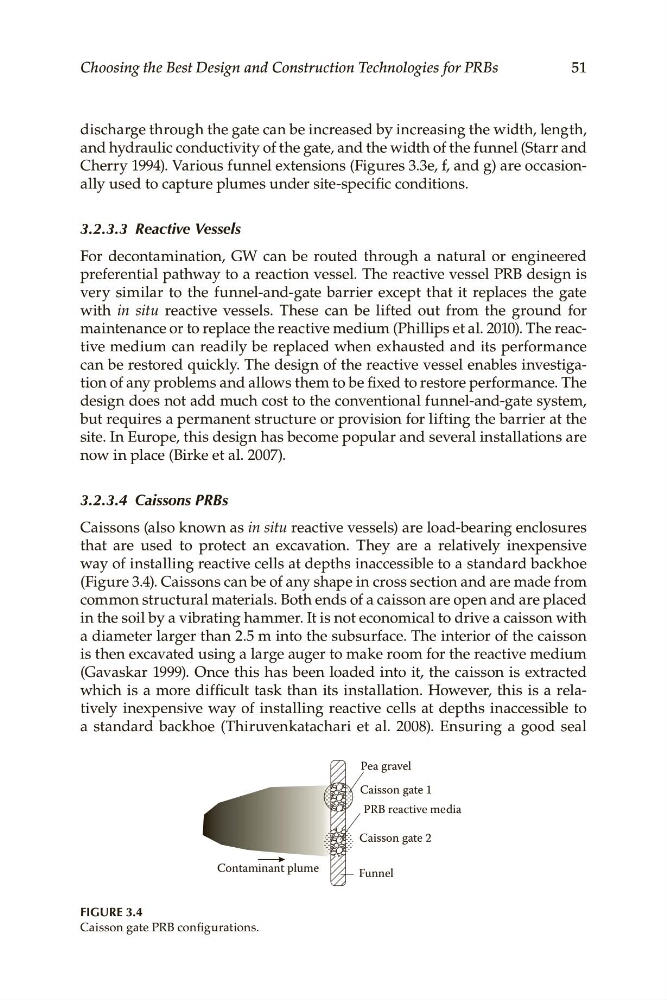
Caissons (also known as in situ reactive vessels) are load-bearing enclosures
that are used to protect an excavation. They are a relatively inexpensive
way of installing reactive cells at depths inaccessible to a standard backhoe
(Figure 3.4). Caissons can be of any shape in cross section and are made from
common structural materials. Both ends of a caisson are open and are placed
in the soil by a vibrating hammer. It is not economical to drive a caisson with
a diameter larger than 2.5 m into the subsurface. The interior of the caisson
is then excavated using a large auger to make room for the reactive medium
(Gavaskar 1999). Once this has been loaded into it, the caisson is extracted
which is a more difficult task than its installation. However, this is a relatively inexpensive way of installing reactive cells at depths inaccessible to
a standard backhoe (Thiruvenkatachari et al. 2008). Ensuring a good seal
Contaminant plume
Pea gravel
Caisson gate 1
PRB reactive media
Caisson gate 2
Funnel
FIGURE 3.4
Caisson gate PRB configurations.
Choosing the Best Design and Construction Technologies for PRBs
discharge through the gate can be increased by increasing the width, length,
and hydraulic conductivity of the gate, and the width of the funnel (Starr and
Cherry 1994). Various funnel extensions (Figures 3.3e, f, and g) are occasionally used to capture plumes under site-specific conditions.
3.2.3.3 Reactive Vessels
For decontamination, GW can be routed through a natural or engineered
preferential pathway to a reaction vessel. The reactive vessel PRB design is
very similar to the funnel-and-gate barrier except that it replaces the gate
with in situ reactive vessels. These can be lifted out from the ground for
maintenance or to replace the reactive medium (Phillips et al. 2010). The reactive medium can readily be replaced when exhausted and its performance
can be restored quickly. The design of the reactive vessel enables investigation of any problems and allows them to be fixed to restore performance. The
design does not add much cost to the conventional funnel-and-gate system,
but requires a permanent structure or provision for lifting the barrier at the
site. In Europe, this design has become popular and several installations are
now in place (Birke et al. 2007).
3.2.3.4 Caissons PRBs
Caissons (also known as in situ reactive vessels) are load-bearing enclosures
that are used to protect an excavation. They are a relatively inexpensive
way of installing reactive cells at depths inaccessible to a standard backhoe
(Figure 3.4). Caissons can be of any shape in cross section and are made from
common structural materials. Both ends of a caisson are open and are placed
in the soil by a vibrating hammer. It is not economical to drive a caisson with
a diameter larger than 2.5 m into the subsurface. The interior of the caisson
is then excavated using a large auger to make room for the reactive medium
(Gavaskar 1999). Once this has been loaded into it, the caisson is extracted
which is a more difficult task than its installation. However, this is a relatively inexpensive way of installing reactive cells at depths inaccessible to
a standard backhoe (Thiruvenkatachari et al. 2008). Ensuring a good seal
Contaminant plume
Pea gravel
Caisson gate 1
PRB reactive media
Caisson gate 2
Funnel
FIGURE 3.4
Caisson gate PRB configurations.