

*
*
(3.3)
=
V S
L B t r es b f
48
Permeable Reactive Barrier
3.2.2.2 Sizing the Reactive Material Wall
The design of the appropriate sizing for the reactive barrier wall is made subsequent to the results from laboratory trials (material selection), and hydraulic
and geochemical modeling. Detailed site characterization and hydrogeological modeling are essential steps in PRB design and construction such as the
capture zones (i.e., optimization of the length, best location and orientation,
type and configuration of the barrier) and aquifer thickness and heterogeneity (determines depth/height of the barrier). However, sizing the barrier
thickness involves understanding the removal mechanism and reaction
kinetics with an appropriate safety factor for the uncertainties of the input
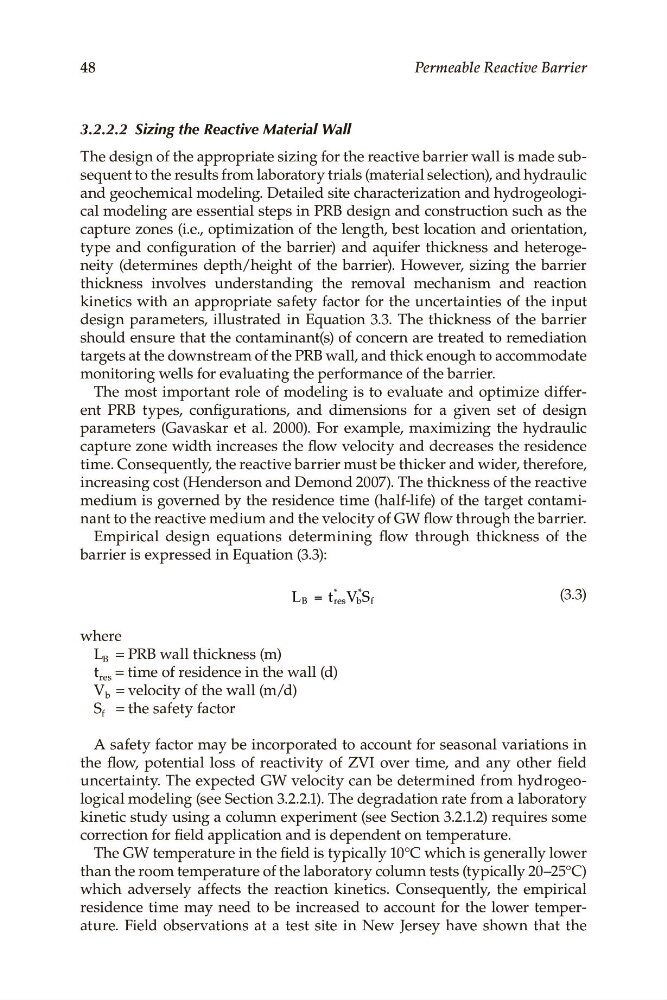
design parameters, illustrated in Equation 3.3. The thickness of the barrier
should ensure that the contaminant(s) of concern are treated to remediation
targets at the downstream of the PRB wall, and thick enough to accommodate
monitoring wells for evaluating the performance of the barrier.
The most important role of modeling is to evaluate and optimize different PRB types, configurations, and dimensions for a given set of design
parameters (Gavaskar et al. 2000). For example, maximizing the hydraulic
capture zone width increases the flow velocity and decreases the residence
time. Consequently, the reactive barrier must be thicker and wider, therefore,
increasing cost (Henderson and Demond 2007). The thickness of the reactive
medium is governed by the residence time (half-life) of the target contaminant to the reactive medium and the velocity of GW flow through the barrier.
Empirical design equations determining flow through thickness of the
barrier is expressed in Equation (3.3):
where
L B = PRB wall thickness (m)
t res = time of residence in the wall (d)
V b = velocity of the wall (m/d)
S f = the safety factor
A safety factor may be incorporated to account for seasonal variations in
the flow, potential loss of reactivity of ZVI over time, and any other field
uncertainty. The expected GW velocity can be determined from hydrogeological modeling (see Section 3.2.2.1). The degradation rate from a laboratory
kinetic study using a column experiment (see Section 3.2.1.2) requires some
correction for field application and is dependent on temperature.
The GW temperature in the field is typically 10°C which is generally lower
than the room temperature of the laboratory column tests (typically 20–25°C)
which adversely affects the reaction kinetics. Consequently, the empirical
residence time may need to be increased to account for the lower temperature. Field observations at a test site in New Jersey have shown that the
*
(3.3)
=
V S
L B t r es b f
48
Permeable Reactive Barrier
3.2.2.2 Sizing the Reactive Material Wall
The design of the appropriate sizing for the reactive barrier wall is made subsequent to the results from laboratory trials (material selection), and hydraulic
and geochemical modeling. Detailed site characterization and hydrogeological modeling are essential steps in PRB design and construction such as the
capture zones (i.e., optimization of the length, best location and orientation,
type and configuration of the barrier) and aquifer thickness and heterogeneity (determines depth/height of the barrier). However, sizing the barrier
thickness involves understanding the removal mechanism and reaction
kinetics with an appropriate safety factor for the uncertainties of the input
design parameters, illustrated in Equation 3.3. The thickness of the barrier
should ensure that the contaminant(s) of concern are treated to remediation
targets at the downstream of the PRB wall, and thick enough to accommodate
monitoring wells for evaluating the performance of the barrier.
The most important role of modeling is to evaluate and optimize different PRB types, configurations, and dimensions for a given set of design
parameters (Gavaskar et al. 2000). For example, maximizing the hydraulic
capture zone width increases the flow velocity and decreases the residence
time. Consequently, the reactive barrier must be thicker and wider, therefore,
increasing cost (Henderson and Demond 2007). The thickness of the reactive
medium is governed by the residence time (half-life) of the target contaminant to the reactive medium and the velocity of GW flow through the barrier.
Empirical design equations determining flow through thickness of the
barrier is expressed in Equation (3.3):
where
L B = PRB wall thickness (m)
t res = time of residence in the wall (d)
V b = velocity of the wall (m/d)
S f = the safety factor
A safety factor may be incorporated to account for seasonal variations in
the flow, potential loss of reactivity of ZVI over time, and any other field
uncertainty. The expected GW velocity can be determined from hydrogeological modeling (see Section 3.2.2.1). The degradation rate from a laboratory
kinetic study using a column experiment (see Section 3.2.1.2) requires some
correction for field application and is dependent on temperature.
The GW temperature in the field is typically 10°C which is generally lower
than the room temperature of the laboratory column tests (typically 20–25°C)
which adversely affects the reaction kinetics. Consequently, the empirical
residence time may need to be increased to account for the lower temperature. Field observations at a test site in New Jersey have shown that the