

46
Permeable Reactive Barrier
TABLE 3.1
ZVI Gain Size Specification for Different Types of PRB
Construction
Construction Type
Iron Grain Size (mm)
Excavation
2–0.25
Vertical hydraulic fracture
1–0.17
High-pressure jetting
0.59–0.21
Pneumatic fracturing
0.04–0.08
where
C = the outlet concentration
C 0 = the initial concentration
k = the reaction kinetic
t = the residence time within the barrier
The reactive ZVI reaction kinetics (Equation 3.2) and formation of byproducts requires investigation by conducting laboratory batch and column
experiments (Figure 3.1), using contaminated GW from the remediation site
(Thangavadivel et al. 2013). Such experiments also help to select an appropriate reactive material for the particular site application. The column experiments acts as a plug flow reactor and mimic the actual GW flow conditions
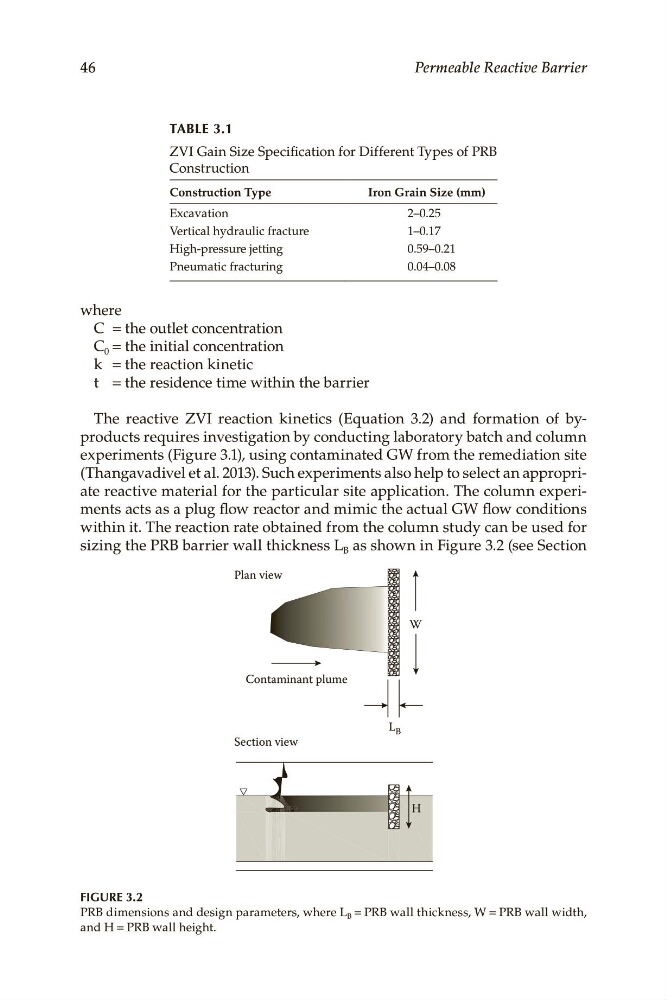
within it. The reaction rate obtained from the column study can be used for
sizing the PRB barrier wall thickness L B as shown in Figure 3.2 (see Section
W
H
L B
Plan view
Section view
Contaminant plume
FIGURE 3.2
PRB dimensions and design parameters, where L B = PRB wall thickness, W = PRB wall width,
and H = PRB wall height.
Permeable Reactive Barrier
TABLE 3.1
ZVI Gain Size Specification for Different Types of PRB
Construction
Construction Type
Iron Grain Size (mm)
Excavation
2–0.25
Vertical hydraulic fracture
1–0.17
High-pressure jetting
0.59–0.21
Pneumatic fracturing
0.04–0.08
where
C = the outlet concentration
C 0 = the initial concentration
k = the reaction kinetic
t = the residence time within the barrier
The reactive ZVI reaction kinetics (Equation 3.2) and formation of byproducts requires investigation by conducting laboratory batch and column
experiments (Figure 3.1), using contaminated GW from the remediation site
(Thangavadivel et al. 2013). Such experiments also help to select an appropriate reactive material for the particular site application. The column experiments acts as a plug flow reactor and mimic the actual GW flow conditions
within it. The reaction rate obtained from the column study can be used for
sizing the PRB barrier wall thickness L B as shown in Figure 3.2 (see Section
W
H
L B
Plan view
Section view
Contaminant plume
FIGURE 3.2
PRB dimensions and design parameters, where L B = PRB wall thickness, W = PRB wall width,
and H = PRB wall height.