

PRB Reactive Material
Target Chemical
References
Organic-based materials:
Metals and metalloids:
Blowes et al. (2000),
activated carbon, leaf, peat,
arsenic (As), hexavalent
Guerin et al. (2002),
sewage sludge, sawdust,
chromium, Cr(VI), cadmium
Han et al. (2000),
compost, wood chips, chitin,
(Cd), mercury (II), uranium (U)
Meggyes and Simon
lignin, and so on
and molybdenum (Mo)
(2000), Meza (2009),
Aromatic compounds
Scherer et al. (2000)
Alkaline-complexing agents:
Petroleum hydrocarbons
Roehl et al. (2005b)
hydrated lime, ferrous sulfate, etc.
and metals
Phosphate minerals:
Divalent heavy metal ions
Admassu and Breese
hydroxyapatite and biogenic
(1999), Arey et al.
apatite (e.g., fish bone)
(1999), Leyva et al.
(2001)
Surfactant-modified zeolites
BTEX and other gasoline
Haggerty and
(SMZs):
by-products, perchloroethylene
Bowman (1994), Li
Natural zeolites coated with
(PCE), radionuclides, inorganic
et al. (1998), Xenidis
hexadecyltrimethylammonium,
oxyanions (sulfate, chromate,
et al. (2002)
Clinoptiloite-rich zeolite
and selenate)
Colloidal:
Carbothiolate herbicide,
Joo et al. (2004),
Iron size (1–3 μm) or nano size
molinate, dechlorination of
Wang and Zhang
(1–00 nm = 0.001–0.1 μm)
TCE and PCBs
(1997)
Metal oxides:
Phosphorus attenuation,
Baker et al. (1998),
(Iron/calcium oxides, and
removing mercury (Hg 2+ ),
Huttenloch et al.
fine-grained activated aluminum
chlorinated hydrocarbon, and
(2003), Tratnyek
oxide, elemental copper (CuO)
some aromatics
et al. (2003)
Alkaline materials:
Leachate from acid sulfate soils
Ake et al. (2001),
recycled concrete, limestone,
Golab et al. (2006),
calcite-bearing zeolitic breccia,
Waybrant et al.
blast furnace slag, lime,
(1998)
organo-clay, and fly ash,
and so on
Microorganisms
Chlorinated solvents
USEPA (2000)
Polymers:
Uranium contaminated
Shimotori et al.
polyacryloamidoxime resin
groundwater, carbon
(2004), Stewart et al.
derived from polyacrylonitrile,
tetrachloride, copper (Cu 2+ ),
(2006)
which is deposited from solution
nitrobenzene,
onto the surface of quartz sand
4-nitroacetophenone, and
to form a thin film coating
2− )
chromate (CrO 4
17
Permeable Reactive Barriers
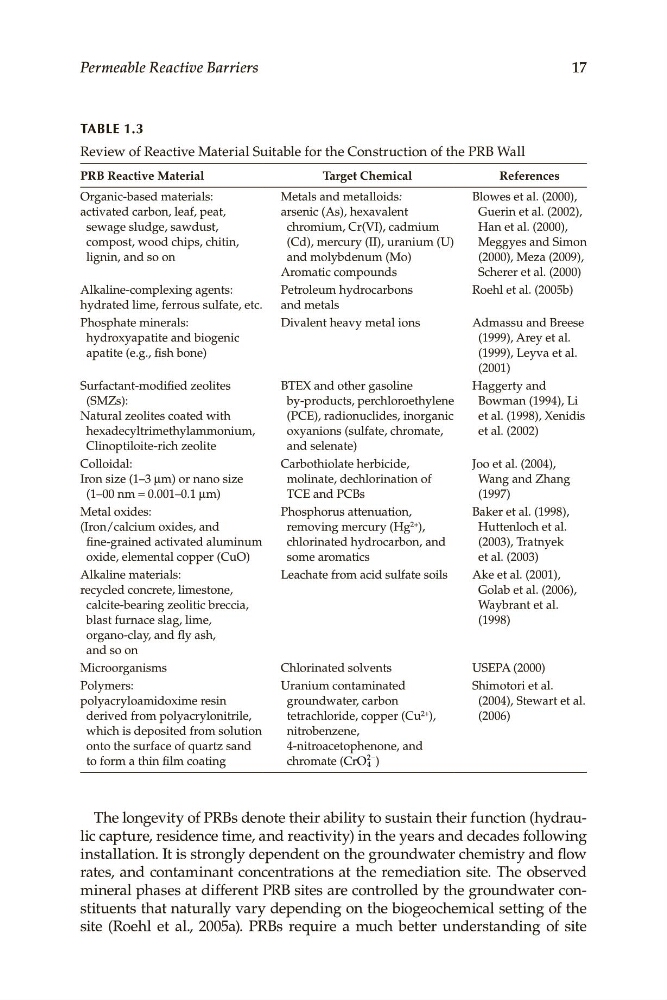
TABLE 1.3
Review of Reactive Material Suitable for the Construction of the PRB Wall
The longevity of PRBs denote their ability to sustain their function (hydraulic capture, residence time, and reactivity) in the years and decades following
installation. It is strongly dependent on the groundwater chemistry and flow
rates, and contaminant concentrations at the remediation site. The observed
mineral phases at different PRB sites are controlled by the groundwater constituents that naturally vary depending on the biogeochemical setting of the
site (Roehl et al., 2005a). PRBs require a much better understanding of site
Target Chemical
References
Organic-based materials:
Metals and metalloids:
Blowes et al. (2000),
activated carbon, leaf, peat,
arsenic (As), hexavalent
Guerin et al. (2002),
sewage sludge, sawdust,
chromium, Cr(VI), cadmium
Han et al. (2000),
compost, wood chips, chitin,
(Cd), mercury (II), uranium (U)
Meggyes and Simon
lignin, and so on
and molybdenum (Mo)
(2000), Meza (2009),
Aromatic compounds
Scherer et al. (2000)
Alkaline-complexing agents:
Petroleum hydrocarbons
Roehl et al. (2005b)
hydrated lime, ferrous sulfate, etc.
and metals
Phosphate minerals:
Divalent heavy metal ions
Admassu and Breese
hydroxyapatite and biogenic
(1999), Arey et al.
apatite (e.g., fish bone)
(1999), Leyva et al.
(2001)
Surfactant-modified zeolites
BTEX and other gasoline
Haggerty and
(SMZs):
by-products, perchloroethylene
Bowman (1994), Li
Natural zeolites coated with
(PCE), radionuclides, inorganic
et al. (1998), Xenidis
hexadecyltrimethylammonium,
oxyanions (sulfate, chromate,
et al. (2002)
Clinoptiloite-rich zeolite
and selenate)
Colloidal:
Carbothiolate herbicide,
Joo et al. (2004),
Iron size (1–3 μm) or nano size
molinate, dechlorination of
Wang and Zhang
(1–00 nm = 0.001–0.1 μm)
TCE and PCBs
(1997)
Metal oxides:
Phosphorus attenuation,
Baker et al. (1998),
(Iron/calcium oxides, and
removing mercury (Hg 2+ ),
Huttenloch et al.
fine-grained activated aluminum
chlorinated hydrocarbon, and
(2003), Tratnyek
oxide, elemental copper (CuO)
some aromatics
et al. (2003)
Alkaline materials:
Leachate from acid sulfate soils
Ake et al. (2001),
recycled concrete, limestone,
Golab et al. (2006),
calcite-bearing zeolitic breccia,
Waybrant et al.
blast furnace slag, lime,
(1998)
organo-clay, and fly ash,
and so on
Microorganisms
Chlorinated solvents
USEPA (2000)
Polymers:
Uranium contaminated
Shimotori et al.
polyacryloamidoxime resin
groundwater, carbon
(2004), Stewart et al.
derived from polyacrylonitrile,
tetrachloride, copper (Cu 2+ ),
(2006)
which is deposited from solution
nitrobenzene,
onto the surface of quartz sand
4-nitroacetophenone, and
to form a thin film coating
2− )
chromate (CrO 4
17
Permeable Reactive Barriers
TABLE 1.3
Review of Reactive Material Suitable for the Construction of the PRB Wall
The longevity of PRBs denote their ability to sustain their function (hydraulic capture, residence time, and reactivity) in the years and decades following
installation. It is strongly dependent on the groundwater chemistry and flow
rates, and contaminant concentrations at the remediation site. The observed
mineral phases at different PRB sites are controlled by the groundwater constituents that naturally vary depending on the biogeochemical setting of the
site (Roehl et al., 2005a). PRBs require a much better understanding of site