

279
Permeable Reactive Barriers in Europe
Plume
Source zones
Plume
GW flow
GW flow
Cleaned GW
GW flow
Pipe
Drainage
Drainages
Collector
Gate
Funnel
Gate
Distributor
Level of drainage
can be manipulated
GW flow
Cleaned GW
Source zones
Plume
Source zones
Plume
Source zones
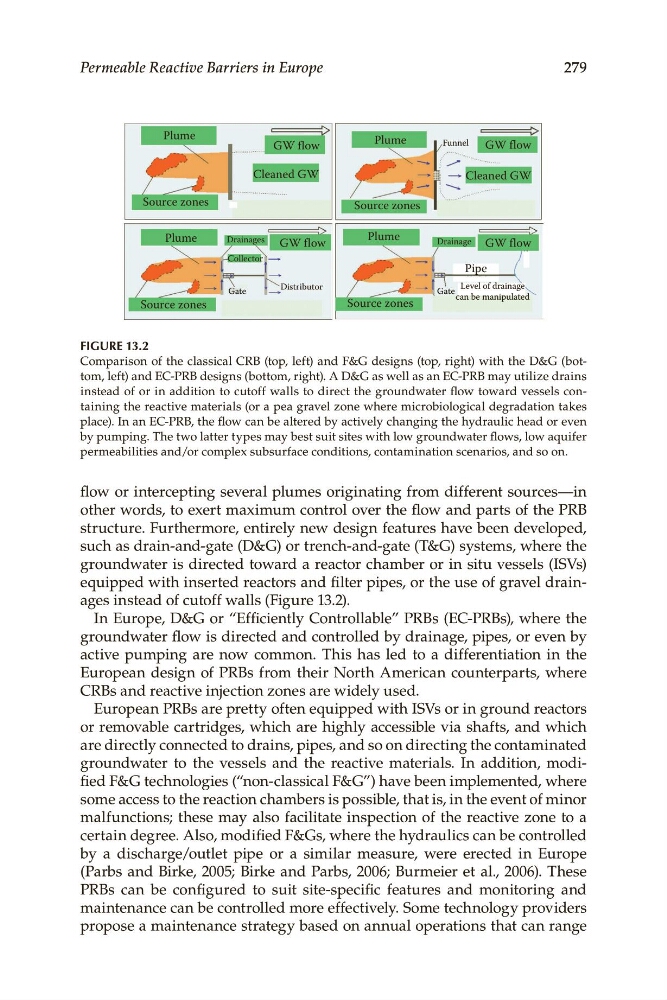
FIGURE 13.2
Comparison of the classical CRB (top, left) and F&G designs (top, right) with the D&G (bottom, left) and EC-PRB designs (bottom, right). A D&G as well as an EC-PRB may utilize drains
instead of or in addition to cutoff walls to direct the groundwater flow toward vessels containing the reactive materials (or a pea gravel zone where microbiological degradation takes
place). In an EC-PRB, the flow can be altered by actively changing the hydraulic head or even
by pumping. The two latter types may best suit sites with low groundwater flows, low aquifer
permeabilities and/or complex subsurface conditions, contamination scenarios, and so on.
flow or intercepting several plumes originating from different sources—in
other words, to exert maximum control over the flow and parts of the PRB
structure. Furthermore, entirely new design features have been developed,
such as drain-and-gate (D&G) or trench-and-gate (T&G) systems, where the
groundwater is directed toward a reactor chamber or in situ vessels (ISVs)
equipped with inserted reactors and filter pipes, or the use of gravel drainages instead of cutoff walls (Figure 13.2).
In Europe, D&G or “Efficiently Controllable” PRBs (EC-PRBs), where the
groundwater flow is directed and controlled by drainage, pipes, or even by
active pumping are now common. This has led to a differentiation in the
European design of PRBs from their North American counterparts, where
CRBs and reactive injection zones are widely used.
European PRBs are pretty often equipped with ISVs or in ground reactors
or removable cartridges, which are highly accessible via shafts, and which
are directly connected to drains, pipes, and so on directing the contaminated
groundwater to the vessels and the reactive materials. In addition, modified F&G technologies (“non-classical F&G”) have been implemented, where
some access to the reaction chambers is possible, that is, in the event of minor
malfunctions; these may also facilitate inspection of the reactive zone to a
certain degree. Also, modified F&Gs, where the hydraulics can be controlled
by a discharge/outlet pipe or a similar measure, were erected in Europe
(Parbs and Birke, 2005; Birke and Parbs, 2006; Burmeier et al., 2006). These
PRBs can be configured to suit site-specific features and monitoring and
maintenance can be controlled more effectively. Some technology providers
propose a maintenance strategy based on annual operations that can range
Permeable Reactive Barriers in Europe
Plume
Source zones
Plume
GW flow
GW flow
Cleaned GW
GW flow
Pipe
Drainage
Drainages
Collector
Gate
Funnel
Gate
Distributor
Level of drainage
can be manipulated
GW flow
Cleaned GW
Source zones
Plume
Source zones
Plume
Source zones
FIGURE 13.2
Comparison of the classical CRB (top, left) and F&G designs (top, right) with the D&G (bottom, left) and EC-PRB designs (bottom, right). A D&G as well as an EC-PRB may utilize drains
instead of or in addition to cutoff walls to direct the groundwater flow toward vessels containing the reactive materials (or a pea gravel zone where microbiological degradation takes
place). In an EC-PRB, the flow can be altered by actively changing the hydraulic head or even
by pumping. The two latter types may best suit sites with low groundwater flows, low aquifer
permeabilities and/or complex subsurface conditions, contamination scenarios, and so on.
flow or intercepting several plumes originating from different sources—in
other words, to exert maximum control over the flow and parts of the PRB
structure. Furthermore, entirely new design features have been developed,
such as drain-and-gate (D&G) or trench-and-gate (T&G) systems, where the
groundwater is directed toward a reactor chamber or in situ vessels (ISVs)
equipped with inserted reactors and filter pipes, or the use of gravel drainages instead of cutoff walls (Figure 13.2).
In Europe, D&G or “Efficiently Controllable” PRBs (EC-PRBs), where the
groundwater flow is directed and controlled by drainage, pipes, or even by
active pumping are now common. This has led to a differentiation in the
European design of PRBs from their North American counterparts, where
CRBs and reactive injection zones are widely used.
European PRBs are pretty often equipped with ISVs or in ground reactors
or removable cartridges, which are highly accessible via shafts, and which
are directly connected to drains, pipes, and so on directing the contaminated
groundwater to the vessels and the reactive materials. In addition, modified F&G technologies (“non-classical F&G”) have been implemented, where
some access to the reaction chambers is possible, that is, in the event of minor
malfunctions; these may also facilitate inspection of the reactive zone to a
certain degree. Also, modified F&Gs, where the hydraulics can be controlled
by a discharge/outlet pipe or a similar measure, were erected in Europe
(Parbs and Birke, 2005; Birke and Parbs, 2006; Burmeier et al., 2006). These
PRBs can be configured to suit site-specific features and monitoring and
maintenance can be controlled more effectively. Some technology providers
propose a maintenance strategy based on annual operations that can range