

256
Permeable Reactive Barrier
12.4 Laboratory Column Trials
To evaluate the feasibility of employing a reactive iron barrier to degrade
the target contaminants with negligible hydraulic and hydrogeochemical impacts on the aquifer, a series of column trials were conducted at the
University of Waterloo under the supervision of ETI. The column trials were
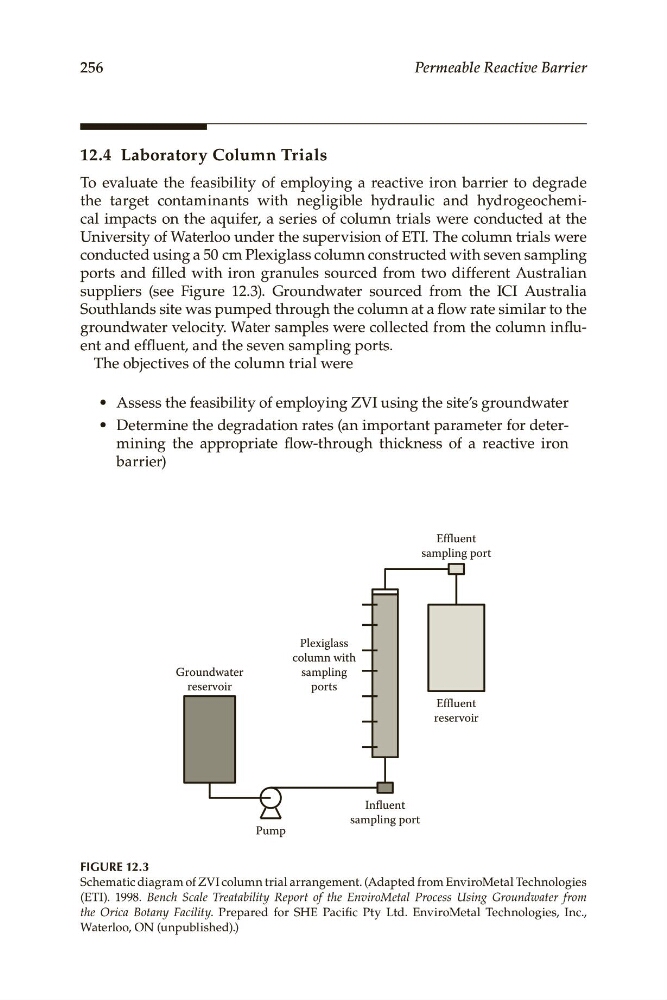
conducted using a 50 cm Plexiglass column constructed with seven sampling
ports and filled with iron granules sourced from two different Australian
suppliers (see Figure 12.3). Groundwater sourced from the ICI Australia
Southlands site was pumped through the column at a flow rate similar to the
groundwater velocity. Water samples were collected from the column influent and effluent, and the seven sampling ports.
The objectives of the column trial were
• Assess the feasibility of employing ZVI using the site’s groundwater
• Determine the degradation rates (an important parameter for determining the appropriate flow-through thickness of a reactive iron
barrier)
Effluent
sampling port
Plexiglass
column with
Groundwater
sampling
reservoir
ports
Effluent
reservoir
Influent
sampling port
Pump
FIGURE 12.3
Schematic diagram of ZVI column trial arrangement. (Adapted from EnviroMetal Technologies
(ETI). 1998. Bench Scale Treatability Report of the EnviroMetal Process Using Groundwater from
the Orica Botany Facility. Prepared for SHE Pacific Pty Ltd. EnviroMetal Technologies, Inc.,
Waterloo, ON (unpublished).)
Permeable Reactive Barrier
12.4 Laboratory Column Trials
To evaluate the feasibility of employing a reactive iron barrier to degrade
the target contaminants with negligible hydraulic and hydrogeochemical impacts on the aquifer, a series of column trials were conducted at the
University of Waterloo under the supervision of ETI. The column trials were
conducted using a 50 cm Plexiglass column constructed with seven sampling
ports and filled with iron granules sourced from two different Australian
suppliers (see Figure 12.3). Groundwater sourced from the ICI Australia
Southlands site was pumped through the column at a flow rate similar to the
groundwater velocity. Water samples were collected from the column influent and effluent, and the seven sampling ports.
The objectives of the column trial were
• Assess the feasibility of employing ZVI using the site’s groundwater
• Determine the degradation rates (an important parameter for determining the appropriate flow-through thickness of a reactive iron
barrier)
Effluent
sampling port
Plexiglass
column with
Groundwater
sampling
reservoir
ports
Effluent
reservoir
Influent
sampling port
Pump
FIGURE 12.3
Schematic diagram of ZVI column trial arrangement. (Adapted from EnviroMetal Technologies
(ETI). 1998. Bench Scale Treatability Report of the EnviroMetal Process Using Groundwater from
the Orica Botany Facility. Prepared for SHE Pacific Pty Ltd. EnviroMetal Technologies, Inc.,
Waterloo, ON (unpublished).)