

237
v/mg
AC h –1
100
80
Abiotic column
Epibon Y12×40 GAC
(Donau carbon)
T = 285K/pH~7
Anaerobic conditions
Biotic column
S
O
N
H
S
O
N
60
40
20
0
Phenol
Benzene
2-Methylphenol
3-/4-Methylphenol
3,5-Diemethylphenol
2,3-Diemethylphenol
Toluene
2,4/2,5-Diemethylphenol
2,6-Diemethylphenol
3,4-Diemethylphenol
2,4,6-Trimethylphenol
2,3,6-Trimethylphenol
Benzofuran (HSGC)
Benzofuran (GCMS)
Ethylbenzene
o-Xylene
2,3,5-Trimethylphenol
3,4,5-Trimethylphenol
Indene (HSGC)
Indene (GCMS)
m,p-Xylene
1-Aminonaphthalene
2-Naphthol
1-Indanone
Indane (GCMS)
Indane (HSGC)
1-Naphthol
1-Benzothiphene (GCMS)
2-Methylbenzofuran
1,2,3-trimethylbenzene
1-Benzothiophene (HSGC)
Isoquinoline
Acridine
1,3,5-Trimethylbenzene
2-Methylquinoline
2-phenylridine
1,2,4-Trimethylbenzene
1,2-Dimethylnaphthalene
6- / 7-methylquinoline
Naphthalene
1-Cyanonaphthalene
2-Hydroxycarbazole
Dibenzothiophene
3-Methylbenzothiophene
2-Hydroxydibenzofuran
2-Methylnaphthalene
Carbazole
1-Methylnaphthalene
Biphenyl
Acenaphthene
Acenaphthylene
1,3-Dimethylnaphthalene
Anthracene
1,6-Dimethylnaphthalene
2-Ethylnaphthalene
,4-/2,3-Dimethylnaphthalene
Dibenzofuran
Xanthone
,7-/2,6-Dimethylnaphthalene
Fluorene
Phenanthrene
Pyrene
Fluoranthene
1
2
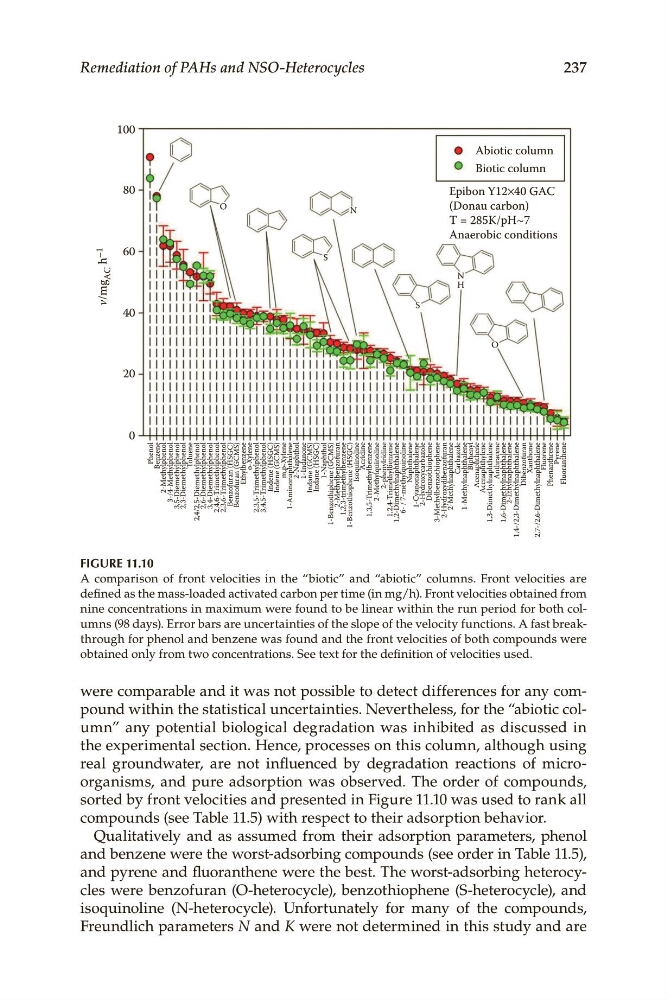
FIGURE 11.10
A comparison of front velocities in the “biotic” and “abiotic” columns. Front velocities are
defined as the mass-loaded activated carbon per time (in mg/h). Front velocities obtained from
nine concentrations in maximum were found to be linear within the run period for both columns (98 days). Error bars are uncertainties of the slope of the velocity functions. A fast breakthrough for phenol and benzene was found and the front velocities of both compounds were
obtained only from two concentrations. See text for the definition of velocities used.
Remediation of PAHs and NSO-Heterocycles
were comparable and it was not possible to detect differences for any compound within the statistical uncertainties. Nevertheless, for the “abiotic column” any potential biological degradation was inhibited as discussed in
the experimental section. Hence, processes on this column, although using
real groundwater, are not influenced by degradation reactions of microorganisms, and pure adsorption was observed. The order of compounds,
sorted by front velocities and presented in Figure 11.10 was used to rank all
compounds (see Table 11.5) with respect to their adsorption behavior.
Qualitatively and as assumed from their adsorption parameters, phenol
and benzene were the worst-adsorbing compounds (see order in Table 11.5),
and pyrene and fluoranthene were the best. The worst-adsorbing heterocycles were benzofuran (O-heterocycle), benzothiophene (S-heterocycle), and
isoquinoline (N-heterocycle). Unfortunately for many of the compounds,
Freundlich parameters N and K were not determined in this study and are
v/mg
AC h –1
100
80
Abiotic column
Epibon Y12×40 GAC
(Donau carbon)
T = 285K/pH~7
Anaerobic conditions
Biotic column
S
O
N
H
S
O
N
60
40
20
0
Phenol
Benzene
2-Methylphenol
3-/4-Methylphenol
3,5-Diemethylphenol
2,3-Diemethylphenol
Toluene
2,4/2,5-Diemethylphenol
2,6-Diemethylphenol
3,4-Diemethylphenol
2,4,6-Trimethylphenol
2,3,6-Trimethylphenol
Benzofuran (HSGC)
Benzofuran (GCMS)
Ethylbenzene
o-Xylene
2,3,5-Trimethylphenol
3,4,5-Trimethylphenol
Indene (HSGC)
Indene (GCMS)
m,p-Xylene
1-Aminonaphthalene
2-Naphthol
1-Indanone
Indane (GCMS)
Indane (HSGC)
1-Naphthol
1-Benzothiphene (GCMS)
2-Methylbenzofuran
1,2,3-trimethylbenzene
1-Benzothiophene (HSGC)
Isoquinoline
Acridine
1,3,5-Trimethylbenzene
2-Methylquinoline
2-phenylridine
1,2,4-Trimethylbenzene
1,2-Dimethylnaphthalene
6- / 7-methylquinoline
Naphthalene
1-Cyanonaphthalene
2-Hydroxycarbazole
Dibenzothiophene
3-Methylbenzothiophene
2-Hydroxydibenzofuran
2-Methylnaphthalene
Carbazole
1-Methylnaphthalene
Biphenyl
Acenaphthene
Acenaphthylene
1,3-Dimethylnaphthalene
Anthracene
1,6-Dimethylnaphthalene
2-Ethylnaphthalene
,4-/2,3-Dimethylnaphthalene
Dibenzofuran
Xanthone
,7-/2,6-Dimethylnaphthalene
Fluorene
Phenanthrene
Pyrene
Fluoranthene
1
2
FIGURE 11.10
A comparison of front velocities in the “biotic” and “abiotic” columns. Front velocities are
defined as the mass-loaded activated carbon per time (in mg/h). Front velocities obtained from
nine concentrations in maximum were found to be linear within the run period for both columns (98 days). Error bars are uncertainties of the slope of the velocity functions. A fast breakthrough for phenol and benzene was found and the front velocities of both compounds were
obtained only from two concentrations. See text for the definition of velocities used.
Remediation of PAHs and NSO-Heterocycles
were comparable and it was not possible to detect differences for any compound within the statistical uncertainties. Nevertheless, for the “abiotic column” any potential biological degradation was inhibited as discussed in
the experimental section. Hence, processes on this column, although using
real groundwater, are not influenced by degradation reactions of microorganisms, and pure adsorption was observed. The order of compounds,
sorted by front velocities and presented in Figure 11.10 was used to rank all
compounds (see Table 11.5) with respect to their adsorption behavior.
Qualitatively and as assumed from their adsorption parameters, phenol
and benzene were the worst-adsorbing compounds (see order in Table 11.5),
and pyrene and fluoranthene were the best. The worst-adsorbing heterocycles were benzofuran (O-heterocycle), benzothiophene (S-heterocycle), and
isoquinoline (N-heterocycle). Unfortunately for many of the compounds,
Freundlich parameters N and K were not determined in this study and are