

P h e n o l
B e n z e n e
T o l u e n e
B e n z o f u r a n
2 - M
e t h y l q u i n o l i n e
1 - B e n z o t h i o p h e n e
250
Activated carbons used:
S
200
Hydraffin 30N
Epibon Y12×40
Norit ROW supra
Norit GAC 1240
±22%
150 Chemviron F400
Chemviron F200
K/mg 1–N
g –1
L N
CH 3
O
CH 3
N
±11%
100
OH
±23%
±23%
50
±14%
±23%
0
232
Permeable Reactive Barrier
When K and n were known, a reverse fit was used to simulate multiadsorption processes for mixtures in batch experiments. Although six compounds
were used for comparison purposes, the number of compounds is only
restricted by the computation time and not by the number of components.
11.3.2.3.2 Comparison of Activated Carbons
A number of experiments are necessary to compare different activated carbons for a number of selected compounds. The time-consuming procedure
to measure adsorption isotherms was the main motivation for the development of an applicable computer program to evaluate Freundlich parameters
from mixtures, discussed in the previous section. Hence, for a comparison of
six compounds on six activated carbons, a potential total of 36 experiments
was reduced to only six experiments using mixtures with six compounds.
However, suitable analytical methods for the evaluation of mixtures were
required for all of the components. Freundlich parameters were evaluated
for six mixtures using six activated carbons and the fit procedure described
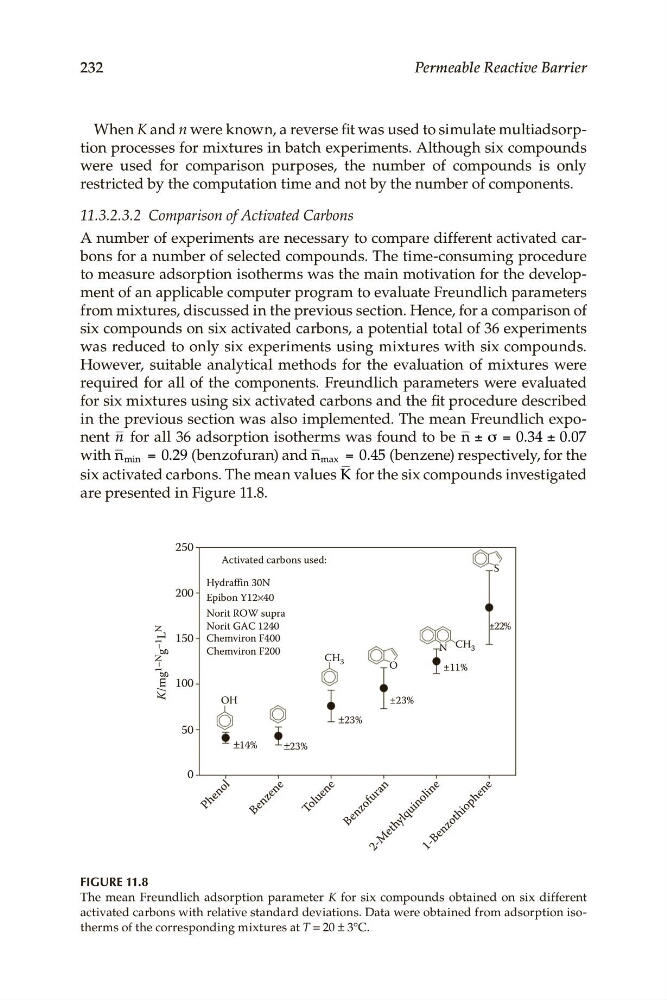
in the previous section was also implemented. The mean Freundlich exponent n for all 36 adsorption isotherms was found to be n ± σ = 0.3 4 ± 00 . 7
with n min = 0.2 9 (benzofuran) and n max = 0.4 5 (benzene) respectively, for the
six activated carbons. The mean values K for the six compounds investigated
are presented in Figure 11.8.
FIGURE 11.8
The mean Freundlich adsorption parameter K for six compounds obtained on six different
activated carbons with relative standard deviations. Data were obtained from adsorption isotherms of the corresponding mixtures at T = 20 ± 3°C.
B e n z e n e
T o l u e n e
B e n z o f u r a n
2 - M
e t h y l q u i n o l i n e
1 - B e n z o t h i o p h e n e
250
Activated carbons used:
S
200
Hydraffin 30N
Epibon Y12×40
Norit ROW supra
Norit GAC 1240
±22%
150 Chemviron F400
Chemviron F200
K/mg 1–N
g –1
L N
CH 3
O
CH 3
N
±11%
100
OH
±23%
±23%
50
±14%
±23%
0
232
Permeable Reactive Barrier
When K and n were known, a reverse fit was used to simulate multiadsorption processes for mixtures in batch experiments. Although six compounds
were used for comparison purposes, the number of compounds is only
restricted by the computation time and not by the number of components.
11.3.2.3.2 Comparison of Activated Carbons
A number of experiments are necessary to compare different activated carbons for a number of selected compounds. The time-consuming procedure
to measure adsorption isotherms was the main motivation for the development of an applicable computer program to evaluate Freundlich parameters
from mixtures, discussed in the previous section. Hence, for a comparison of
six compounds on six activated carbons, a potential total of 36 experiments
was reduced to only six experiments using mixtures with six compounds.
However, suitable analytical methods for the evaluation of mixtures were
required for all of the components. Freundlich parameters were evaluated
for six mixtures using six activated carbons and the fit procedure described
in the previous section was also implemented. The mean Freundlich exponent n for all 36 adsorption isotherms was found to be n ± σ = 0.3 4 ± 00 . 7
with n min = 0.2 9 (benzofuran) and n max = 0.4 5 (benzene) respectively, for the
six activated carbons. The mean values K for the six compounds investigated
are presented in Figure 11.8.
FIGURE 11.8
The mean Freundlich adsorption parameter K for six compounds obtained on six different
activated carbons with relative standard deviations. Data were obtained from adsorption isotherms of the corresponding mixtures at T = 20 ± 3°C.