

Reactive Barrier
Parameter
Karlsruhe (Germany)
Brunn am Gebirge
(Austria)
Constructed
2000/2001
1999
barrier type
Full-scale, GAC (granulated activated
carbon)
Full-scale, GAC
Concentration sum
of the contaminants
About 2000 μg/L
About 8000 μg/L
Length of barrier
240 m
220 m
# of gates (reactors)
8
4
Dimension reactors
Diameter 1.8 m, height 15–18 m
(volume for AC filling 21–27 m 3 )
Diameter 2 m, height 6–8 m
AC used
GAC TL830 (Chemviron) for gates 1, 2,
7, and 8 and D 43/1 (CarboTech) for
gates 3, 4, 5, and 6
CC 15 (Donau Carbon) for
all four gates
Sum mass AC
About 100 tonnes
About 20–24 tonnes
Water flow
9–10 L/s (mean, total flow through the
whole system) variable flow through
individual gates 1–8:1.0–1.4 L/s
0.5–2 L/s (total flow
through the whole system)
224
Permeable Reactive Barrier
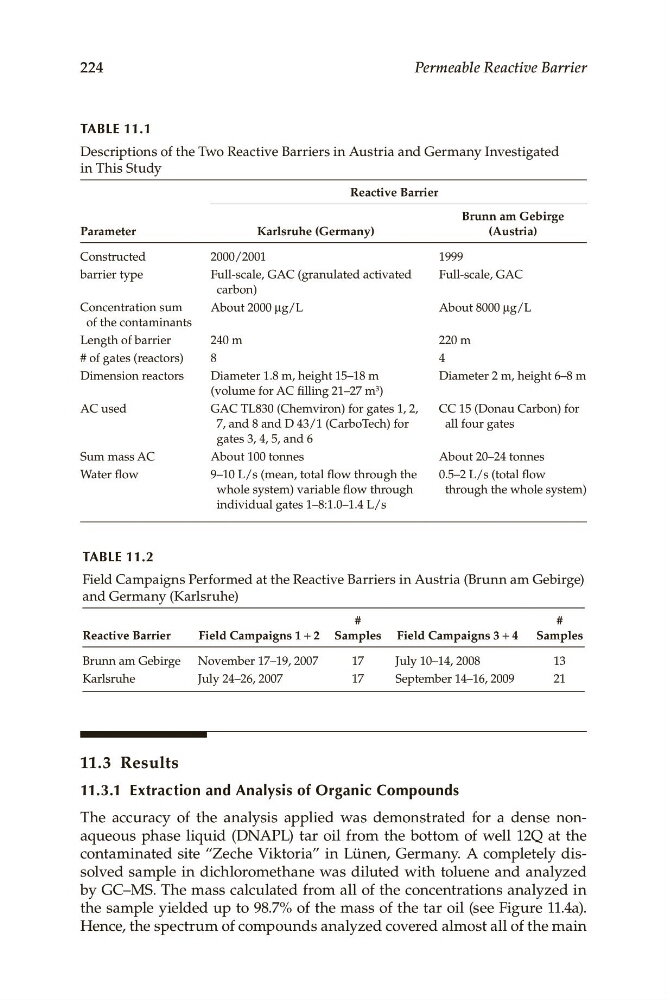
TABLE 11.1
Descriptions of the Two Reactive Barriers in Austria and Germany Investigated
in This Study
TABLE 11.2
Field Campaigns Performed at the Reactive Barriers in Austria (Brunn am Gebirge)
and Germany (Karlsruhe)
Reactive Barrier
Field Campaigns 1 + 2
#
Samples Field Campaigns 3 + 4
#
Samples
Brunn am Gebirge
Karlsruhe
November 17–19, 2007
July 24–26, 2007
17
17
July 10–14, 2008
September 14–16, 2009
13
21
11.3 Results
11.3.1 Extraction and Analysis of Organic Compounds
The accuracy of the analysis applied was demonstrated for a dense nonaqueous phase liquid (DNAPL) tar oil from the bottom of well 12Q at the
contaminated site “Zeche Viktoria” in Lünen, Germany. A completely dissolved sample in dichloromethane was diluted with toluene and analyzed
by GC–MS. The mass calculated from all of the concentrations analyzed in
the sample yielded up to 98.7% of the mass of the tar oil (see Figure 11.4a).
Hence, the spectrum of compounds analyzed covered almost all of the main
Parameter
Karlsruhe (Germany)
Brunn am Gebirge
(Austria)
Constructed
2000/2001
1999
barrier type
Full-scale, GAC (granulated activated
carbon)
Full-scale, GAC
Concentration sum
of the contaminants
About 2000 μg/L
About 8000 μg/L
Length of barrier
240 m
220 m
# of gates (reactors)
8
4
Dimension reactors
Diameter 1.8 m, height 15–18 m
(volume for AC filling 21–27 m 3 )
Diameter 2 m, height 6–8 m
AC used
GAC TL830 (Chemviron) for gates 1, 2,
7, and 8 and D 43/1 (CarboTech) for
gates 3, 4, 5, and 6
CC 15 (Donau Carbon) for
all four gates
Sum mass AC
About 100 tonnes
About 20–24 tonnes
Water flow
9–10 L/s (mean, total flow through the
whole system) variable flow through
individual gates 1–8:1.0–1.4 L/s
0.5–2 L/s (total flow
through the whole system)
224
Permeable Reactive Barrier
TABLE 11.1
Descriptions of the Two Reactive Barriers in Austria and Germany Investigated
in This Study
TABLE 11.2
Field Campaigns Performed at the Reactive Barriers in Austria (Brunn am Gebirge)
and Germany (Karlsruhe)
Reactive Barrier
Field Campaigns 1 + 2
#
Samples Field Campaigns 3 + 4
#
Samples
Brunn am Gebirge
Karlsruhe
November 17–19, 2007
July 24–26, 2007
17
17
July 10–14, 2008
September 14–16, 2009
13
21
11.3 Results
11.3.1 Extraction and Analysis of Organic Compounds
The accuracy of the analysis applied was demonstrated for a dense nonaqueous phase liquid (DNAPL) tar oil from the bottom of well 12Q at the
contaminated site “Zeche Viktoria” in Lünen, Germany. A completely dissolved sample in dichloromethane was diluted with toluene and analyzed
by GC–MS. The mass calculated from all of the concentrations analyzed in
the sample yielded up to 98.7% of the mass of the tar oil (see Figure 11.4a).
Hence, the spectrum of compounds analyzed covered almost all of the main