

222
Permeable Reactive Barrier
11.2.4 Column Experiments
A number of column experiments were performed using artificial solutions
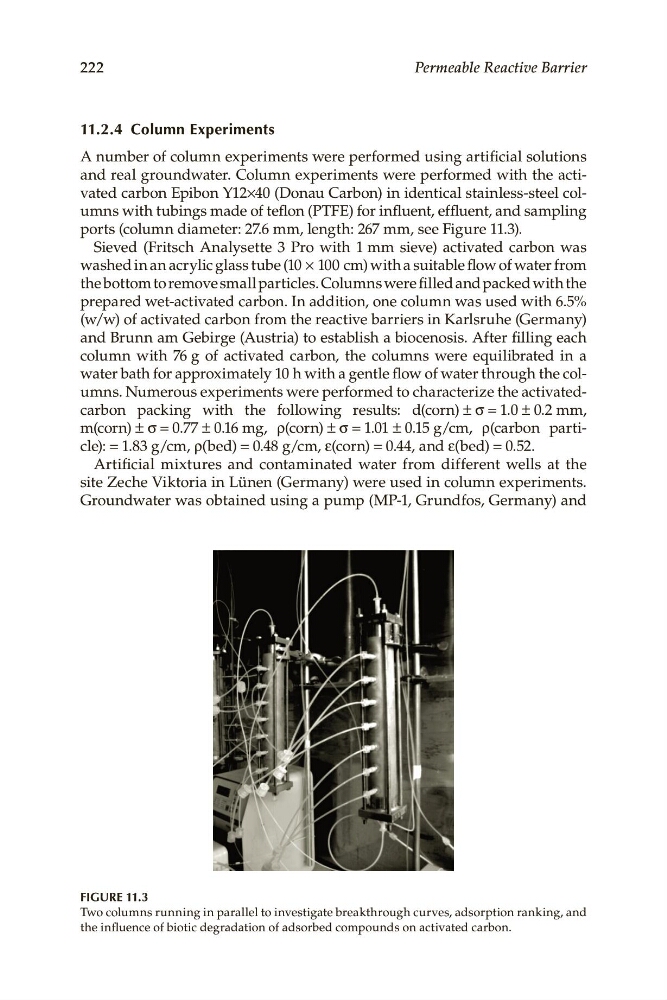
and real groundwater. Column experiments were performed with the activated carbon Epibon Y12×40 (Donau Carbon) in identical stainless-steel columns with tubings made of teflon (PTFE) for influent, effluent, and sampling
ports (column diameter: 27.6 mm, length: 267 mm, see Figure 11.3).
Sieved (Fritsch Analysette 3 Pro with 1 mm sieve) activated carbon was
washed in an acrylic glass tube (10 × 100 cm) with a suitable flow of water from
the bottom to remove small particles. Columns were filled and packed with the
prepared wet-activated carbon. In addition, one column was used with 6.5%
(w/w) of activated carbon from the reactive barriers in Karlsruhe (Germany)
and Brunn am Gebirge (Austria) to establish a biocenosis. After filling each
column with 76 g of activated carbon, the columns were equilibrated in a
water bath for approximately 10 h with a gentle flow of water through the columns. Numerous experiments were performed to characterize the activatedcarbon packing with the following results: d(corn) ± σ = 1.0 ± 0.2 mm,
m(corn) ± σ = 0.77 ± 0.16 mg, ρ(corn) ± σ = 1.01 ± 0.15 g/cm, ρ(carbon particle): = 1.83 g/cm, ρ(bed) = 0.48 g/cm, ε(corn) = 0.44, and ε(bed) = 0.52.
Artificial mixtures and contaminated water from different wells at the
site Zeche Viktoria in Lünen (Germany) were used in column experiments.
Groundwater was obtained using a pump (MP-1, Grundfos, Germany) and
FIGURE 11.3
Two columns running in parallel to investigate breakthrough curves, adsorption ranking, and
the influence of biotic degradation of adsorbed compounds on activated carbon.
Permeable Reactive Barrier
11.2.4 Column Experiments
A number of column experiments were performed using artificial solutions
and real groundwater. Column experiments were performed with the activated carbon Epibon Y12×40 (Donau Carbon) in identical stainless-steel columns with tubings made of teflon (PTFE) for influent, effluent, and sampling
ports (column diameter: 27.6 mm, length: 267 mm, see Figure 11.3).
Sieved (Fritsch Analysette 3 Pro with 1 mm sieve) activated carbon was
washed in an acrylic glass tube (10 × 100 cm) with a suitable flow of water from
the bottom to remove small particles. Columns were filled and packed with the
prepared wet-activated carbon. In addition, one column was used with 6.5%
(w/w) of activated carbon from the reactive barriers in Karlsruhe (Germany)
and Brunn am Gebirge (Austria) to establish a biocenosis. After filling each
column with 76 g of activated carbon, the columns were equilibrated in a
water bath for approximately 10 h with a gentle flow of water through the columns. Numerous experiments were performed to characterize the activatedcarbon packing with the following results: d(corn) ± σ = 1.0 ± 0.2 mm,
m(corn) ± σ = 0.77 ± 0.16 mg, ρ(corn) ± σ = 1.01 ± 0.15 g/cm, ρ(carbon particle): = 1.83 g/cm, ρ(bed) = 0.48 g/cm, ε(corn) = 0.44, and ε(bed) = 0.52.
Artificial mixtures and contaminated water from different wells at the
site Zeche Viktoria in Lünen (Germany) were used in column experiments.
Groundwater was obtained using a pump (MP-1, Grundfos, Germany) and
FIGURE 11.3
Two columns running in parallel to investigate breakthrough curves, adsorption ranking, and
the influence of biotic degradation of adsorbed compounds on activated carbon.