

(pK a −pH)
S = S 0 ⋅ (1 10
)
(11.1)
+
218
Permeable Reactive Barrier
The solubilities of short-chained alkylated phenols at pH ≪ pK a in general are approximately a factor of 50 higher than that of their parent aromatic compounds. In contrast, a comparison of NSO-heterocycles to their
parent hydrocarbons and PAHs presents a different view. The solubilities of
S-heterocycles are comparable to their analog hydrocarbons; a comparable
and in some cases higher solubility is found for O-heterocycles. However,
the solubilities of N-HETs are usually much higher (for instance the solubility of acridine is about a factor of 1000 higher compared to that of anthracene). Only a relatively few measurements are available for pH-dependent
solubilities. However, the Henderson–Hasselbalch Equation 11.1 is often
used to predict solubilities (S = solubility, S 0 = intrinsic solubility of the neutral molecule) [17]:
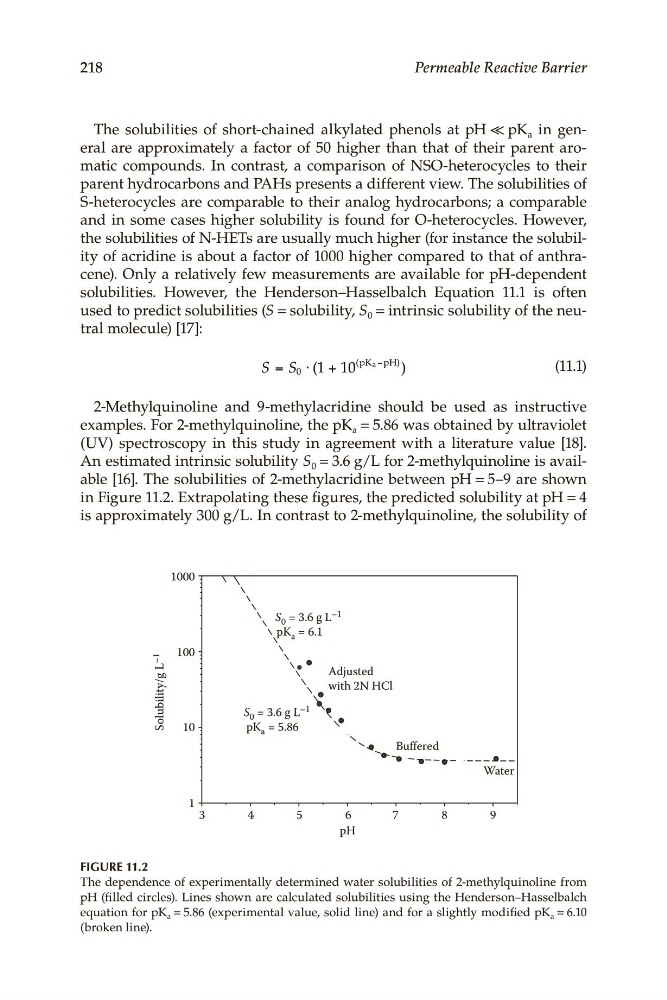
2-Methylquinoline and 9-methylacridine should be used as instructive
examples. For 2-methylquinoline, the pK a = 5.86 was obtained by ultraviolet
(UV) spectroscopy in this study in agreement with a literature value [18].
An estimated intrinsic solubility S 0 = 3.6 g/L for 2-methylquinoline is available [16]. The solubilities of 2-methylacridine between pH = 5–9 are shown
in Figure 11.2. Extrapolating these figures, the predicted solubility at pH = 4
is approximately 300 g/L. In contrast to 2-methylquinoline, the solubility of
1
10
Solubility/g L –1
S 0 = 3.6 g L –1
pK a = 6.1
Adjusted
with 2N HCl
Buffered
Water
S 0 = 3.6 g L –1
pK a = 5.86
100
1000
3
4
5
6
7
8
9
pH
FIGURE 11.2
The dependence of experimentally determined water solubilities of 2-methylquinoline from
pH (filled circles). Lines shown are calculated solubilities using the Henderson–Hasselbalch
equation for pK a = 5.86 (experimental value, solid line) and for a slightly modified pK a = 6.10
(broken line).
S = S 0 ⋅ (1 10
)
(11.1)
+
218
Permeable Reactive Barrier
The solubilities of short-chained alkylated phenols at pH ≪ pK a in general are approximately a factor of 50 higher than that of their parent aromatic compounds. In contrast, a comparison of NSO-heterocycles to their
parent hydrocarbons and PAHs presents a different view. The solubilities of
S-heterocycles are comparable to their analog hydrocarbons; a comparable
and in some cases higher solubility is found for O-heterocycles. However,
the solubilities of N-HETs are usually much higher (for instance the solubility of acridine is about a factor of 1000 higher compared to that of anthracene). Only a relatively few measurements are available for pH-dependent
solubilities. However, the Henderson–Hasselbalch Equation 11.1 is often
used to predict solubilities (S = solubility, S 0 = intrinsic solubility of the neutral molecule) [17]:
2-Methylquinoline and 9-methylacridine should be used as instructive
examples. For 2-methylquinoline, the pK a = 5.86 was obtained by ultraviolet
(UV) spectroscopy in this study in agreement with a literature value [18].
An estimated intrinsic solubility S 0 = 3.6 g/L for 2-methylquinoline is available [16]. The solubilities of 2-methylacridine between pH = 5–9 are shown
in Figure 11.2. Extrapolating these figures, the predicted solubility at pH = 4
is approximately 300 g/L. In contrast to 2-methylquinoline, the solubility of
1
10
Solubility/g L –1
S 0 = 3.6 g L –1
pK a = 6.1
Adjusted
with 2N HCl
Buffered
Water
S 0 = 3.6 g L –1
pK a = 5.86
100
1000
3
4
5
6
7
8
9
pH
FIGURE 11.2
The dependence of experimentally determined water solubilities of 2-methylquinoline from
pH (filled circles). Lines shown are calculated solubilities using the Henderson–Hasselbalch
equation for pK a = 5.86 (experimental value, solid line) and for a slightly modified pK a = 6.10
(broken line).