

io n
Zone A
t
Collector
Zone A
Zone C
Zone B
Distributor
Gas-sampling
port
Container with the
ozone generator
NH 3 -tank
N 2 -tank
Oxygen tank
P7 P8 P9 P10
P11
P12
P13
P3 P4
P5 P6
P1 P2
B1
B2
B3
B4
B5
P14
G3
G4-1
G4-2
G1
G2
G5-1 G5-2
G7
G6-1
G6-2
Groundwater
observation well
Groundwater
observation well
G r o u n d w a t e r
fl o w d ir e c
Input collector
60
Fe
total —concentration in mg/L
O 2 -injection
NH 3 -injection
fence
Gas injection port
50
40
30
20
10
0
0
100
200
300
400
500
600
Time in days
211
Reactive (Oxygen) Gas Barrier and Zone Technologies
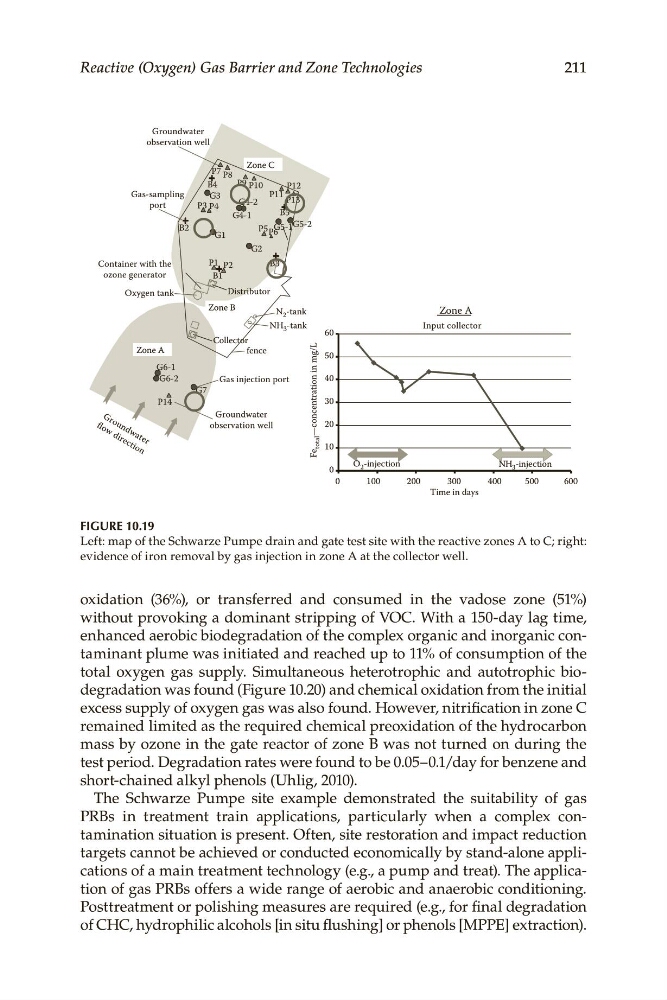
FIGURE 10.19
Left: map of the Schwarze Pumpe drain and gate test site with the reactive zones A to C; right:
evidence of iron removal by gas injection in zone A at the collector well.
oxidation (36%), or transferred and consumed in the vadose zone (51%)
without provoking a dominant stripping of VOC. With a 150-day lag time,
enhanced aerobic biodegradation of the complex organic and inorganic contaminant plume was initiated and reached up to 11% of consumption of the
total oxygen gas supply. Simultaneous heterotrophic and autotrophic biodegradation was found (Figure 10.20) and chemical oxidation from the initial
excess supply of oxygen gas was also found. However, nitrification in zone C
remained limited as the required chemical preoxidation of the hydrocarbon
mass by ozone in the gate reactor of zone B was not turned on during the
test period. Degradation rates were found to be 0.05–0.1/day for benzene and
short-chained alkyl phenols (Uhlig, 2010).
The Schwarze Pumpe site example demonstrated the suitability of gas
PRBs in treatment train applications, particularly when a complex contamination situation is present. Often, site restoration and impact reduction
targets cannot be achieved or conducted economically by stand-alone applications of a main treatment technology (e.g., a pump and treat). The application of gas PRBs offers a wide range of aerobic and anaerobic conditioning.
Posttreatment or polishing measures are required (e.g., for final degradation
of CHC, hydrophilic alcohols [in situ flushing] or phenols [MPPE] extraction).
Zone A
t
Collector
Zone A
Zone C
Zone B
Distributor
Gas-sampling
port
Container with the
ozone generator
NH 3 -tank
N 2 -tank
Oxygen tank
P7 P8 P9 P10
P11
P12
P13
P3 P4
P5 P6
P1 P2
B1
B2
B3
B4
B5
P14
G3
G4-1
G4-2
G1
G2
G5-1 G5-2
G7
G6-1
G6-2
Groundwater
observation well
Groundwater
observation well
G r o u n d w a t e r
fl o w d ir e c
Input collector
60
Fe
total —concentration in mg/L
O 2 -injection
NH 3 -injection
fence
Gas injection port
50
40
30
20
10
0
0
100
200
300
400
500
600
Time in days
211
Reactive (Oxygen) Gas Barrier and Zone Technologies
FIGURE 10.19
Left: map of the Schwarze Pumpe drain and gate test site with the reactive zones A to C; right:
evidence of iron removal by gas injection in zone A at the collector well.
oxidation (36%), or transferred and consumed in the vadose zone (51%)
without provoking a dominant stripping of VOC. With a 150-day lag time,
enhanced aerobic biodegradation of the complex organic and inorganic contaminant plume was initiated and reached up to 11% of consumption of the
total oxygen gas supply. Simultaneous heterotrophic and autotrophic biodegradation was found (Figure 10.20) and chemical oxidation from the initial
excess supply of oxygen gas was also found. However, nitrification in zone C
remained limited as the required chemical preoxidation of the hydrocarbon
mass by ozone in the gate reactor of zone B was not turned on during the
test period. Degradation rates were found to be 0.05–0.1/day for benzene and
short-chained alkyl phenols (Uhlig, 2010).
The Schwarze Pumpe site example demonstrated the suitability of gas
PRBs in treatment train applications, particularly when a complex contamination situation is present. Often, site restoration and impact reduction
targets cannot be achieved or conducted economically by stand-alone applications of a main treatment technology (e.g., a pump and treat). The application of gas PRBs offers a wide range of aerobic and anaerobic conditioning.
Posttreatment or polishing measures are required (e.g., for final degradation
of CHC, hydrophilic alcohols [in situ flushing] or phenols [MPPE] extraction).