

198
Permeable Reactive Barrier
Pre-oxidation balance (initial gradual operation)
Aerobic zone control (regular operation)
M O2(input) = Σ M O2(transform) + Σ M O2(losses) + M O2(trapp)
Σ M O2(transform) = M O2(sediment_gaszone) + M O2(sediment_downstream) +
M O2(aq_dissolved) + M O2(aq_contaminants)
Low permeable aquifer zone
Injection lance
Soil surface
High permeable aquifer zone
Observation point
ROI
Σ M O2(losses) = M O2(horizontal) + M O2(degass_aquifer) + M O2(degass_well)
M O2(trapp) = Σ M O2_g(residual) + Σ M O2_g(mobile) + Σ M O2_g(capt)
M O2(inject) = M O2_g(aq_contaminants) + M O2_g(aq_dissolved)
Impervious layer
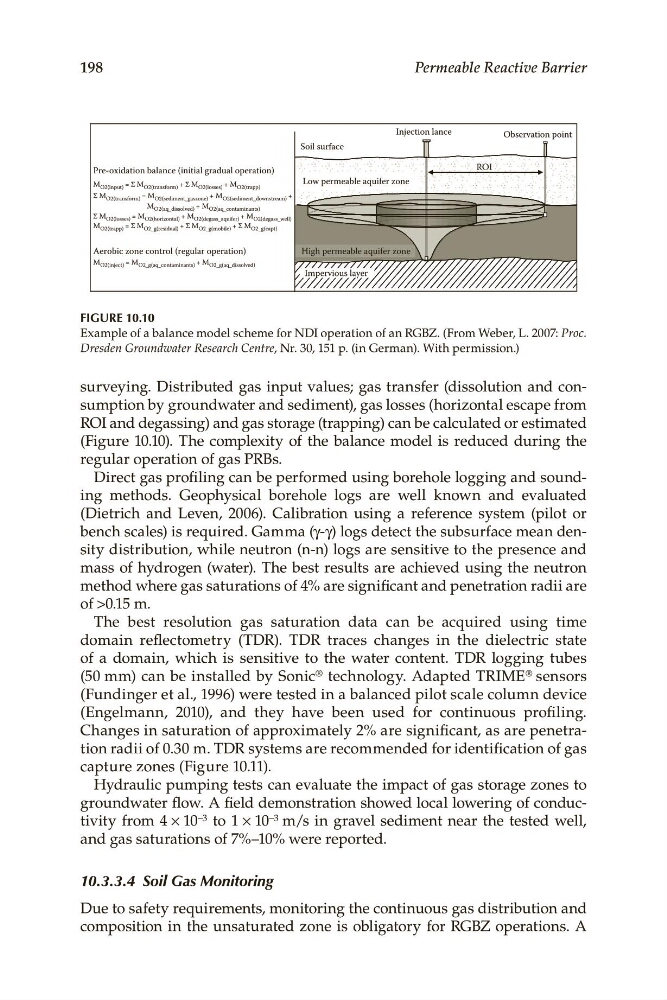
FIGURE 10.10
Example of a balance model scheme for NDI operation of an RGBZ. (From Weber, L. 2007: Proc.
Dresden Groundwater Research Centre, Nr. 30, 151 p. (in German). With permission.)
surveying. Distributed gas input values; gas transfer (dissolution and consumption by groundwater and sediment), gas losses (horizontal escape from
ROI and degassing) and gas storage (trapping) can be calculated or estimated
(Figure 10.10). The complexity of the balance model is reduced during the
regular operation of gas PRBs.
Direct gas profiling can be performed using borehole logging and sounding methods. Geophysical borehole logs are well known and evaluated
(Dietrich and Leven, 2006). Calibration using a reference system (pilot or
bench scales) is required. Gamma (γ-γ) logs detect the subsurface mean density distribution, while neutron (n-n) logs are sensitive to the presence and
mass of hydrogen (water). The best results are achieved using the neutron
method where gas saturations of 4% are significant and penetration radii are
of >0.15 m.
The best resolution gas saturation data can be acquired using time
domain reflectometry (TDR). TDR traces changes in the dielectric state
of a domain, which is sensitive to the water content. TDR logging tubes
(50 mm) can be installed by Sonic ® technology. Adapted TRIME • sensors
(Fundinger et al., 1996) were tested in a balanced pilot scale column device
(Engelmann, 2010), and they have been used for continuous profiling.
Changes in saturation of approximately 2% are significant, as are penetration radii of 0.30 m. TDR systems are recommended for identification of gas
capture zones (Figure 10.11).
Hydraulic pumping tests can evaluate the impact of gas storage zones to
groundwater flow. A field demonstration showed local lowering of conductivity from 4 × 10 −3 to 1 × 10 −3 m/s in gravel sediment near the tested well,
and gas saturations of 7%–10% were reported.
10.3.3.4 Soil Gas Monitoring
Due to safety requirements, monitoring the continuous gas distribution and
composition in the unsaturated zone is obligatory for RGBZ operations. A