

(a)
Gas injection
Injection lance
Upstream
Gas-PRB
Downstream
Aerobic
Gas propagation
Anaerobic
transport zone
and dissolution
transport zone
In situ
sediment reactor
for conditioning
i.e., iron removal
Collector + reactor
Hydraulic
barrier
Distributor + reactor
In situ
sediment reactor
for posttreatment
i.e., oxygen wall
(b) Gas injection
Supply with reactants
removal of reaction products
Surface
Gas injection
Reactor
Pump
179
Reactive (Oxygen) Gas Barrier and Zone Technologies
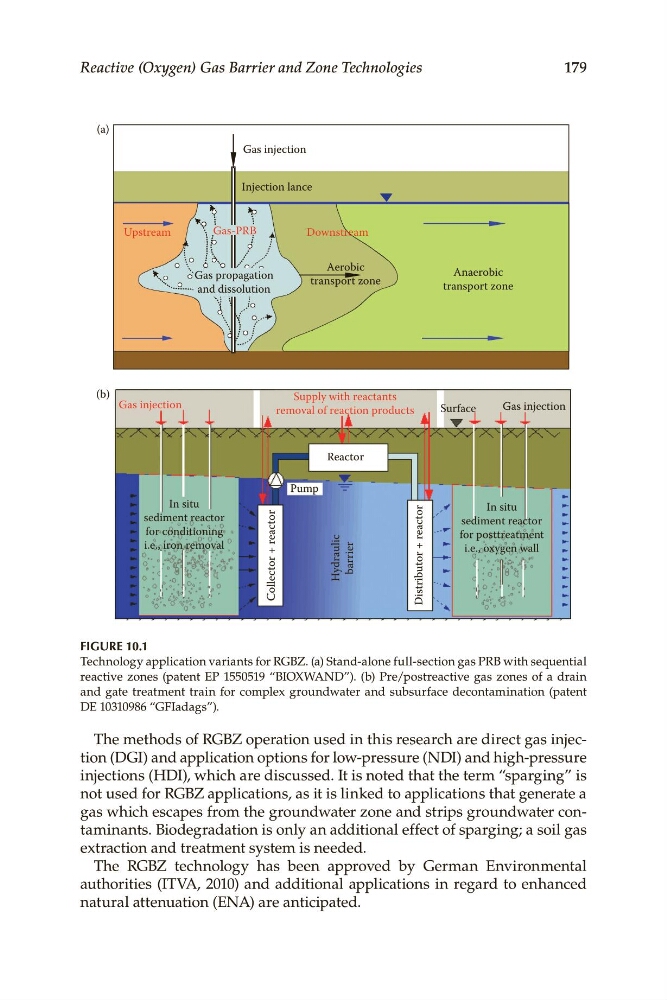
FIGURE 10.1
Technology application variants for RGBZ. (a) Stand-alone full-section gas PRB with sequential
reactive zones (patent EP 1550519 “BIOXWAND”). (b) Pre/postreactive gas zones of a drain
and gate treatment train for complex groundwater and subsurface decontamination (patent
DE 10310986 “GFIadags”).
The methods of RGBZ operation used in this research are direct gas injection (DGI) and application options for low-pressure (NDI) and high-pressure
injections (HDI), which are discussed. It is noted that the term “sparging” is
not used for RGBZ applications, as it is linked to applications that generate a
gas which escapes from the groundwater zone and strips groundwater contaminants. Biodegradation is only an additional effect of sparging; a soil gas
extraction and treatment system is needed.
The RGBZ technology has been approved by German Environmental
authorities (ITVA, 2010) and additional applications in regard to enhanced
natural attenuation (ENA) are anticipated.
Gas injection
Injection lance
Upstream
Gas-PRB
Downstream
Aerobic
Gas propagation
Anaerobic
transport zone
and dissolution
transport zone
In situ
sediment reactor
for conditioning
i.e., iron removal
Collector + reactor
Hydraulic
barrier
Distributor + reactor
In situ
sediment reactor
for posttreatment
i.e., oxygen wall
(b) Gas injection
Supply with reactants
removal of reaction products
Surface
Gas injection
Reactor
Pump
179
Reactive (Oxygen) Gas Barrier and Zone Technologies
FIGURE 10.1
Technology application variants for RGBZ. (a) Stand-alone full-section gas PRB with sequential
reactive zones (patent EP 1550519 “BIOXWAND”). (b) Pre/postreactive gas zones of a drain
and gate treatment train for complex groundwater and subsurface decontamination (patent
DE 10310986 “GFIadags”).
The methods of RGBZ operation used in this research are direct gas injection (DGI) and application options for low-pressure (NDI) and high-pressure
injections (HDI), which are discussed. It is noted that the term “sparging” is
not used for RGBZ applications, as it is linked to applications that generate a
gas which escapes from the groundwater zone and strips groundwater contaminants. Biodegradation is only an additional effect of sparging; a soil gas
extraction and treatment system is needed.
The RGBZ technology has been approved by German Environmental
authorities (ITVA, 2010) and additional applications in regard to enhanced
natural attenuation (ENA) are anticipated.