

165
Effective Cleanup of Groundwater Contaminated with Radionuclides
log K
d (l/kg)
7
6
5
4
3
2
1
0
–1
–2 2
3
4
5
6
7
8
9
10 11
pH
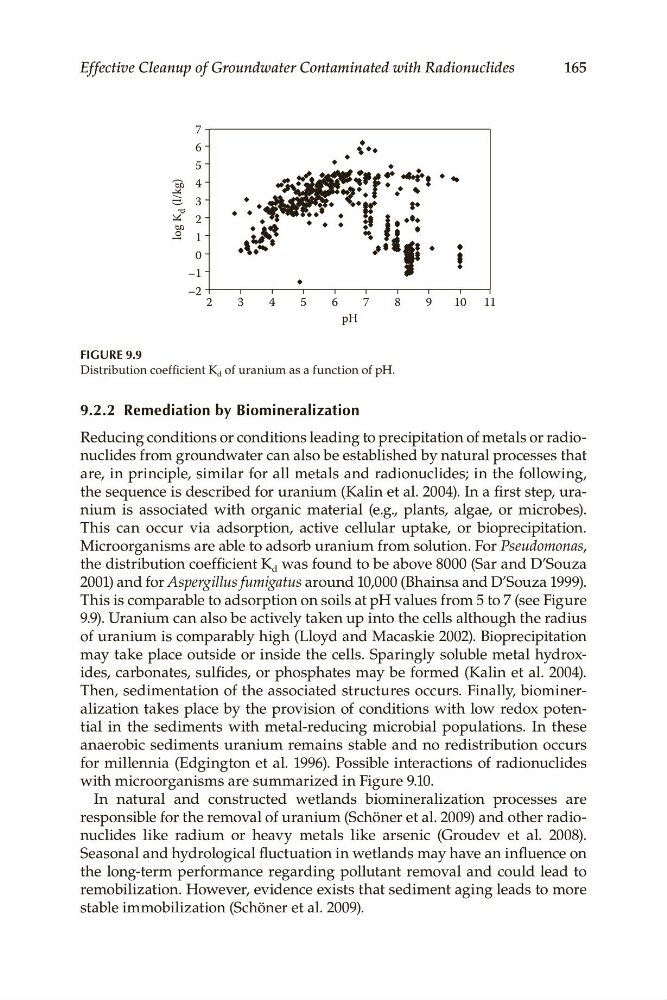
FIGURE 9.9
Distribution coefficient K d of uranium as a function of pH.
9.2.2 Remediation by Biomineralization
Reducing conditions or conditions leading to precipitation of metals or radionuclides from groundwater can also be established by natural processes that
are, in principle, similar for all metals and radionuclides; in the following,
the sequence is described for uranium (Kalin et al. 2004). In a first step, uranium is associated with organic material (e.g., plants, algae, or microbes).
This can occur via adsorption, active cellular uptake, or bioprecipitation.
Microorganisms are able to adsorb uranium from solution. For Pseudomonas,
the distribution coefficient K d was found to be above 8000 (Sar and D’Souza
2001) and for Aspergillus fumigatus around 10,000 (Bhainsa and D’Souza 1999).
This is comparable to adsorption on soils at pH values from 5 to 7 (see Figure
9.9). Uranium can also be actively taken up into the cells although the radius
of uranium is comparably high (Lloyd and Macaskie 2002). Bioprecipitation
may take place outside or inside the cells. Sparingly soluble metal hydroxides, carbonates, sulfides, or phosphates may be formed (Kalin et al. 2004).
Then, sedimentation of the associated structures occurs. Finally, biomineralization takes place by the provision of conditions with low redox potential in the sediments with metal-reducing microbial populations. In these
anaerobic sediments uranium remains stable and no redistribution occurs
for millennia (Edgington et al. 1996). Possible interactions of radionuclides
with microorganisms are summarized in Figure 9.10.
In natural and constructed wetlands biomineralization processes are
responsible for the removal of uranium (Schöner et al. 2009) and other radionuclides like radium or heavy metals like arsenic (Groudev et al. 2008).
Seasonal and hydrological fluctuation in wetlands may have an influence on
the long-term performance regarding pollutant removal and could lead to
remobilization. However, evidence exists that sediment aging leads to more
stable immobilization (Schöner et al. 2009).
Effective Cleanup of Groundwater Contaminated with Radionuclides
log K
d (l/kg)
7
6
5
4
3
2
1
0
–1
–2 2
3
4
5
6
7
8
9
10 11
pH
FIGURE 9.9
Distribution coefficient K d of uranium as a function of pH.
9.2.2 Remediation by Biomineralization
Reducing conditions or conditions leading to precipitation of metals or radionuclides from groundwater can also be established by natural processes that
are, in principle, similar for all metals and radionuclides; in the following,
the sequence is described for uranium (Kalin et al. 2004). In a first step, uranium is associated with organic material (e.g., plants, algae, or microbes).
This can occur via adsorption, active cellular uptake, or bioprecipitation.
Microorganisms are able to adsorb uranium from solution. For Pseudomonas,
the distribution coefficient K d was found to be above 8000 (Sar and D’Souza
2001) and for Aspergillus fumigatus around 10,000 (Bhainsa and D’Souza 1999).
This is comparable to adsorption on soils at pH values from 5 to 7 (see Figure
9.9). Uranium can also be actively taken up into the cells although the radius
of uranium is comparably high (Lloyd and Macaskie 2002). Bioprecipitation
may take place outside or inside the cells. Sparingly soluble metal hydroxides, carbonates, sulfides, or phosphates may be formed (Kalin et al. 2004).
Then, sedimentation of the associated structures occurs. Finally, biomineralization takes place by the provision of conditions with low redox potential in the sediments with metal-reducing microbial populations. In these
anaerobic sediments uranium remains stable and no redistribution occurs
for millennia (Edgington et al. 1996). Possible interactions of radionuclides
with microorganisms are summarized in Figure 9.10.
In natural and constructed wetlands biomineralization processes are
responsible for the removal of uranium (Schöner et al. 2009) and other radionuclides like radium or heavy metals like arsenic (Groudev et al. 2008).
Seasonal and hydrological fluctuation in wetlands may have an influence on
the long-term performance regarding pollutant removal and could lead to
remobilization. However, evidence exists that sediment aging leads to more
stable immobilization (Schöner et al. 2009).