

161
Effective Cleanup of Groundwater Contaminated with Radionuclides
N
1 Coarse iron and sand
2 Iron and sand
3 Sand
Monitoring wells
Geosynthetic clay
liner (Bentofix)
4
5
6
7
8
3
2
1
3
4
4
5
8
6
5
7
Clay
Aquifers
Aquitard
Bedrock
Soil
S
Geomembrane (HDPE)
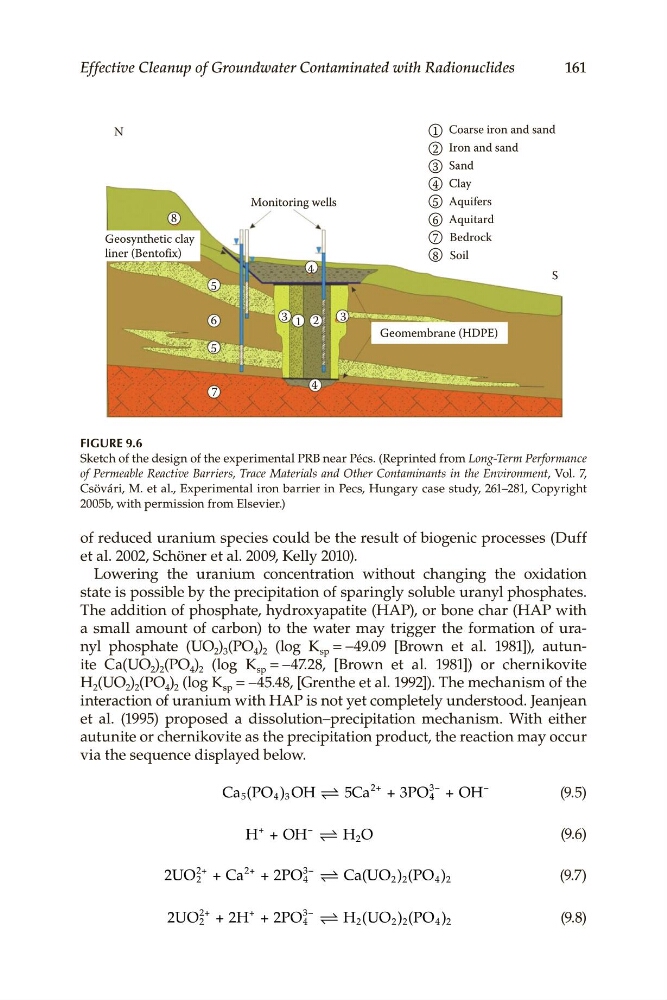
FIGURE 9.6
Sketch of the design of the experimental PRB near Pécs. (Reprinted from Long-Term Performance
of Permeable Reactive Barriers, Trace Materials and Other Contaminants in the Environment, Vol. 7,
Csövári, M. et al., Experimental iron barrier in Pecs, Hungary case study, 261–281, Copyright
2005b, with permission from Elsevier.)
of reduced uranium species could be the result of biogenic processes (Duff
et al. 2002, Schöner et al. 2009, Kelly 2010).
Lowering the uranium concentration without changing the oxidation
state is possible by the precipitation of sparingly soluble uranyl phosphates.
The addition of phosphate, hydroxyapatite (HAP), or bone char (HAP with
a small amount of carbon) to the water may trigger the formation of uranyl phosphate (UO 2 ) 3 (PO 4 ) 2 (log K sp = −49.09 [Brown et al. 1981]), autunite Ca(UO 2 ) 2 (PO 4 ) 2 (log K sp = −47.28, [Brown et al. 1981]) or chernikovite
H 2 (UO 2 ) 2 (PO 4 ) 2 (log K sp = −45.48, [Grenthe et al. 1992]). The mechanism of the
interaction of uranium with HAP is not yet completely understood. Jeanjean
et al. (1995) proposed a dissolution–precipitation mechanism. With either
autunite or chernikovite as the precipitation product, the reaction may occur
via the sequence displayed below.
Ca 5 (PO 4 ) 3 OH 5Ca
2+ + 3PO
3−
4 + OH
−
(9.5)
H
+ + OH
− H 2 O
(9.6)
2UO
2+
2 + Ca
2+ + 2PO
3−
4 Ca(UO )
2 2 (PO 4 2
)
(9.7)
2UO
2+
H
+
2 + 2
+ 2PO
3− H UO ) (PO )
(
4
2 (
2 2
4 2
9.8)
Effective Cleanup of Groundwater Contaminated with Radionuclides
N
1 Coarse iron and sand
2 Iron and sand
3 Sand
Monitoring wells
Geosynthetic clay
liner (Bentofix)
4
5
6
7
8
3
2
1
3
4
4
5
8
6
5
7
Clay
Aquifers
Aquitard
Bedrock
Soil
S
Geomembrane (HDPE)
FIGURE 9.6
Sketch of the design of the experimental PRB near Pécs. (Reprinted from Long-Term Performance
of Permeable Reactive Barriers, Trace Materials and Other Contaminants in the Environment, Vol. 7,
Csövári, M. et al., Experimental iron barrier in Pecs, Hungary case study, 261–281, Copyright
2005b, with permission from Elsevier.)
of reduced uranium species could be the result of biogenic processes (Duff
et al. 2002, Schöner et al. 2009, Kelly 2010).
Lowering the uranium concentration without changing the oxidation
state is possible by the precipitation of sparingly soluble uranyl phosphates.
The addition of phosphate, hydroxyapatite (HAP), or bone char (HAP with
a small amount of carbon) to the water may trigger the formation of uranyl phosphate (UO 2 ) 3 (PO 4 ) 2 (log K sp = −49.09 [Brown et al. 1981]), autunite Ca(UO 2 ) 2 (PO 4 ) 2 (log K sp = −47.28, [Brown et al. 1981]) or chernikovite
H 2 (UO 2 ) 2 (PO 4 ) 2 (log K sp = −45.48, [Grenthe et al. 1992]). The mechanism of the
interaction of uranium with HAP is not yet completely understood. Jeanjean
et al. (1995) proposed a dissolution–precipitation mechanism. With either
autunite or chernikovite as the precipitation product, the reaction may occur
via the sequence displayed below.
Ca 5 (PO 4 ) 3 OH 5Ca
2+ + 3PO
3−
4 + OH
−
(9.5)
H
+ + OH
− H 2 O
(9.6)
2UO
2+
2 + Ca
2+ + 2PO
3−
4 Ca(UO )
2 2 (PO 4 2
)
(9.7)
2UO
2+
H
+
2 + 2
+ 2PO
3− H UO ) (PO )
(
4
2 (
2 2
4 2
9.8)