

89
14.000
12.000
10.000
8.000
6.000
4.000
I/area (mA/cm 2
)
2.000
–2.000
–4.000
–1400.0
0.000
Fe (pure)
Responge
Pt
–1000.0
–600.0
–200.0
E vs. SCE (mV)
200.0
600.0
1000.0
Impact of Trace Elements and Impurities in Technical ZVI Brands
5.2 Results and Discussions
In contrast to numerous other technical ZVI and NZVI brands, carbonyl
micro-ZVI basically shows a low reactivity regarding the reductive dehalogenation of perchloroethene (PCE) in groundwater. This can be readily
understood because it consists highly pure iron, and it is well known to be
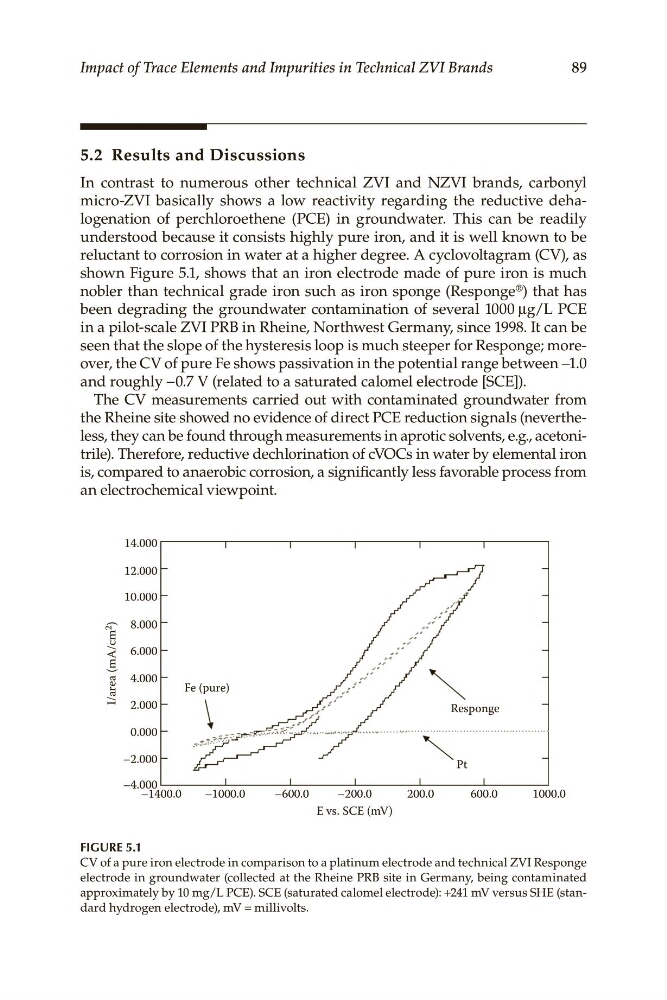
reluctant to corrosion in water at a higher degree. A cyclovoltagram (CV), as
shown Figure 5.1, shows that an iron electrode made of pure iron is much
nobler than technical grade iron such as iron sponge (Responge ® ) that has
been degrading the groundwater contamination of several 1000 μg/L PCE
in a pilot-scale ZVI PRB in Rheine, Northwest Germany, since 1998. It can be
seen that the slope of the hysteresis loop is much steeper for Responge; moreover, the CV of pure Fe shows passivation in the potential range between −1.0
and roughly −0.7 V ( related to a saturated calomel electrode [SCE]).
The CV measurements carried out with contaminated groundwater from
the Rheine site showed no evidence of direct PCE reduction signals (nevertheless, they can be found through measurements in aprotic solvents, e.g., acetonitrile). Therefore, reductive dechlorination of cVOCs in water by elemental iron
is, compared to anaerobic corrosion, a significantly less favorable process from
an electrochemical viewpoint.
FIGURE 5.1
CV of a pure iron electrode in comparison to a platinum electrode and technical ZVI Responge
electrode in groundwater (collected at the Rheine PRB site in Germany, being contaminated
approximately by 10 mg/L PCE). SCE (saturated calomel electrode): +241 mV versus SHE (standard hydrogen electrode), mV = millivolts.
14.000
12.000
10.000
8.000
6.000
4.000
I/area (mA/cm 2
)
2.000
–2.000
–4.000
–1400.0
0.000
Fe (pure)
Responge
Pt
–1000.0
–600.0
–200.0
E vs. SCE (mV)
200.0
600.0
1000.0
Impact of Trace Elements and Impurities in Technical ZVI Brands
5.2 Results and Discussions
In contrast to numerous other technical ZVI and NZVI brands, carbonyl
micro-ZVI basically shows a low reactivity regarding the reductive dehalogenation of perchloroethene (PCE) in groundwater. This can be readily
understood because it consists highly pure iron, and it is well known to be
reluctant to corrosion in water at a higher degree. A cyclovoltagram (CV), as
shown Figure 5.1, shows that an iron electrode made of pure iron is much
nobler than technical grade iron such as iron sponge (Responge ® ) that has
been degrading the groundwater contamination of several 1000 μg/L PCE
in a pilot-scale ZVI PRB in Rheine, Northwest Germany, since 1998. It can be
seen that the slope of the hysteresis loop is much steeper for Responge; moreover, the CV of pure Fe shows passivation in the potential range between −1.0
and roughly −0.7 V ( related to a saturated calomel electrode [SCE]).
The CV measurements carried out with contaminated groundwater from
the Rheine site showed no evidence of direct PCE reduction signals (nevertheless, they can be found through measurements in aprotic solvents, e.g., acetonitrile). Therefore, reductive dechlorination of cVOCs in water by elemental iron
is, compared to anaerobic corrosion, a significantly less favorable process from
an electrochemical viewpoint.
FIGURE 5.1
CV of a pure iron electrode in comparison to a platinum electrode and technical ZVI Responge
electrode in groundwater (collected at the Rheine PRB site in Germany, being contaminated
approximately by 10 mg/L PCE). SCE (saturated calomel electrode): +241 mV versus SHE (standard hydrogen electrode), mV = millivolts.