

58 M. M. Bugge et al.
interactions could have weakening effects. These mechanisms also have
different functions in the different stages of path development. Only in the
last stages will the process get locked in and become path- dependent (Sydow,
Schreyögg & Koch, 2009). Moreover, non- predictability and coexistence of
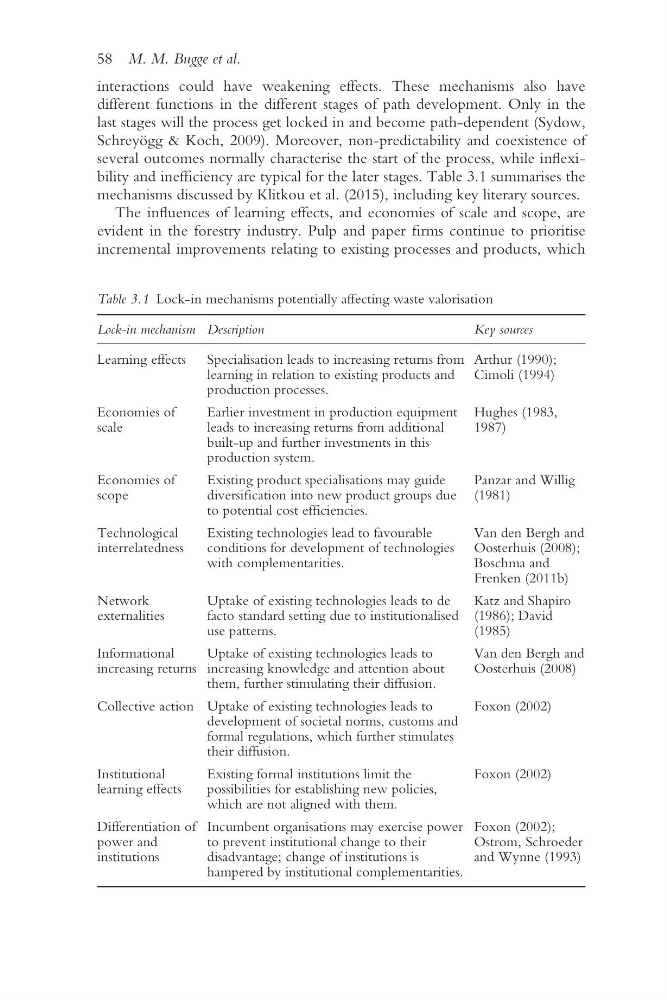
several outcomes normally characterise the start of the process, while inflexibility and inefficiency are typical for the later stages. Table 3.1 summarises the
mechanisms discussed by Klitkou et al. (2015), including key literary sources.
The influences of learning effects, and economies of scale and scope, are
evident in the forestry industry. Pulp and paper firms continue to prioritise
incremental improvements relating to existing processes and products, which
Table 3.1 Lock-in mechanisms potentially affecting waste valorisation
Lock-in mechanism Description
Key sources
Learning effects Specialisation leads to increasing returns from
learning in relation to existing products and
production processes.
Arthur (1990);
Cimoli (1994)
Economies of
scale
Earlier investment in production equipment
leads to increasing returns from additional
built-up and further investments in this
production system.
Hughes (1983,
1987)
Economies of
scope
Existing product specialisations may guide
diversification into new product groups due
to potential cost efficiencies.
Panzar and Willig
(1981)
Technological
interrelatedness
Existing technologies lead to favourable
conditions for development of technologies
with complementarities.
Van den Bergh and
Oosterhuis (2008);
Boschma and
Frenken (2011b)
Network
externalities
Uptake of existing technologies leads to de
facto standard setting due to institutionalised
use patterns.
Katz and Shapiro
(1986); David
(1985)
Informational
increasing returns
Uptake of existing technologies leads to
increasing knowledge and attention about
them, further stimulating their diffusion.
Van den Bergh and
Oosterhuis (2008)
Collective action Uptake of existing technologies leads to
development of societal norms, customs and
formal regulations, which further stimulates
their diffusion.
Foxon (2002)
Institutional
learning effects
Existing formal institutions limit the
possibilities for establishing new policies,
which are not aligned with them.
Foxon (2002)
Differentiation of
power and
institutions
Incumbent organisations may exercise power
to prevent institutional change to their
disadvantage; change of institutions is
hampered by institutional complementarities.
Foxon (2002);
Ostrom, Schroeder
and Wynne (1993)
interactions could have weakening effects. These mechanisms also have
different functions in the different stages of path development. Only in the
last stages will the process get locked in and become path- dependent (Sydow,
Schreyögg & Koch, 2009). Moreover, non- predictability and coexistence of
several outcomes normally characterise the start of the process, while inflexibility and inefficiency are typical for the later stages. Table 3.1 summarises the
mechanisms discussed by Klitkou et al. (2015), including key literary sources.
The influences of learning effects, and economies of scale and scope, are
evident in the forestry industry. Pulp and paper firms continue to prioritise
incremental improvements relating to existing processes and products, which
Table 3.1 Lock-in mechanisms potentially affecting waste valorisation
Lock-in mechanism Description
Key sources
Learning effects Specialisation leads to increasing returns from
learning in relation to existing products and
production processes.
Arthur (1990);
Cimoli (1994)
Economies of
scale
Earlier investment in production equipment
leads to increasing returns from additional
built-up and further investments in this
production system.
Hughes (1983,
1987)
Economies of
scope
Existing product specialisations may guide
diversification into new product groups due
to potential cost efficiencies.
Panzar and Willig
(1981)
Technological
interrelatedness
Existing technologies lead to favourable
conditions for development of technologies
with complementarities.
Van den Bergh and
Oosterhuis (2008);
Boschma and
Frenken (2011b)
Network
externalities
Uptake of existing technologies leads to de
facto standard setting due to institutionalised
use patterns.
Katz and Shapiro
(1986); David
(1985)
Informational
increasing returns
Uptake of existing technologies leads to
increasing knowledge and attention about
them, further stimulating their diffusion.
Van den Bergh and
Oosterhuis (2008)
Collective action Uptake of existing technologies leads to
development of societal norms, customs and
formal regulations, which further stimulates
their diffusion.
Foxon (2002)
Institutional
learning effects
Existing formal institutions limit the
possibilities for establishing new policies,
which are not aligned with them.
Foxon (2002)
Differentiation of
power and
institutions
Incumbent organisations may exercise power
to prevent institutional change to their
disadvantage; change of institutions is
hampered by institutional complementarities.
Foxon (2002);
Ostrom, Schroeder
and Wynne (1993)