

54 M. M. Bugge et al.
In regard to the point made earlier that the bioeconomy consists of diverging perspectives, it is here interesting to note that waste plays various roles
and is assigned different values at each level of the waste pyramid depending
on the industry and country in focus.
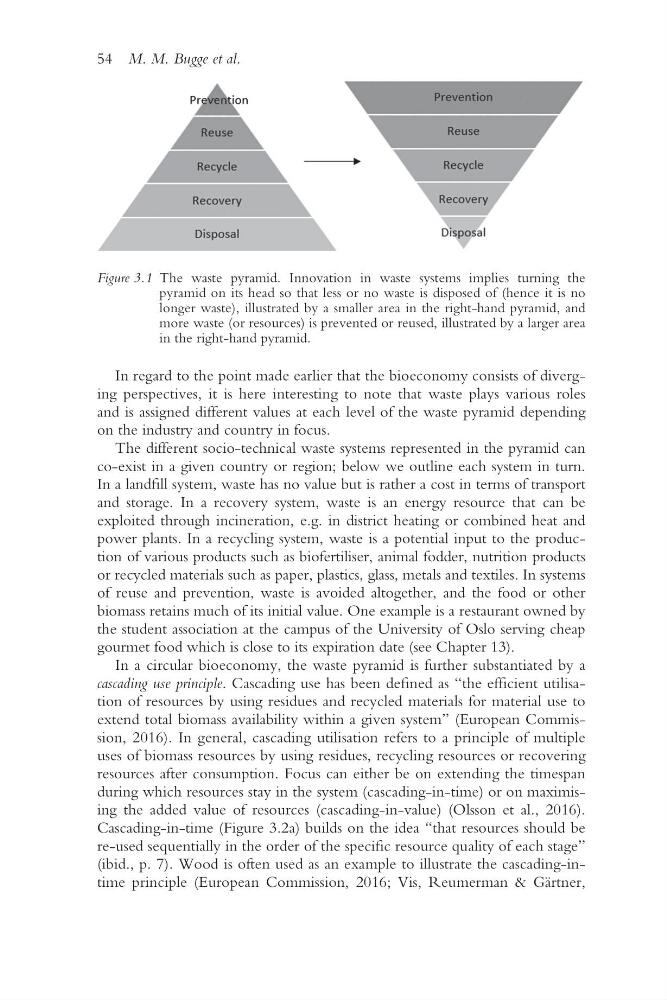
The different socio- technical waste systems represented in the pyramid can
co- exist in a given country or region; below we outline each system in turn.
In a landfill system, waste has no value but is rather a cost in terms of transport
and storage. In a recovery system, waste is an energy resource that can be
exploited through incineration, e.g. in district heating or combined heat and
power plants. In a recycling system, waste is a potential input to the production of various products such as biofertiliser, animal fodder, nutrition products
or recycled materials such as paper, plastics, glass, metals and textiles. In systems
of reuse and prevention, waste is avoided altogether, and the food or other
biomass retains much of its initial value. One example is a restaurant owned by
the student association at the campus of the University of Oslo serving cheap
gourmet food which is close to its expiration date (see Chapter 13).
In a circular bioeconomy, the waste pyramid is further substantiated by a
cascading use principle. Cascading use has been defined as “the efficient utilisation of resources by using residues and recycled materials for material use to
extend total biomass availability within a given system” (European Commission, 2016). In general, cascading utilisation refers to a principle of multiple
uses of biomass resources by using residues, recycling resources or recovering
resources after consumption. Focus can either be on extending the timespan
during which resources stay in the system (cascading- in-time) or on maximising the added value of resources (cascading- in-value) (Olsson et al., 2016).
Cascading- in-time (Figure 3.2a) builds on the idea “that resources should be
re- used sequentially in the order of the specific resource quality of each stage”
(ibid., p. 7). Wood is often used as an example to illustrate the cascading- intime principle (European Commission, 2016; Vis, Reumerman & Gärtner,
Figure 3.1 The waste pyramid. Innovation in waste systems implies turning the
pyramid on its head so that less or no waste is disposed of (hence it is no
longer waste), illustrated by a smaller area in the right-hand pyramid, and
more waste (or resources) is prevented or reused, illustrated by a larger area
in the right-hand pyramid.
In regard to the point made earlier that the bioeconomy consists of diverging perspectives, it is here interesting to note that waste plays various roles
and is assigned different values at each level of the waste pyramid depending
on the industry and country in focus.
The different socio- technical waste systems represented in the pyramid can
co- exist in a given country or region; below we outline each system in turn.
In a landfill system, waste has no value but is rather a cost in terms of transport
and storage. In a recovery system, waste is an energy resource that can be
exploited through incineration, e.g. in district heating or combined heat and
power plants. In a recycling system, waste is a potential input to the production of various products such as biofertiliser, animal fodder, nutrition products
or recycled materials such as paper, plastics, glass, metals and textiles. In systems
of reuse and prevention, waste is avoided altogether, and the food or other
biomass retains much of its initial value. One example is a restaurant owned by
the student association at the campus of the University of Oslo serving cheap
gourmet food which is close to its expiration date (see Chapter 13).
In a circular bioeconomy, the waste pyramid is further substantiated by a
cascading use principle. Cascading use has been defined as “the efficient utilisation of resources by using residues and recycled materials for material use to
extend total biomass availability within a given system” (European Commission, 2016). In general, cascading utilisation refers to a principle of multiple
uses of biomass resources by using residues, recycling resources or recovering
resources after consumption. Focus can either be on extending the timespan
during which resources stay in the system (cascading- in-time) or on maximising the added value of resources (cascading- in-value) (Olsson et al., 2016).
Cascading- in-time (Figure 3.2a) builds on the idea “that resources should be
re- used sequentially in the order of the specific resource quality of each stage”
(ibid., p. 7). Wood is often used as an example to illustrate the cascading- intime principle (European Commission, 2016; Vis, Reumerman & Gärtner,
Figure 3.1 The waste pyramid. Innovation in waste systems implies turning the
pyramid on its head so that less or no waste is disposed of (hence it is no
longer waste), illustrated by a smaller area in the right-hand pyramid, and
more waste (or resources) is prevented or reused, illustrated by a larger area
in the right-hand pyramid.