

Life cycle assessment 285
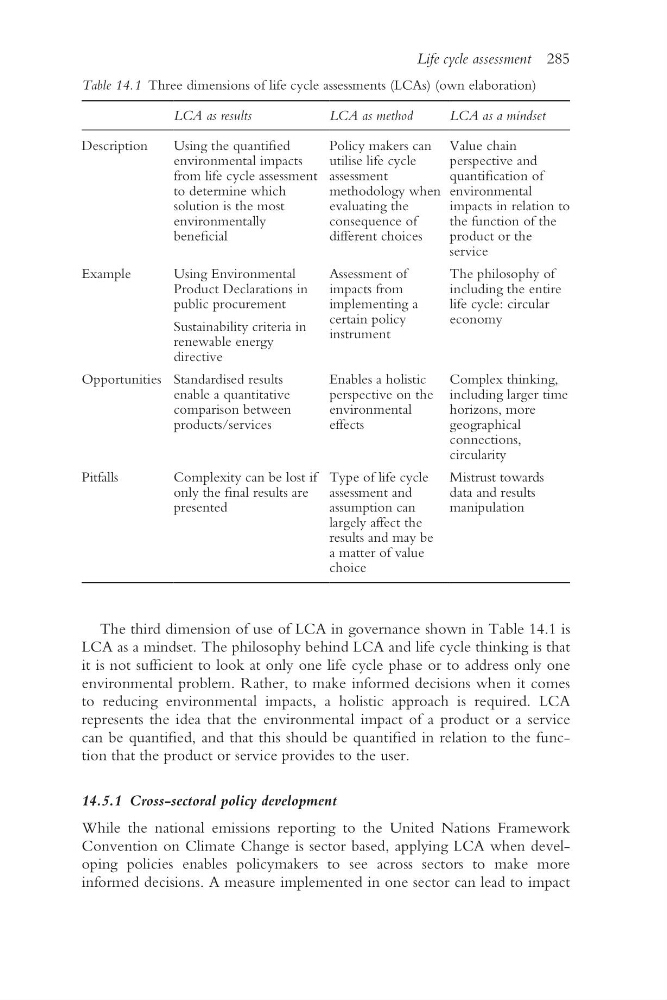
The third dimension of use of LCA in governance shown in Table 14.1 is
LCA as a mindset. The philosophy behind LCA and life cycle thinking is that
it is not sufficient to look at only one life cycle phase or to address only one
environmental problem. Rather, to make informed decisions when it comes
to reducing environmental impacts, a holistic approach is required. LCA
represents the idea that the environmental impact of a product or a service
can be quantified, and that this should be quantified in relation to the function that the product or service provides to the user.
14.5.1 Cross- sectoral policy development
While the national emissions reporting to the United Nations Framework
Convention on Climate Change is sector based, applying LCA when developing policies enables policymakers to see across sectors to make more
informed decisions. A measure implemented in one sector can lead to impact
Table 14.1 Three dimensions of life cycle assessments (LCAs) (own elaboration)
LCA as results
LCA as method
LCA as a mindset
Description
Using the quantified
environmental impacts
from life cycle assessment
to determine which
solution is the most
environmentally
beneficial
Policy makers can
utilise life cycle
assessment
methodology when
evaluating the
consequence of
different choices
Value chain
perspective and
quantification of
environmental
impacts in relation to
the function of the
product or the
service
Example
Using Environmental
Product Declarations in
public procurement
Sustainability criteria in
renewable energy
directive
Assessment of
impacts from
implementing a
certain policy
instrument
The philosophy of
including the entire
life cycle: circular
economy
Opportunities Standardised results
enable a quantitative
comparison between
products/services
Enables a holistic
perspective on the
environmental
effects
Complex thinking,
including larger time
horizons, more
geographical
connections,
circularity
Pitfalls
Complexity can be lost if
only the final results are
presented
Type of life cycle
assessment and
assumption can
largely affect the
results and may be
a matter of value
choice
Mistrust towards
data and results
manipulation
The third dimension of use of LCA in governance shown in Table 14.1 is
LCA as a mindset. The philosophy behind LCA and life cycle thinking is that
it is not sufficient to look at only one life cycle phase or to address only one
environmental problem. Rather, to make informed decisions when it comes
to reducing environmental impacts, a holistic approach is required. LCA
represents the idea that the environmental impact of a product or a service
can be quantified, and that this should be quantified in relation to the function that the product or service provides to the user.
14.5.1 Cross- sectoral policy development
While the national emissions reporting to the United Nations Framework
Convention on Climate Change is sector based, applying LCA when developing policies enables policymakers to see across sectors to make more
informed decisions. A measure implemented in one sector can lead to impact
Table 14.1 Three dimensions of life cycle assessments (LCAs) (own elaboration)
LCA as results
LCA as method
LCA as a mindset
Description
Using the quantified
environmental impacts
from life cycle assessment
to determine which
solution is the most
environmentally
beneficial
Policy makers can
utilise life cycle
assessment
methodology when
evaluating the
consequence of
different choices
Value chain
perspective and
quantification of
environmental
impacts in relation to
the function of the
product or the
service
Example
Using Environmental
Product Declarations in
public procurement
Sustainability criteria in
renewable energy
directive
Assessment of
impacts from
implementing a
certain policy
instrument
The philosophy of
including the entire
life cycle: circular
economy
Opportunities Standardised results
enable a quantitative
comparison between
products/services
Enables a holistic
perspective on the
environmental
effects
Complex thinking,
including larger time
horizons, more
geographical
connections,
circularity
Pitfalls
Complexity can be lost if
only the final results are
presented
Type of life cycle
assessment and
assumption can
largely affect the
results and may be
a matter of value
choice
Mistrust towards
data and results
manipulation