

240 L. Scordato et al.
submissions were about two pages long, whereas a few were detailed reports
of up to 13 pages, with annexes.
Although a considerable number of written statements were submitted, it
remains an open question whether or not these statements reflect the opinion
of all the stakeholders in the bioeconomy. Some stakeholders might not have
learned about the public inquiry process and others might not have felt sufficiently competent to express their opinion publicly. Nevertheless, we believe
that both the variety of submissions and the extensive participation of interest
organisations and NGOs suggest that the public inquiry process gathered a
fairly broad and balanced selection of different stakeholders’ opinions.
The text analysis was carried out in two main steps. First, the submissions
were categorised by actor groups and sectors (Figure 12.1). Second, the text
elements were coded according to the applied predefined bioeconomy visions
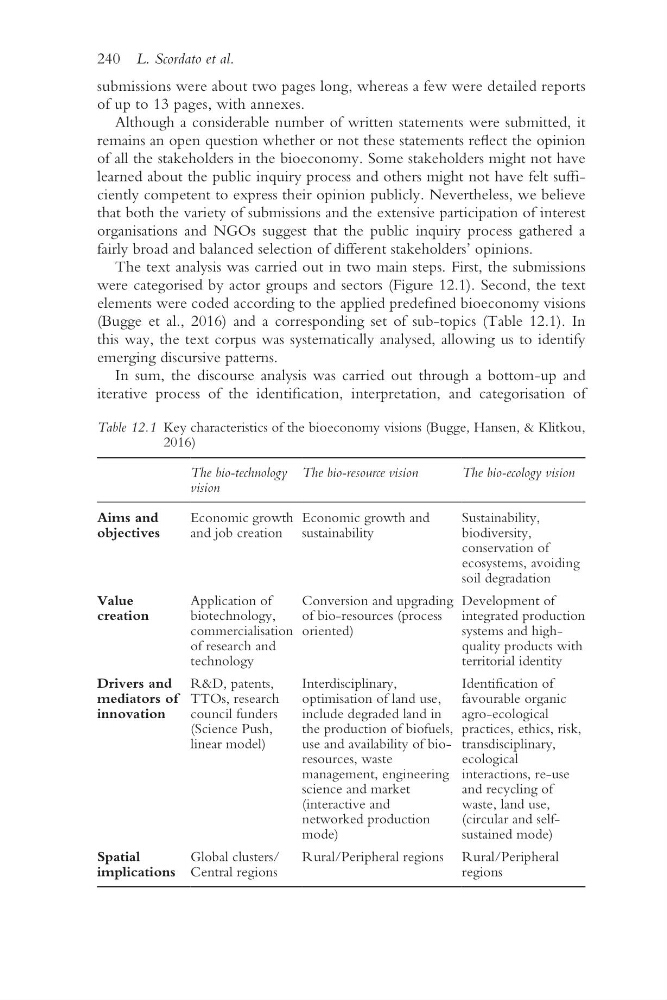
(Bugge et al., 2016) and a corresponding set of sub- topics (Table 12.1). In
this way, the text corpus was systematically analysed, allowing us to identify
emerging discursive patterns.
In sum, the discourse analysis was carried out through a bottom- up and
iterative process of the identification, interpretation, and categorisation of
Table 12.1 Key characteristics of the bioeconomy visions (Bugge, Hansen, & Klitkou,
2016)
The bio-technology
vision
The bio-resource vision
The bio-ecology vision
Aims and
objectives
Economic growth
and job creation
Economic growth and
sustainability
Sustainability,
biodiversity,
conservation of
ecosystems, avoiding
soil degradation
Value
creation
Application of
biotechnology,
commercialisation
of research and
technology
Conversion and upgrading
of bio-resources (process
oriented)
Development of
integrated production
systems and highquality products with
territorial identity
Drivers and
mediators of
innovation
R&D, patents,
TTOs, research
council funders
(Science Push,
linear model)
Interdisciplinary,
optimisation of land use,
include degraded land in
the production of biofuels,
use and availability of bioresources, waste
management, engineering
science and market
(interactive and
networked production
mode)
Identification of
favourable organic
agro-ecological
practices, ethics, risk,
transdisciplinary,
ecological
interactions, re-use
and recycling of
waste, land use,
(circular and selfsustained mode)
Spatial
implications
Global clusters/
Central regions
Rural/Peripheral regions Rural/Peripheral
regions
submissions were about two pages long, whereas a few were detailed reports
of up to 13 pages, with annexes.
Although a considerable number of written statements were submitted, it
remains an open question whether or not these statements reflect the opinion
of all the stakeholders in the bioeconomy. Some stakeholders might not have
learned about the public inquiry process and others might not have felt sufficiently competent to express their opinion publicly. Nevertheless, we believe
that both the variety of submissions and the extensive participation of interest
organisations and NGOs suggest that the public inquiry process gathered a
fairly broad and balanced selection of different stakeholders’ opinions.
The text analysis was carried out in two main steps. First, the submissions
were categorised by actor groups and sectors (Figure 12.1). Second, the text
elements were coded according to the applied predefined bioeconomy visions
(Bugge et al., 2016) and a corresponding set of sub- topics (Table 12.1). In
this way, the text corpus was systematically analysed, allowing us to identify
emerging discursive patterns.
In sum, the discourse analysis was carried out through a bottom- up and
iterative process of the identification, interpretation, and categorisation of
Table 12.1 Key characteristics of the bioeconomy visions (Bugge, Hansen, & Klitkou,
2016)
The bio-technology
vision
The bio-resource vision
The bio-ecology vision
Aims and
objectives
Economic growth
and job creation
Economic growth and
sustainability
Sustainability,
biodiversity,
conservation of
ecosystems, avoiding
soil degradation
Value
creation
Application of
biotechnology,
commercialisation
of research and
technology
Conversion and upgrading
of bio-resources (process
oriented)
Development of
integrated production
systems and highquality products with
territorial identity
Drivers and
mediators of
innovation
R&D, patents,
TTOs, research
council funders
(Science Push,
linear model)
Interdisciplinary,
optimisation of land use,
include degraded land in
the production of biofuels,
use and availability of bioresources, waste
management, engineering
science and market
(interactive and
networked production
mode)
Identification of
favourable organic
agro-ecological
practices, ethics, risk,
transdisciplinary,
ecological
interactions, re-use
and recycling of
waste, land use,
(circular and selfsustained mode)
Spatial
implications
Global clusters/
Central regions
Rural/Peripheral regions Rural/Peripheral
regions