

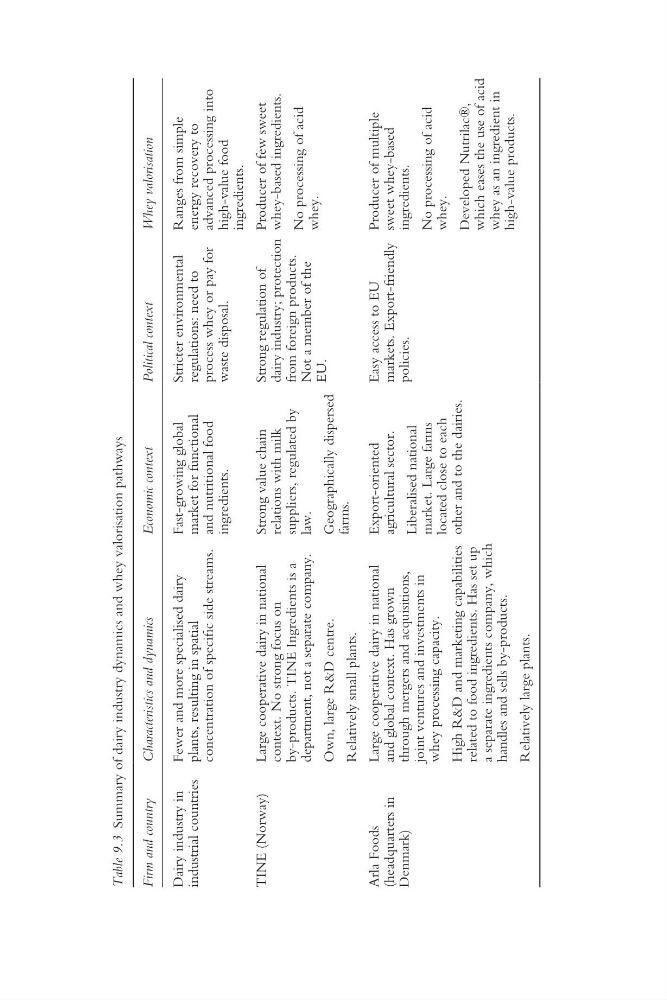
Table 9.3 Summary of dairy industry dynamics and whey valorisation pathways
Firm and country
Characteristics and dynamics
Economic context
Political context
Whey valorisation
Dairy industry in
industrial countries
Fewer and more specialised dairy
plants, resulting in spatial
concentration of specific side streams.
Fast-growing global
market for functional
and nutritional food
ingredients.
Stricter environmental
regulations: need to
process whey or pay for
waste disposal.
Ranges from simple
energy recovery to
advanced processing into
high-value food
ingredients.
TINE (Norway)
Large cooperative dairy in national
context. No strong focus on
by-products. TINE Ingredients is a
department, not a separate company.
Own, large R&D centre.
Relatively small plants.
Strong value chain
relations with milk
suppliers, regulated by
law.
Geographically dispersed
farms.
Strong regulation of
dairy industry; protection
from foreign products.
Not a member of the
EU.
Producer of few sweet
whey-based ingredients.
No processing of acid
whey.
Arla Foods
(headquarters in
Denmark)
Large cooperative dairy in national
and global context. Has grown
through mergers and acquisitions,
joint ventures and investments in
whey processing capacity.
High R&D and marketing capabilities
related to food ingredients. Has set up
a separate ingredients company, which
handles and sells by-products.
Relatively large plants.
Export-oriented
agricultural sector.
Liberalised national
market. Large farms
located close to each
other and to the dairies.
Easy access to EU
markets. Export-friendly
policies.
Producer of multiple
sweet whey-based
ingredients.
No processing of acid
whey.
Developed Nutrilac®,
which eases the use of acid
whey as an ingredient in
high-value products.
Firm and country
Characteristics and dynamics
Economic context
Political context
Whey valorisation
Dairy industry in
industrial countries
Fewer and more specialised dairy
plants, resulting in spatial
concentration of specific side streams.
Fast-growing global
market for functional
and nutritional food
ingredients.
Stricter environmental
regulations: need to
process whey or pay for
waste disposal.
Ranges from simple
energy recovery to
advanced processing into
high-value food
ingredients.
TINE (Norway)
Large cooperative dairy in national
context. No strong focus on
by-products. TINE Ingredients is a
department, not a separate company.
Own, large R&D centre.
Relatively small plants.
Strong value chain
relations with milk
suppliers, regulated by
law.
Geographically dispersed
farms.
Strong regulation of
dairy industry; protection
from foreign products.
Not a member of the
EU.
Producer of few sweet
whey-based ingredients.
No processing of acid
whey.
Arla Foods
(headquarters in
Denmark)
Large cooperative dairy in national
and global context. Has grown
through mergers and acquisitions,
joint ventures and investments in
whey processing capacity.
High R&D and marketing capabilities
related to food ingredients. Has set up
a separate ingredients company, which
handles and sells by-products.
Relatively large plants.
Export-oriented
agricultural sector.
Liberalised national
market. Large farms
located close to each
other and to the dairies.
Easy access to EU
markets. Export-friendly
policies.
Producer of multiple
sweet whey-based
ingredients.
No processing of acid
whey.
Developed Nutrilac®,
which eases the use of acid
whey as an ingredient in
high-value products.