

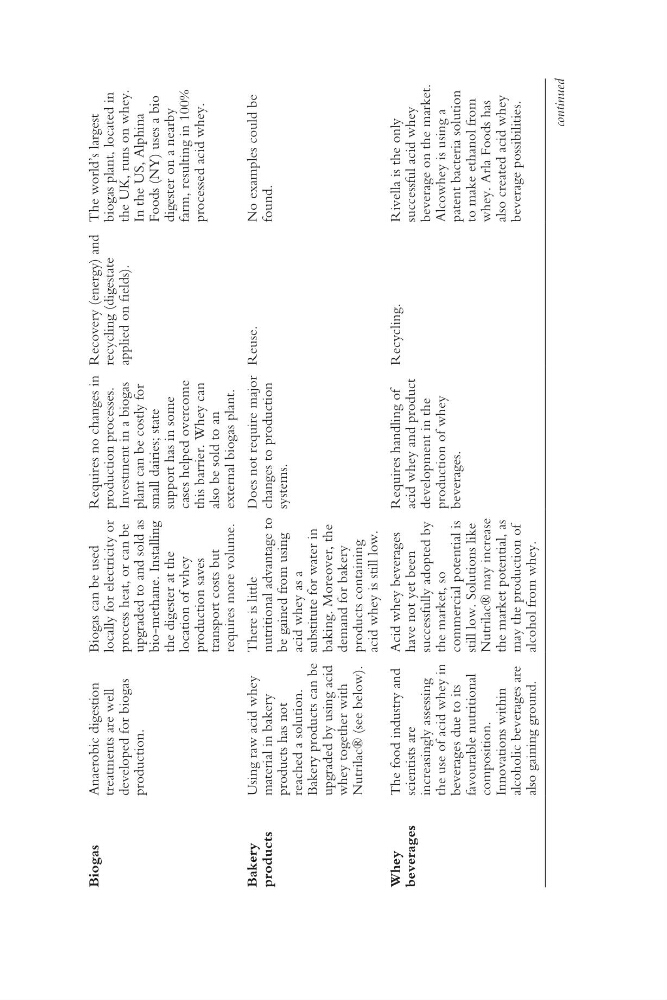
Biogas
Anaerobic digestion
treatments are well
developed for biogas
production.
Biogas can be used
locally for electricity or
process heat, or can be
upgraded to and sold as
bio-methane. Installing
the digester at the
location of whey
production saves
transport costs but
requires more volume.
Requires no changes in
production processes.
Investment in a biogas
plant can be costly for
small dairies; state
support has in some
cases helped overcome
this barrier. Whey can
also be sold to an
external biogas plant.
Recovery (energy) and
recycling (digestate
applied on fields).
The world’s largest
biogas plant, located in
the UK, runs on whey.
In the US, Alphina
Foods (NY) uses a bio
digester on a nearby
farm, resulting in 100%
processed acid whey.
Bakery
products
Using raw acid whey
material in bakery
products has not
reached a solution.
Bakery products can be
upgraded by using acid
whey together with
Nutrilac® (see below).
There is little
nutritional advantage to
be gained from using
acid whey as a
substitute for water in
baking. Moreover, the
demand for bakery
products containing
acid whey is still low.
Does not require major
changes to production
systems.
Reuse.
No examples could be
found.
Whey
beverages
The food industry and
scientists are
increasingly assessing
the use of acid whey in
beverages due to its
favourable nutritional
composition.
Innovations within
alcoholic beverages are
also gaining ground.
Acid whey beverages
have not yet been
successfully adopted by
the market, so
commercial potential is
still low. Solutions like
Nutrilac® may increase
the market potential, as
may the production of
alcohol from whey.
Requires handling of
acid whey and product
development in the
production of whey
beverages.
Recycling.
Rivella is the only
successful acid whey
beverage on the market.
Alcowhey is using a
patent bacteria solution
to make ethanol from
whey. Arla Foods has
also created acid whey
beverage possibilities.
continued
Anaerobic digestion
treatments are well
developed for biogas
production.
Biogas can be used
locally for electricity or
process heat, or can be
upgraded to and sold as
bio-methane. Installing
the digester at the
location of whey
production saves
transport costs but
requires more volume.
Requires no changes in
production processes.
Investment in a biogas
plant can be costly for
small dairies; state
support has in some
cases helped overcome
this barrier. Whey can
also be sold to an
external biogas plant.
Recovery (energy) and
recycling (digestate
applied on fields).
The world’s largest
biogas plant, located in
the UK, runs on whey.
In the US, Alphina
Foods (NY) uses a bio
digester on a nearby
farm, resulting in 100%
processed acid whey.
Bakery
products
Using raw acid whey
material in bakery
products has not
reached a solution.
Bakery products can be
upgraded by using acid
whey together with
Nutrilac® (see below).
There is little
nutritional advantage to
be gained from using
acid whey as a
substitute for water in
baking. Moreover, the
demand for bakery
products containing
acid whey is still low.
Does not require major
changes to production
systems.
Reuse.
No examples could be
found.
Whey
beverages
The food industry and
scientists are
increasingly assessing
the use of acid whey in
beverages due to its
favourable nutritional
composition.
Innovations within
alcoholic beverages are
also gaining ground.
Acid whey beverages
have not yet been
successfully adopted by
the market, so
commercial potential is
still low. Solutions like
Nutrilac® may increase
the market potential, as
may the production of
alcohol from whey.
Requires handling of
acid whey and product
development in the
production of whey
beverages.
Recycling.
Rivella is the only
successful acid whey
beverage on the market.
Alcowhey is using a
patent bacteria solution
to make ethanol from
whey. Arla Foods has
also created acid whey
beverage possibilities.
continued