

118 S. Bolwig et al.
6.6.1 Current activities
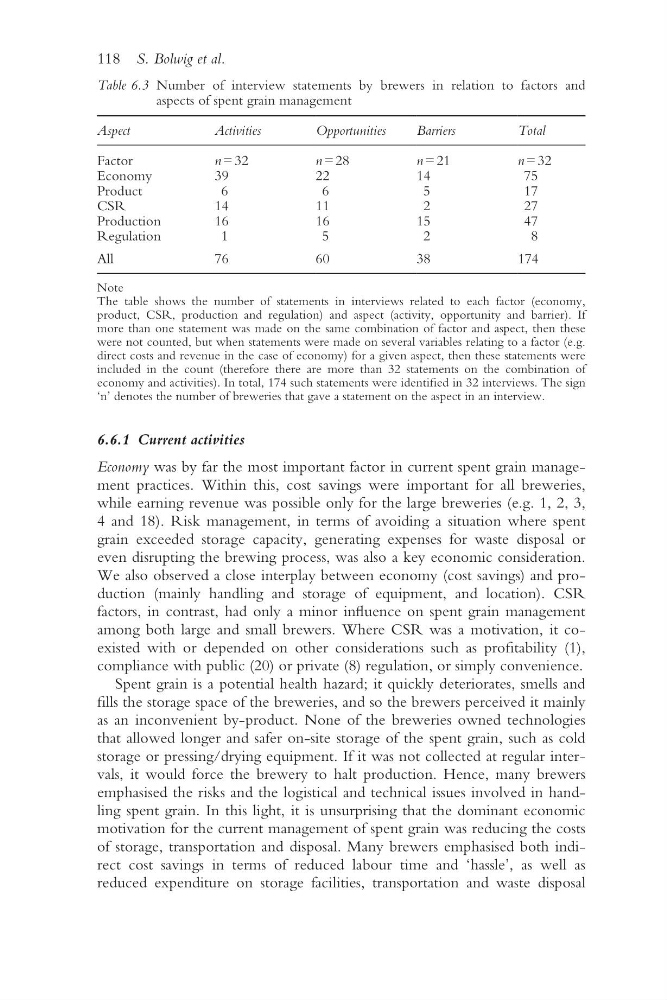
Economy was by far the most important factor in current spent grain management practices. Within this, cost savings were important for all breweries,
while earning revenue was possible only for the large breweries (e.g. 1, 2, 3,
4 and 18). Risk management, in terms of avoiding a situation where spent
grain exceeded storage capacity, generating expenses for waste disposal or
even disrupting the brewing process, was also a key economic consideration.
We also observed a close interplay between economy (cost savings) and production (mainly handling and storage of equipment, and location). CSR
factors, in contrast, had only a minor influence on spent grain management
among both large and small brewers. Where CSR was a motivation, it coexisted with or depended on other considerations such as profitability (1),
compliance with public (20) or private (8) regulation, or simply convenience.
Spent grain is a potential health hazard; it quickly deteriorates, smells and
fills the storage space of the breweries, and so the brewers perceived it mainly
as an inconvenient by- product. None of the breweries owned technologies
that allowed longer and safer on- site storage of the spent grain, such as cold
storage or pressing/drying equipment. If it was not collected at regular intervals, it would force the brewery to halt production. Hence, many brewers
emphasised the risks and the logistical and technical issues involved in handling spent grain. In this light, it is unsurprising that the dominant economic
motivation for the current management of spent grain was reducing the costs
of storage, transportation and disposal. Many brewers emphasised both indirect cost savings in terms of reduced labour time and ‘hassle’, as well as
reduced expenditure on storage facilities, transportation and waste disposal
Table 6.3 Number of interview statements by brewers in relation to factors and
aspects of spent grain management
Aspect
Activities
Opportunities
Barriers
Total
Factor
n = 32
n = 28
n = 21
n = 32
Economy
39
22
14
75
Product
6
6
5
17
CSR
14
11
2
27
Production
16
16
15
47
Regulation
1
5
2
8
All
76
60
38
174
Note
The table shows the number of statements in interviews related to each factor (economy,
product, CSR, production and regulation) and aspect (activity, opportunity and barrier). If
more than one statement was made on the same combination of factor and aspect, then these
were not counted, but when statements were made on several variables relating to a factor (e.g.
direct costs and revenue in the case of economy) for a given aspect, then these statements were
included in the count (therefore there are more than 32 statements on the combination of
economy and activities). In total, 174 such statements were identified in 32 interviews. The sign
‘n’ denotes the number of breweries that gave a statement on the aspect in an interview.
6.6.1 Current activities
Economy was by far the most important factor in current spent grain management practices. Within this, cost savings were important for all breweries,
while earning revenue was possible only for the large breweries (e.g. 1, 2, 3,
4 and 18). Risk management, in terms of avoiding a situation where spent
grain exceeded storage capacity, generating expenses for waste disposal or
even disrupting the brewing process, was also a key economic consideration.
We also observed a close interplay between economy (cost savings) and production (mainly handling and storage of equipment, and location). CSR
factors, in contrast, had only a minor influence on spent grain management
among both large and small brewers. Where CSR was a motivation, it coexisted with or depended on other considerations such as profitability (1),
compliance with public (20) or private (8) regulation, or simply convenience.
Spent grain is a potential health hazard; it quickly deteriorates, smells and
fills the storage space of the breweries, and so the brewers perceived it mainly
as an inconvenient by- product. None of the breweries owned technologies
that allowed longer and safer on- site storage of the spent grain, such as cold
storage or pressing/drying equipment. If it was not collected at regular intervals, it would force the brewery to halt production. Hence, many brewers
emphasised the risks and the logistical and technical issues involved in handling spent grain. In this light, it is unsurprising that the dominant economic
motivation for the current management of spent grain was reducing the costs
of storage, transportation and disposal. Many brewers emphasised both indirect cost savings in terms of reduced labour time and ‘hassle’, as well as
reduced expenditure on storage facilities, transportation and waste disposal
Table 6.3 Number of interview statements by brewers in relation to factors and
aspects of spent grain management
Aspect
Activities
Opportunities
Barriers
Total
Factor
n = 32
n = 28
n = 21
n = 32
Economy
39
22
14
75
Product
6
6
5
17
CSR
14
11
2
27
Production
16
16
15
47
Regulation
1
5
2
8
All
76
60
38
174
Note
The table shows the number of statements in interviews related to each factor (economy,
product, CSR, production and regulation) and aspect (activity, opportunity and barrier). If
more than one statement was made on the same combination of factor and aspect, then these
were not counted, but when statements were made on several variables relating to a factor (e.g.
direct costs and revenue in the case of economy) for a given aspect, then these statements were
included in the count (therefore there are more than 32 statements on the combination of
economy and activities). In total, 174 such statements were identified in 32 interviews. The sign
‘n’ denotes the number of breweries that gave a statement on the aspect in an interview.