

Urban governance 95
pollution and prevent sickness within a city, landfills lay claim to land
areas and can pollute ground water, air, lakes and rivers. Another implication
of the use of landfills is that the waste is not sorted and precious resources
cannot be recycled or recovered easily (Gee & Uyarra, 2013). ‘Recovery’ is a
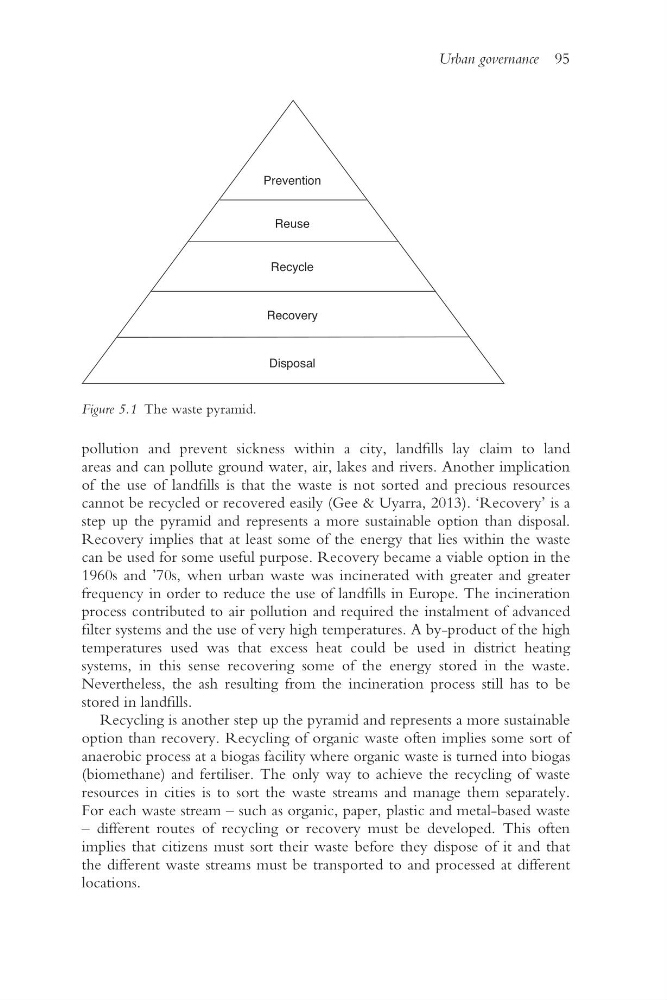
step up the pyramid and represents a more sustainable option than disposal.
Recovery implies that at least some of the energy that lies within the waste
can be used for some useful purpose. Recovery became a viable option in the
1960s and ’70s, when urban waste was incinerated with greater and greater
frequency in order to reduce the use of landfills in Europe. The incineration
process contributed to air pollution and required the instalment of advanced
filter systems and the use of very high temperatures. A by- product of the high
temperatures used was that excess heat could be used in district heating
systems, in this sense recovering some of the energy stored in the waste.
Nevertheless, the ash resulting from the incineration process still has to be
stored in landfills.
Recycling is another step up the pyramid and represents a more sustainable
option than recovery. Recycling of organic waste often implies some sort of
anaerobic process at a biogas facility where organic waste is turned into biogas
(biomethane) and fertiliser. The only way to achieve the recycling of waste
resources in cities is to sort the waste streams and manage them separately.
For each waste stream – such as organic, paper, plastic and metal- based waste
– different routes of recycling or recovery must be developed. This often
implies that citizens must sort their waste before they dispose of it and that
the different waste streams must be transported to and processed at different
locations.
Disposal
Recovery
Recycle
Reuse
Prevention
Figure 5.1 The waste pyramid.
pollution and prevent sickness within a city, landfills lay claim to land
areas and can pollute ground water, air, lakes and rivers. Another implication
of the use of landfills is that the waste is not sorted and precious resources
cannot be recycled or recovered easily (Gee & Uyarra, 2013). ‘Recovery’ is a
step up the pyramid and represents a more sustainable option than disposal.
Recovery implies that at least some of the energy that lies within the waste
can be used for some useful purpose. Recovery became a viable option in the
1960s and ’70s, when urban waste was incinerated with greater and greater
frequency in order to reduce the use of landfills in Europe. The incineration
process contributed to air pollution and required the instalment of advanced
filter systems and the use of very high temperatures. A by- product of the high
temperatures used was that excess heat could be used in district heating
systems, in this sense recovering some of the energy stored in the waste.
Nevertheless, the ash resulting from the incineration process still has to be
stored in landfills.
Recycling is another step up the pyramid and represents a more sustainable
option than recovery. Recycling of organic waste often implies some sort of
anaerobic process at a biogas facility where organic waste is turned into biogas
(biomethane) and fertiliser. The only way to achieve the recycling of waste
resources in cities is to sort the waste streams and manage them separately.
For each waste stream – such as organic, paper, plastic and metal- based waste
– different routes of recycling or recovery must be developed. This often
implies that citizens must sort their waste before they dispose of it and that
the different waste streams must be transported to and processed at different
locations.
Disposal
Recovery
Recycle
Reuse
Prevention
Figure 5.1 The waste pyramid.