

Vibro compaction of granular soils 39
of the construction process need to be scrutinized. A special connection
of the electric cable leading to the vibrator motor was therefore developed
to avoid the otherwise rather time-consuming process of a vibrator change
in deep penetrations where the heavy cable has to be drawn through the
complete length of the extension tubes. This cable connector (cable joint)
is of the same diameter as the depth vibrator, is capable of transmitting an
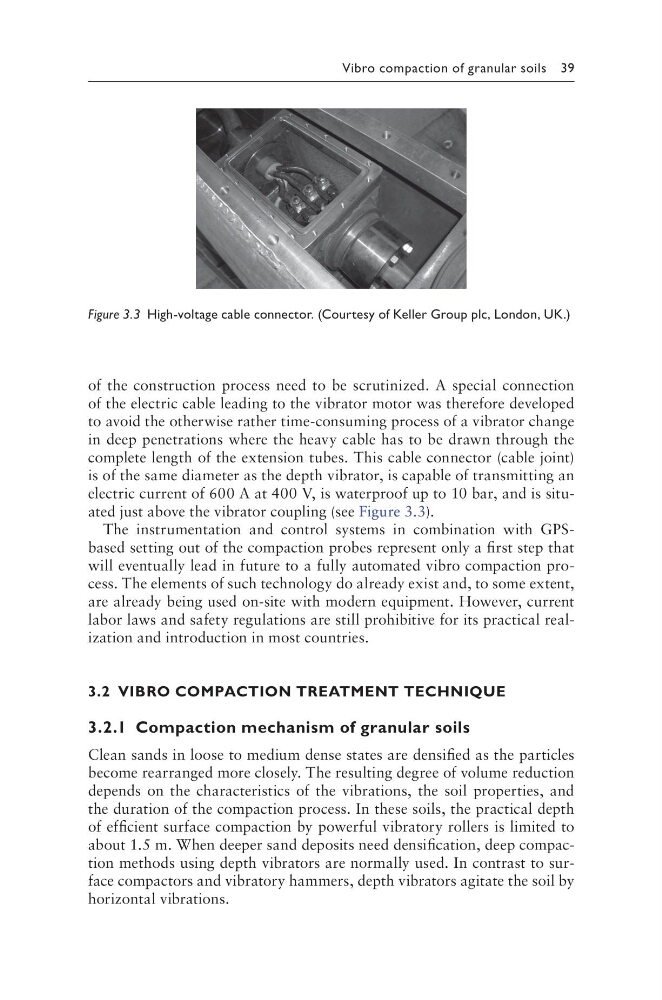
electric current of 600 A at 400 V, is waterproof up to 10 bar, and is situated just above the vibrator coupling (see Figure 3.3).
The instrumentation and control systems in combination with GPSbased setting out of the compaction probes represent only a first step that
will eventually lead in future to a fully automated vibro compaction process. The elements of such technology do already exist and, to some extent,
are already being used on-site with modern equipment. However, current
labor laws and safety regulations are still prohibitive for its practical realization and introduction in most countries.
3.2 VIBRO COMPACTION TREATMENT TECHNIQUE
3.2.1 Compaction mechanism of granular soils
Clean sands in loose to medium dense states are densified as the particles
become rearranged more closely. The resulting degree of volume reduction
depends on the characteristics of the vibrations, the soil properties, and
the duration of the compaction process. In these soils, the practical depth
of efficient surface compaction by powerful vibratory rollers is limited to
about 1.5 m. When deeper sand deposits need densification, deep compaction methods using depth vibrators are normally used. In contrast to surface compactors and vibratory hammers, depth vibrators agitate the soil by
horizontal vibrations.
Figure 3.3 High-voltage cable connector. (Courtesy of Keller Group plc, London, UK.)
of the construction process need to be scrutinized. A special connection
of the electric cable leading to the vibrator motor was therefore developed
to avoid the otherwise rather time-consuming process of a vibrator change
in deep penetrations where the heavy cable has to be drawn through the
complete length of the extension tubes. This cable connector (cable joint)
is of the same diameter as the depth vibrator, is capable of transmitting an
electric current of 600 A at 400 V, is waterproof up to 10 bar, and is situated just above the vibrator coupling (see Figure 3.3).
The instrumentation and control systems in combination with GPSbased setting out of the compaction probes represent only a first step that
will eventually lead in future to a fully automated vibro compaction process. The elements of such technology do already exist and, to some extent,
are already being used on-site with modern equipment. However, current
labor laws and safety regulations are still prohibitive for its practical realization and introduction in most countries.
3.2 VIBRO COMPACTION TREATMENT TECHNIQUE
3.2.1 Compaction mechanism of granular soils
Clean sands in loose to medium dense states are densified as the particles
become rearranged more closely. The resulting degree of volume reduction
depends on the characteristics of the vibrations, the soil properties, and
the duration of the compaction process. In these soils, the practical depth
of efficient surface compaction by powerful vibratory rollers is limited to
about 1.5 m. When deeper sand deposits need densification, deep compaction methods using depth vibrators are normally used. In contrast to surface compactors and vibratory hammers, depth vibrators agitate the soil by
horizontal vibrations.
Figure 3.3 High-voltage cable connector. (Courtesy of Keller Group plc, London, UK.)