

A history of vibratory deep compaction 29
the increasing application of the vibro replacement stone column method, it
was found that the vibrator would not penetrate fast enough into cohesive soil
with relatively low water content. A remedy was found initially by increasing
the weight of the extension tubes of the vibrator. But the additional load increment was rather limited. Only after the vibrocats were modified and improved
in such a way as to allow a downward thrust to be effected on the vibrator was
this handicap eliminated and satisfactory performance also achieved in these
soils. This new setup provided a considerably improved process security and
enhanced productivity when compared with the crane-hung method, and this
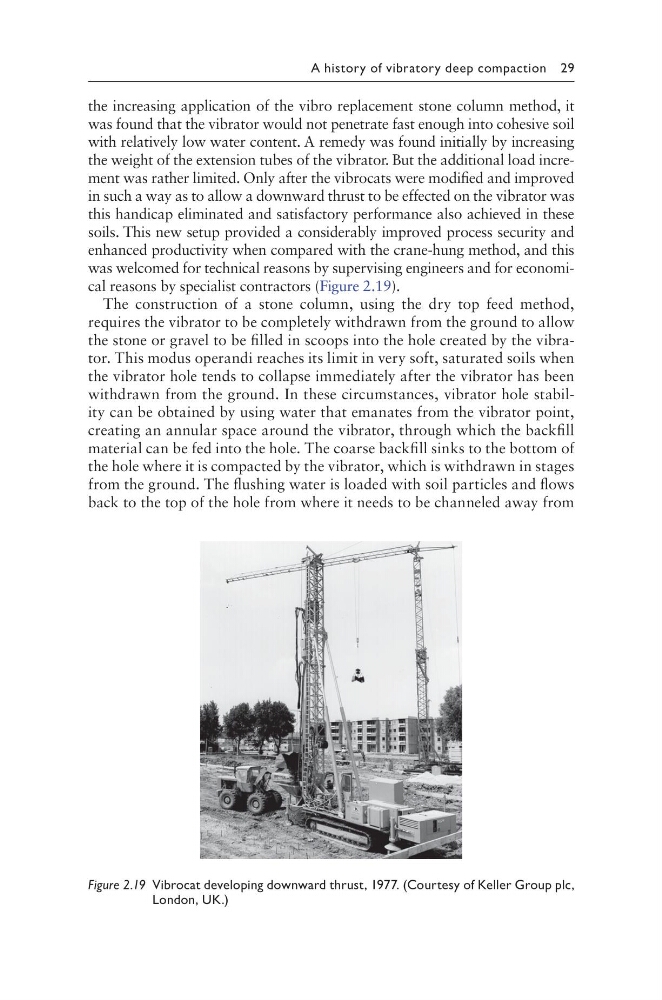
was welcomed for technical reasons by supervising engineers and for economical reasons by specialist contractors (Figure 2.19).
The construction of a stone column, using the dry top feed method,
requires the vibrator to be completely withdrawn from the ground to allow
the stone or gravel to be filled in scoops into the hole created by the vibrator. This modus operandi reaches its limit in very soft, saturated soils when
the vibrator hole tends to collapse immediately after the vibrator has been
withdrawn from the ground. In these circumstances, vibrator hole stability can be obtained by using water that emanates from the vibrator point,
creating an annular space around the vibrator, through which the backfill
material can be fed into the hole. The coarse backfill sinks to the bottom of
the hole where it is compacted by the vibrator, which is withdrawn in stages
from the ground. The flushing water is loaded with soil particles and flows
back to the top of the hole from where it needs to be channeled away from
Figure 2.19 Vibrocat developing downward thrust, 1977. (Courtesy of Keller Group plc,
London, UK.)
the increasing application of the vibro replacement stone column method, it
was found that the vibrator would not penetrate fast enough into cohesive soil
with relatively low water content. A remedy was found initially by increasing
the weight of the extension tubes of the vibrator. But the additional load increment was rather limited. Only after the vibrocats were modified and improved
in such a way as to allow a downward thrust to be effected on the vibrator was
this handicap eliminated and satisfactory performance also achieved in these
soils. This new setup provided a considerably improved process security and
enhanced productivity when compared with the crane-hung method, and this
was welcomed for technical reasons by supervising engineers and for economical reasons by specialist contractors (Figure 2.19).
The construction of a stone column, using the dry top feed method,
requires the vibrator to be completely withdrawn from the ground to allow
the stone or gravel to be filled in scoops into the hole created by the vibrator. This modus operandi reaches its limit in very soft, saturated soils when
the vibrator hole tends to collapse immediately after the vibrator has been
withdrawn from the ground. In these circumstances, vibrator hole stability can be obtained by using water that emanates from the vibrator point,
creating an annular space around the vibrator, through which the backfill
material can be fed into the hole. The coarse backfill sinks to the bottom of
the hole where it is compacted by the vibrator, which is withdrawn in stages
from the ground. The flushing water is loaded with soil particles and flows
back to the top of the hole from where it needs to be channeled away from
Figure 2.19 Vibrocat developing downward thrust, 1977. (Courtesy of Keller Group plc,
London, UK.)