

22 Ground improvement by deep vibratory methods
the compaction became the relative density of the sand, measured initially
directly, but increasingly indirectly using the Standard Penetration Test,
and later on also by static Cone Penetration Testing. The general understanding that a safe foundation on sand in a seismic zone required a densification to at least 85% relative density supported the increasing popularity
of the method, at first along the east coast of the United States, then in the
Midwest, and later also in California. The range of application was from
simple foundations for apartment and office buildings to rather complex
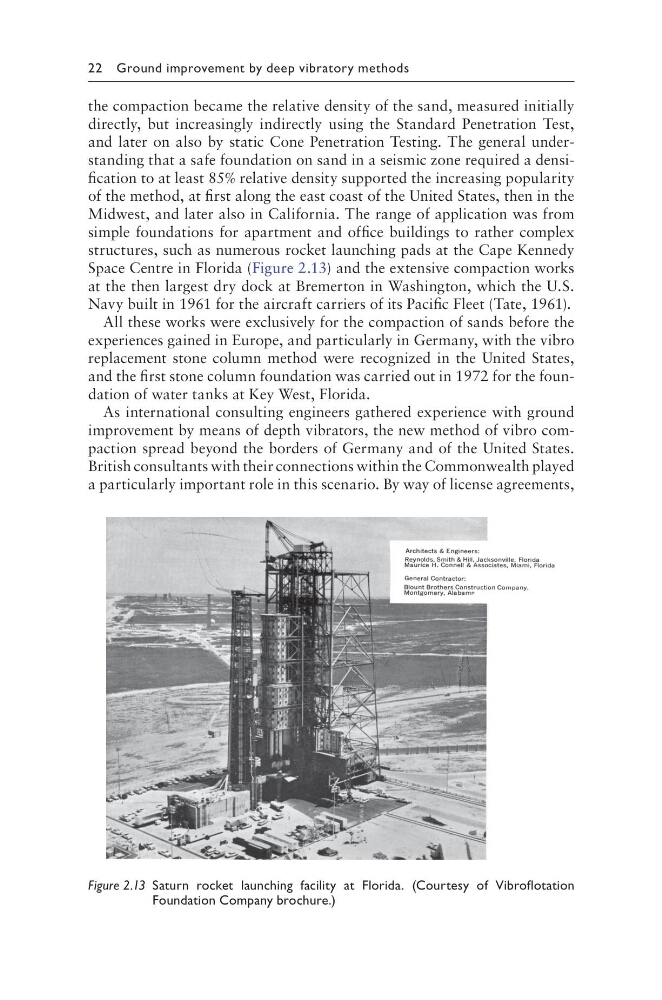
structures, such as numerous rocket launching pads at the Cape Kennedy
Space Centre in Florida (Figure 2.13) and the extensive compaction works
at the then largest dry dock at Bremerton in Washington, which the U.S.
Navy built in 1961 for the aircraft carriers of its Pacific Fleet (Tate, 1961).
All these works were exclusively for the compaction of sands before the
experiences gained in Europe, and particularly in Germany, with the vibro
replacement stone column method were recognized in the United States,
and the first stone column foundation was carried out in 1972 for the foundation of water tanks at Key West, Florida.
As international consulting engineers gathered experience with ground
improvement by means of depth vibrators, the new method of vibro compaction spread beyond the borders of Germany and of the United States.
British consultants with their connections within the Commonwealth played
a particularly important role in this scenario. By way of license agreements,
Figure 2.13 Saturn rocket launching facility at Florida. (Courtesy of Vibroflotation
Foundation Company brochure.)
Positive attitude
Positive attitude
Positive attitude
the compaction became the relative density of the sand, measured initially
directly, but increasingly indirectly using the Standard Penetration Test,
and later on also by static Cone Penetration Testing. The general understanding that a safe foundation on sand in a seismic zone required a densification to at least 85% relative density supported the increasing popularity
of the method, at first along the east coast of the United States, then in the
Midwest, and later also in California. The range of application was from
simple foundations for apartment and office buildings to rather complex
structures, such as numerous rocket launching pads at the Cape Kennedy
Space Centre in Florida (Figure 2.13) and the extensive compaction works
at the then largest dry dock at Bremerton in Washington, which the U.S.
Navy built in 1961 for the aircraft carriers of its Pacific Fleet (Tate, 1961).
All these works were exclusively for the compaction of sands before the
experiences gained in Europe, and particularly in Germany, with the vibro
replacement stone column method were recognized in the United States,
and the first stone column foundation was carried out in 1972 for the foundation of water tanks at Key West, Florida.
As international consulting engineers gathered experience with ground
improvement by means of depth vibrators, the new method of vibro compaction spread beyond the borders of Germany and of the United States.
British consultants with their connections within the Commonwealth played
a particularly important role in this scenario. By way of license agreements,
Figure 2.13 Saturn rocket launching facility at Florida. (Courtesy of Vibroflotation
Foundation Company brochure.)
Positive attitude
Positive attitude
Positive attitude