

A history of vibratory deep compaction 19
at 3000 rpm and developing a horizontal force of 156 kN. The double amplitude of the freely suspended vibrator measured 6 mm. Fundamentally new
features were its almost smooth surface and a coupling that was capable of
transmitting substantial vertical forces via the vibrator into the ground stemming from either heavy extension tubes or later from the downward thrust
of the special machines carrying the vibrator. In this way, the vibrator could
achieve penetration into the ground without the assistance of flushing water,
provided the necessary total weight could be applied.
Relatively soon the first foundation works were carried out in only partially saturated silts by forming stone or gravel columns with the vibrator.
These well-compacted stone columns were closely interlocked with the soil
and acted together with the surrounding soil and other adjacent columns
like a normal load-bearing soil. Initially, the stone columns were exclusively
constructed using crane-hung vibrators that were lowered into the partially
saturated soils under their own weight without the help of water. In this
way, the consistency of the soils was not negatively influenced. The vibrator was normally completely withdrawn from the ground and a specified
charge of coarse fill was placed into the cylindrical hole left behind by the
vibrator. Then the vibrator repenetrated and compacted the fill, squeezing
it also laterally into the surrounding soil. By repetition of this sequence, a
strongly compacted stone column was created.
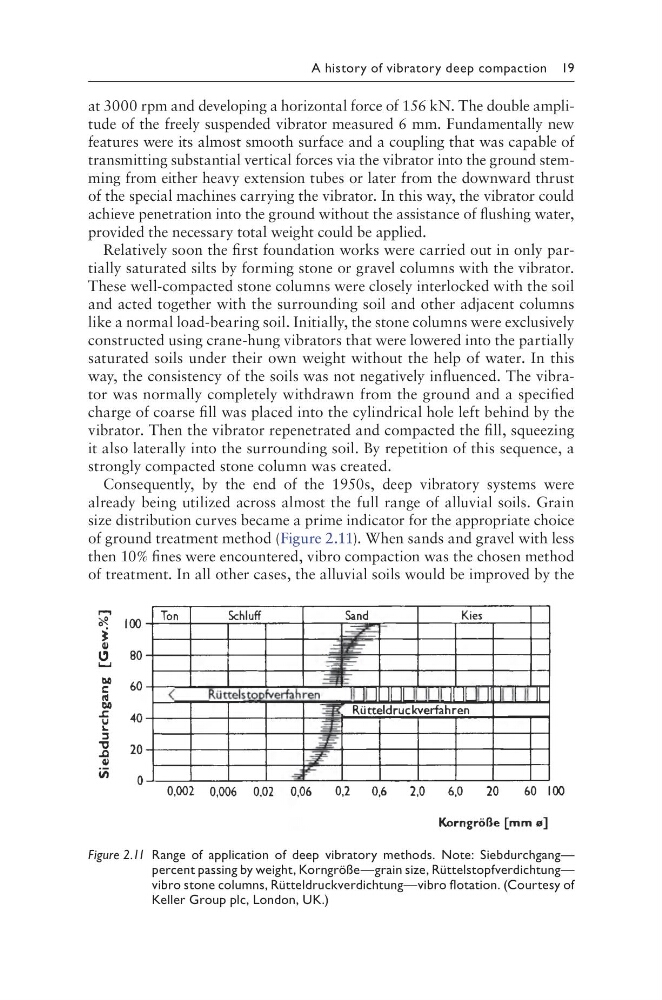
Consequently, by the end of the 1950s, deep vibratory systems were
already being utilized across almost the full range of alluvial soils. Grain
size distribution curves became a prime indicator for the appropriate choice
of ground treatment method (Figure 2.11). When sands and gravel with less
then 10% fines were encountered, vibro compaction was the chosen method
of treatment. In all other cases, the alluvial soils would be improved by the
Figure 2.11 Range of application of deep vibratory methods. Note: Siebdurchgang—
percent passing by weight, Korngröße—grain size, Rüttelstopfverdichtung—
vibro stone columns, Rütteldruckverdichtung—vibro flotation. (Courtesy of
Keller Group plc, London, UK.)
Siebdurchgang [G ew .% ]
Korngröße [m m d]
0,002
0,006
0,02
0,06
0,2
0,6
2,0
6,0
20
60 100
Rütteldruckverfahren
Sand
Kies
Schluff
Ton
100
80
60
40
20
0
at 3000 rpm and developing a horizontal force of 156 kN. The double amplitude of the freely suspended vibrator measured 6 mm. Fundamentally new
features were its almost smooth surface and a coupling that was capable of
transmitting substantial vertical forces via the vibrator into the ground stemming from either heavy extension tubes or later from the downward thrust
of the special machines carrying the vibrator. In this way, the vibrator could
achieve penetration into the ground without the assistance of flushing water,
provided the necessary total weight could be applied.
Relatively soon the first foundation works were carried out in only partially saturated silts by forming stone or gravel columns with the vibrator.
These well-compacted stone columns were closely interlocked with the soil
and acted together with the surrounding soil and other adjacent columns
like a normal load-bearing soil. Initially, the stone columns were exclusively
constructed using crane-hung vibrators that were lowered into the partially
saturated soils under their own weight without the help of water. In this
way, the consistency of the soils was not negatively influenced. The vibrator was normally completely withdrawn from the ground and a specified
charge of coarse fill was placed into the cylindrical hole left behind by the
vibrator. Then the vibrator repenetrated and compacted the fill, squeezing
it also laterally into the surrounding soil. By repetition of this sequence, a
strongly compacted stone column was created.
Consequently, by the end of the 1950s, deep vibratory systems were
already being utilized across almost the full range of alluvial soils. Grain
size distribution curves became a prime indicator for the appropriate choice
of ground treatment method (Figure 2.11). When sands and gravel with less
then 10% fines were encountered, vibro compaction was the chosen method
of treatment. In all other cases, the alluvial soils would be improved by the
Figure 2.11 Range of application of deep vibratory methods. Note: Siebdurchgang—
percent passing by weight, Korngröße—grain size, Rüttelstopfverdichtung—
vibro stone columns, Rütteldruckverdichtung—vibro flotation. (Courtesy of
Keller Group plc, London, UK.)
Siebdurchgang [G ew .% ]
Korngröße [m m d]
0,002
0,006
0,02
0,06
0,2
0,6
2,0
6,0
20
60 100
Rütteldruckverfahren
Sand
Kies
Schluff
Ton
100
80
60
40
20
0