

Contractual matters 215
measurements, such as cone penetration test (CPT) or standard penetration
test, with specified values. Depending on the size of the projects, in-situ testing should be carried out at a frequency between 400 and 900 m 2 per test,
with a time lapse for the posttreatment test of 2 weeks for silica and at least
3 weeks for calcareous sand. Although the location of the post-compaction
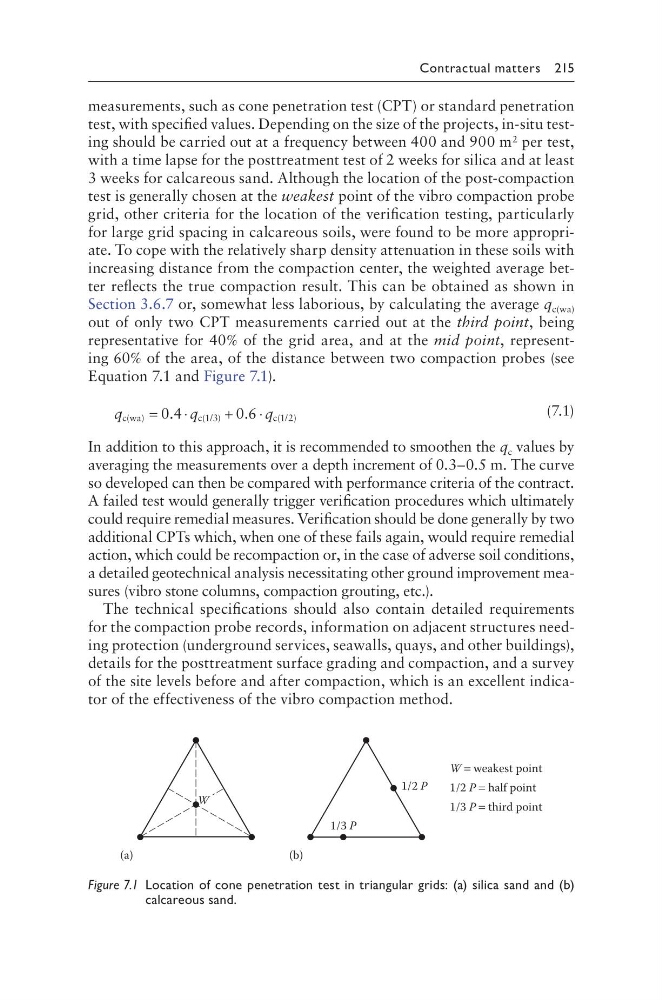
test is generally chosen at the weakest point of the vibro compaction probe
grid, other criteria for the location of the verification testing, particularly
for large grid spacing in calcareous soils, were found to be more appropriate. To cope with the relatively sharp density attenuation in these soils with
increasing distance from the compaction center, the weighted average better reflects the true compaction result. This can be obtained as shown in
Section 3.6.7 or, somewhat less laborious, by calculating the average q c(wa)
out of only two CPT measurements carried out at the third point, being
representative for 40% of the grid area, and at the mid point, representing 60% of the area, of the distance between two compaction probes (see
Equation 7.1 and Figure 7.1).
q c(wa)
c
c
=
⋅
+
⋅
0 4
0 6
1 3
1 2
.
.
( / )
( / )
q
q
(7.1)
In addition to this approach, it is recommended to smoothen the q c values by
averaging the measurements over a depth increment of 0.3–0.5 m. The curve
so developed can then be compared with performance criteria of the contract.
A failed test would generally trigger verification procedures which ultimately
could require remedial measures. Verification should be done generally by two
additional CPTs which, when one of these fails again, would require remedial
action, which could be recompaction or, in the case of adverse soil conditions,
a detailed geotechnical analysis necessitating other ground improvement measures (vibro stone columns, compaction grouting, etc.).
The technical specifications should also contain detailed requirements
for the compaction probe records, information on adjacent structures needing protection (underground services, seawalls, quays, and other buildings),
details for the posttreatment surface grading and compaction, and a survey
of the site levels before and after compaction, which is an excellent indicator of the effectiveness of the vibro compaction method.
W
W = weakest point
1/2 P = half point
1/3 P = third point
1/2 P
1/3 P
(b)
(a)
Figure 7.1 Location of cone penetration test in triangular grids: (a) silica sand and (b)
calcareous sand.
measurements, such as cone penetration test (CPT) or standard penetration
test, with specified values. Depending on the size of the projects, in-situ testing should be carried out at a frequency between 400 and 900 m 2 per test,
with a time lapse for the posttreatment test of 2 weeks for silica and at least
3 weeks for calcareous sand. Although the location of the post-compaction
test is generally chosen at the weakest point of the vibro compaction probe
grid, other criteria for the location of the verification testing, particularly
for large grid spacing in calcareous soils, were found to be more appropriate. To cope with the relatively sharp density attenuation in these soils with
increasing distance from the compaction center, the weighted average better reflects the true compaction result. This can be obtained as shown in
Section 3.6.7 or, somewhat less laborious, by calculating the average q c(wa)
out of only two CPT measurements carried out at the third point, being
representative for 40% of the grid area, and at the mid point, representing 60% of the area, of the distance between two compaction probes (see
Equation 7.1 and Figure 7.1).
q c(wa)
c
c
=
⋅
+
⋅
0 4
0 6
1 3
1 2
.
.
( / )
( / )
q
q
(7.1)
In addition to this approach, it is recommended to smoothen the q c values by
averaging the measurements over a depth increment of 0.3–0.5 m. The curve
so developed can then be compared with performance criteria of the contract.
A failed test would generally trigger verification procedures which ultimately
could require remedial measures. Verification should be done generally by two
additional CPTs which, when one of these fails again, would require remedial
action, which could be recompaction or, in the case of adverse soil conditions,
a detailed geotechnical analysis necessitating other ground improvement measures (vibro stone columns, compaction grouting, etc.).
The technical specifications should also contain detailed requirements
for the compaction probe records, information on adjacent structures needing protection (underground services, seawalls, quays, and other buildings),
details for the posttreatment surface grading and compaction, and a survey
of the site levels before and after compaction, which is an excellent indicator of the effectiveness of the vibro compaction method.
W
W = weakest point
1/2 P = half point
1/3 P = third point
1/2 P
1/3 P
(b)
(a)
Figure 7.1 Location of cone penetration test in triangular grids: (a) silica sand and (b)
calcareous sand.