

196 Ground improvement by deep vibratory methods
level but also extends horizontally and may, when the distance to neighboring columns is too close, result in unwanted horizontal forces on already
cured columns or horizontal deformations of the cylindrical shaft of fresh
or curing columns. The sequence of column construction and the minimal
allowable distance between columns need therefore careful consideration. As
a rule of thumb, the minimum column distance should not fall below three
column diameters. When no experience exists from column executions in
similar soils, a trial execution in a test field is recommended where safe operational parameters can be developed.
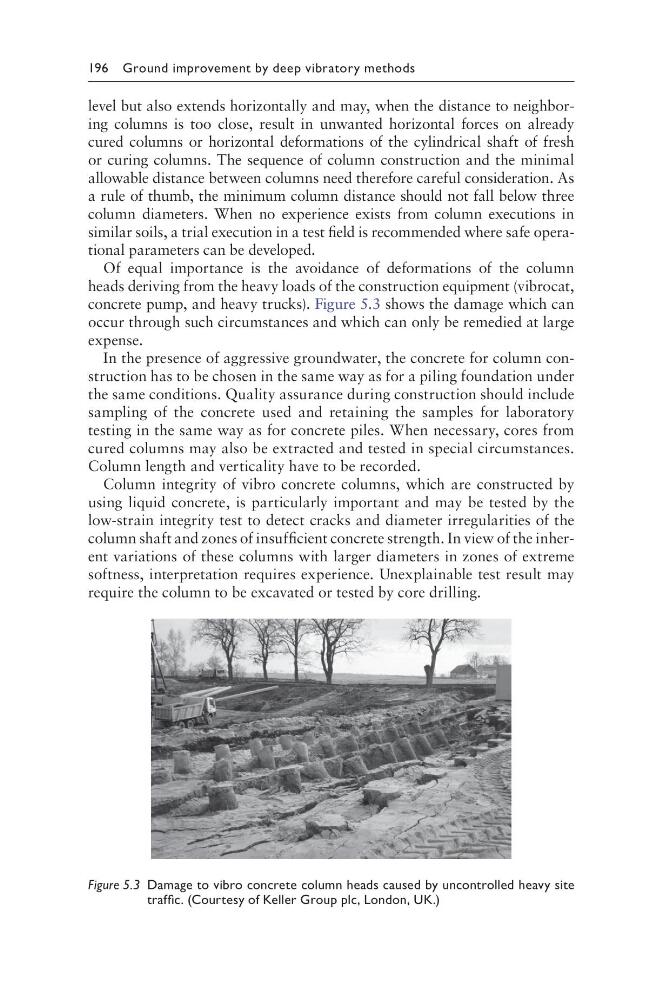
Of equal importance is the avoidance of deformations of the column
heads deriving from the heavy loads of the construction equipment (vibrocat,
concrete pump, and heavy trucks). Figure 5.3 shows the damage which can
occur through such circumstances and which can only be remedied at large
expense.
In the presence of aggressive groundwater, the concrete for column construction has to be chosen in the same way as for a piling foundation under
the same conditions. Quality assurance during construction should include
sampling of the concrete used and retaining the samples for laboratory
testing in the same way as for concrete piles. When necessary, cores from
cured columns may also be extracted and tested in special circumstances.
Column length and verticality have to be recorded.
Column integrity of vibro concrete columns, which are constructed by
using liquid concrete, is particularly important and may be tested by the
low-strain integrity test to detect cracks and diameter irregularities of the
column shaft and zones of insufficient concrete strength. In view of the inherent variations of these columns with larger diameters in zones of extreme
softness, interpretation requires experience. Unexplainable test result may
require the column to be excavated or tested by core drilling.
Figure 5.3 Damage to vibro concrete column heads caused by uncontrolled heavy site
traffic. (Courtesy of Keller Group plc, London, UK.)
level but also extends horizontally and may, when the distance to neighboring columns is too close, result in unwanted horizontal forces on already
cured columns or horizontal deformations of the cylindrical shaft of fresh
or curing columns. The sequence of column construction and the minimal
allowable distance between columns need therefore careful consideration. As
a rule of thumb, the minimum column distance should not fall below three
column diameters. When no experience exists from column executions in
similar soils, a trial execution in a test field is recommended where safe operational parameters can be developed.
Of equal importance is the avoidance of deformations of the column
heads deriving from the heavy loads of the construction equipment (vibrocat,
concrete pump, and heavy trucks). Figure 5.3 shows the damage which can
occur through such circumstances and which can only be remedied at large
expense.
In the presence of aggressive groundwater, the concrete for column construction has to be chosen in the same way as for a piling foundation under
the same conditions. Quality assurance during construction should include
sampling of the concrete used and retaining the samples for laboratory
testing in the same way as for concrete piles. When necessary, cores from
cured columns may also be extracted and tested in special circumstances.
Column length and verticality have to be recorded.
Column integrity of vibro concrete columns, which are constructed by
using liquid concrete, is particularly important and may be tested by the
low-strain integrity test to detect cracks and diameter irregularities of the
column shaft and zones of insufficient concrete strength. In view of the inherent variations of these columns with larger diameters in zones of extreme
softness, interpretation requires experience. Unexplainable test result may
require the column to be excavated or tested by core drilling.
Figure 5.3 Damage to vibro concrete column heads caused by uncontrolled heavy site
traffic. (Courtesy of Keller Group plc, London, UK.)