

2 Ground improvement by deep vibratory methods
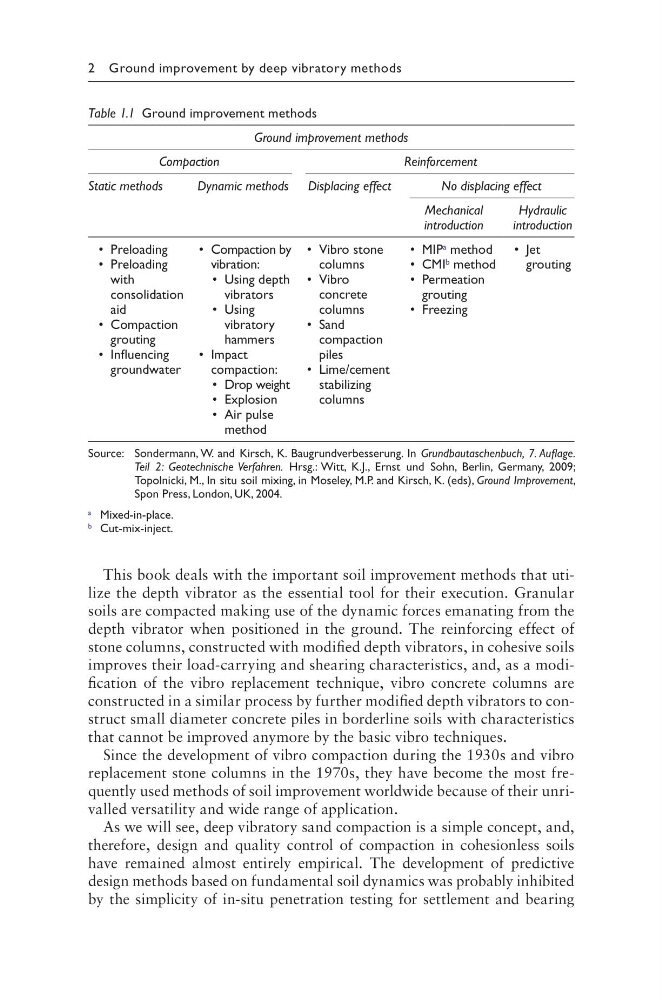
This book deals with the important soil improvement methods that utilize the depth vibrator as the essential tool for their execution. Granular
soils are compacted making use of the dynamic forces emanating from the
depth vibrator when positioned in the ground. The reinforcing effect of
stone columns, constructed with modified depth vibrators, in cohesive soils
improves their load-carrying and shearing characteristics, and, as a modification of the vibro replacement technique, vibro concrete columns are
constructed in a similar process by further modified depth vibrators to construct small diameter concrete piles in borderline soils with characteristics
that cannot be improved anymore by the basic vibro techniques.
Since the development of vibro compaction during the 1930s and vibro
replacement stone columns in the 1970s, they have become the most frequently used methods of soil improvement worldwide because of their unrivalled versatility and wide range of application.
As we will see, deep vibratory sand compaction is a simple concept, and,
therefore, design and quality control of compaction in cohesionless soils
have remained almost entirely empirical. The development of predictive
design methods based on fundamental soil dynamics was probably inhibited
by the simplicity of in-situ penetration testing for settlement and bearing
Table 1.1 Ground improvement methods
Ground improvement methods
Compaction
Reinforcement
Static methods
Dynamic methods Displacing effect
No displacing effect
Mechanical
introduction
Hydraulic
introduction
• Preloading
• Preloading
with
consolidation
aid
• Compaction
grouting
• Influencing
groundwater
• Compaction by
vibration:
• Using depth
vibrators
• Using
vibratory
hammers
• Impact
compaction:
• Drop weight
• Explosion
• Air pulse
method
• Vibro stone
columns
• Vibro
concrete
columns
• Sand
compaction
piles
• Lime/cement
stabilizing
columns
• MIP a method
• CMI b method
• Permeation
grouting
• Freezing
• Jet
grouting
Source: Sondermann, W. and Kirsch, K. Baugrundverbesserung. In Grundbautaschenbuch, 7. Auflage.
Teil 2: Geotechnische Verfahren. Hrsg.: Witt, K.J., Ernst und Sohn, Berlin, Germany, 2009;
Topolnicki, M., In situ soil mixing, in Moseley, M.P. and Kirsch, K. (eds), Ground Improvement,
Spon Press, London, UK, 2004.
a Mixed-in-place.
b Cut-mix-inject.
This book deals with the important soil improvement methods that utilize the depth vibrator as the essential tool for their execution. Granular
soils are compacted making use of the dynamic forces emanating from the
depth vibrator when positioned in the ground. The reinforcing effect of
stone columns, constructed with modified depth vibrators, in cohesive soils
improves their load-carrying and shearing characteristics, and, as a modification of the vibro replacement technique, vibro concrete columns are
constructed in a similar process by further modified depth vibrators to construct small diameter concrete piles in borderline soils with characteristics
that cannot be improved anymore by the basic vibro techniques.
Since the development of vibro compaction during the 1930s and vibro
replacement stone columns in the 1970s, they have become the most frequently used methods of soil improvement worldwide because of their unrivalled versatility and wide range of application.
As we will see, deep vibratory sand compaction is a simple concept, and,
therefore, design and quality control of compaction in cohesionless soils
have remained almost entirely empirical. The development of predictive
design methods based on fundamental soil dynamics was probably inhibited
by the simplicity of in-situ penetration testing for settlement and bearing
Table 1.1 Ground improvement methods
Ground improvement methods
Compaction
Reinforcement
Static methods
Dynamic methods Displacing effect
No displacing effect
Mechanical
introduction
Hydraulic
introduction
• Preloading
• Preloading
with
consolidation
aid
• Compaction
grouting
• Influencing
groundwater
• Compaction by
vibration:
• Using depth
vibrators
• Using
vibratory
hammers
• Impact
compaction:
• Drop weight
• Explosion
• Air pulse
method
• Vibro stone
columns
• Vibro
concrete
columns
• Sand
compaction
piles
• Lime/cement
stabilizing
columns
• MIP a method
• CMI b method
• Permeation
grouting
• Freezing
• Jet
grouting
Source: Sondermann, W. and Kirsch, K. Baugrundverbesserung. In Grundbautaschenbuch, 7. Auflage.
Teil 2: Geotechnische Verfahren. Hrsg.: Witt, K.J., Ernst und Sohn, Berlin, Germany, 2009;
Topolnicki, M., In situ soil mixing, in Moseley, M.P. and Kirsch, K. (eds), Ground Improvement,
Spon Press, London, UK, 2004.
a Mixed-in-place.
b Cut-mix-inject.