

Improvement of fine-grained and cohesive soils 179
Dense tertiary sand, gravel, and marl form the competent bearing strata
below. The silts and clays have a relatively low strength, c u = 15 kN/m 2 , and
a modulus between 5 and 8 MN/m 2 .
To reduce settlements of the embankment behind the bridge abutment,
the soft silts and clays were improved by vibro stone columns over a length
of about 35 m at both sides of the bridge. Settlement analysis was carried
out using the method after Priebe (1995), with an area replacement value
of a c = 0.22 for nine stone column rows immediately behind the pile raft
representing the bridge foundation, and of a c = 0.13 for the remainder and
below the embankment shoulders. These replacement values were achieved
by 0.8 m diameter stone columns at square grid configurations with distances of 1.5 and 2.0 m, respectively. With a chosen angle of friction of
φ c = 42° for the stone column material, modified improvement factors β
were calculated as 3.28 for the 1.5 m grid and 2.17 for the 2.0 m grid, safeguarding a smooth transition between bridge and embankment.
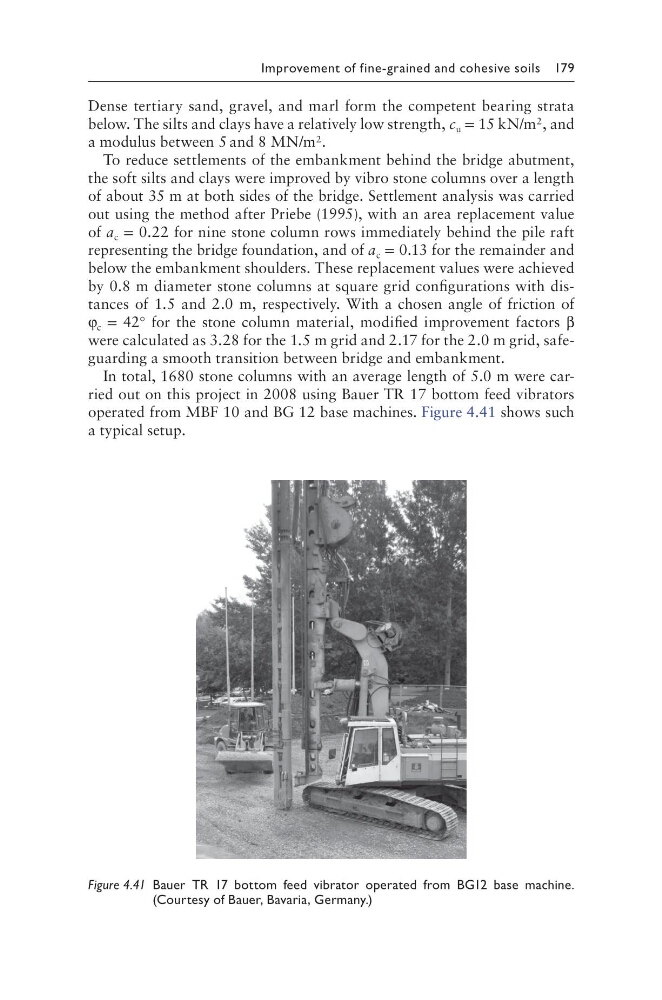
In total, 1680 stone columns with an average length of 5.0 m were carried out on this project in 2008 using Bauer TR 17 bottom feed vibrators
operated from MBF 10 and BG 12 base machines. Figure 4.41 shows such
a typical setup.
Figure 4.41 Bauer TR 17 bottom feed vibrator operated from BG12 base machine.
(Courtesy of Bauer, Bavaria, Germany.)
Dense tertiary sand, gravel, and marl form the competent bearing strata
below. The silts and clays have a relatively low strength, c u = 15 kN/m 2 , and
a modulus between 5 and 8 MN/m 2 .
To reduce settlements of the embankment behind the bridge abutment,
the soft silts and clays were improved by vibro stone columns over a length
of about 35 m at both sides of the bridge. Settlement analysis was carried
out using the method after Priebe (1995), with an area replacement value
of a c = 0.22 for nine stone column rows immediately behind the pile raft
representing the bridge foundation, and of a c = 0.13 for the remainder and
below the embankment shoulders. These replacement values were achieved
by 0.8 m diameter stone columns at square grid configurations with distances of 1.5 and 2.0 m, respectively. With a chosen angle of friction of
φ c = 42° for the stone column material, modified improvement factors β
were calculated as 3.28 for the 1.5 m grid and 2.17 for the 2.0 m grid, safeguarding a smooth transition between bridge and embankment.
In total, 1680 stone columns with an average length of 5.0 m were carried out on this project in 2008 using Bauer TR 17 bottom feed vibrators
operated from MBF 10 and BG 12 base machines. Figure 4.41 shows such
a typical setup.
Figure 4.41 Bauer TR 17 bottom feed vibrator operated from BG12 base machine.
(Courtesy of Bauer, Bavaria, Germany.)