

Improvement of fine-grained and cohesive soils 171
acquisition system measuring depth and amperage versus time of execution.
In addition, numerous load tests were performed on single columns and on
groups of three columns as proof of the load settlement performance of the
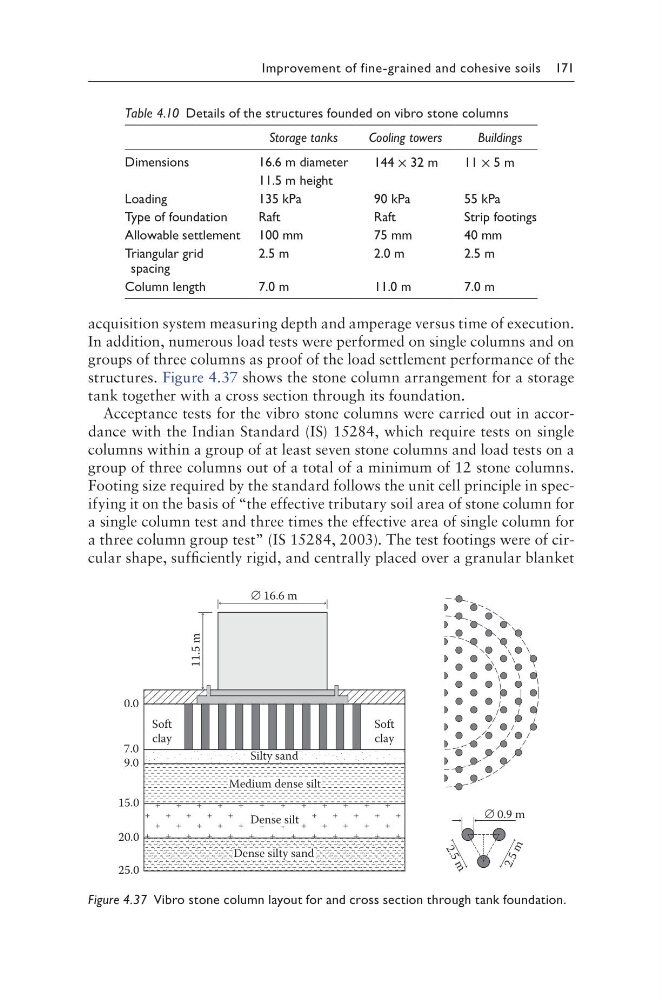
structures. Figure 4.37 shows the stone column arrangement for a storage
tank together with a cross section through its foundation.
Acceptance tests for the vibro stone columns were carried out in accordance with the Indian Standard (IS) 15284, which require tests on single
columns within a group of at least seven stone columns and load tests on a
group of three columns out of a total of a minimum of 12 stone columns.
Footing size required by the standard follows the unit cell principle in specifying it on the basis of “the effective tributary soil area of stone column for
a single column test and three times the effective area of single column for
a three column group test” (IS 15284, 2003). The test footings were of circular shape, sufficiently rigid, and centrally placed over a granular blanket
Table 4.10 Details of the structures founded on vibro stone columns
Storage tanks
Cooling towers
Buildings
Dimensions
16.6 m diameter
144 × 32 m
11 × 5 m
11.5 m height
Loading
135 kPa
90 kPa
55 kPa
Type of foundation
Raft
Raft
Strip footings
Allowable settlement 100 mm
75 mm
40 mm
Triangular grid
spacing
2.5 m
2.0 m
2.5 m
Column length
7.0 m
11.0 m
7.0 m
∅ 16.6 m
25.0
20.0
15.0
9.0
7.0
Silty sand
Medium dense silt
Dense silt
Dense silty sand
11.5 m
0.0
∅ 0.9 m
2 .5 m
2
.5
m
Soft
clay
Soft
clay
Figure 4.37 Vibro stone column layout for and cross section through tank foundation.
acquisition system measuring depth and amperage versus time of execution.
In addition, numerous load tests were performed on single columns and on
groups of three columns as proof of the load settlement performance of the
structures. Figure 4.37 shows the stone column arrangement for a storage
tank together with a cross section through its foundation.
Acceptance tests for the vibro stone columns were carried out in accordance with the Indian Standard (IS) 15284, which require tests on single
columns within a group of at least seven stone columns and load tests on a
group of three columns out of a total of a minimum of 12 stone columns.
Footing size required by the standard follows the unit cell principle in specifying it on the basis of “the effective tributary soil area of stone column for
a single column test and three times the effective area of single column for
a three column group test” (IS 15284, 2003). The test footings were of circular shape, sufficiently rigid, and centrally placed over a granular blanket
Table 4.10 Details of the structures founded on vibro stone columns
Storage tanks
Cooling towers
Buildings
Dimensions
16.6 m diameter
144 × 32 m
11 × 5 m
11.5 m height
Loading
135 kPa
90 kPa
55 kPa
Type of foundation
Raft
Raft
Strip footings
Allowable settlement 100 mm
75 mm
40 mm
Triangular grid
spacing
2.5 m
2.0 m
2.5 m
Column length
7.0 m
11.0 m
7.0 m
∅ 16.6 m
25.0
20.0
15.0
9.0
7.0
Silty sand
Medium dense silt
Dense silt
Dense silty sand
11.5 m
0.0
∅ 0.9 m
2 .5 m
2
.5
m
Soft
clay
Soft
clay
Figure 4.37 Vibro stone column layout for and cross section through tank foundation.